

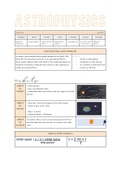
SMALLEST - - - - - - - - - - - - - - - - - - - - - - - - - - - - - - - - - - - - - - - - - - - - - - - - - - - - - - - - - - - - - - - - - - - - - - - - - - - - - - - - - - - BIGGEST
ASTEROID MOON PLANET STAR S. SYSTEM GALAXY UNIVERSE
small rock natural satellite orbits star & has plasma joined in the milky way gas + dust + stars billions of
orbiting sun gravity together + solar system galaxies
GRAVITATIONAL FIELD STRENGTH
An object's gravitational field strength depends on its MASS. The CAUSES:
Moon has less mass than the Earth, so its gravitational field is - moons to orbit planets
much weaker (approx 1/6th of the Earth's). We could jump higher on - the planets to orbit the sun
the Moon, and objects would fall more slowly, as they experience a - art. satellites to orbit the Earth
weaker gravitational force. - comets to orbit Sun
ORBITS • orbits the Sun
OF • have very elliptical orbits
COMETS • esometimes they travel close to the very edge of our Solar
System
ORBITS • Earth has 1 moon (5th largest on the solar system)
OF • Takes 27 days to do 1 orbit
MOONS
• Mars = 2 moons
• Jupiter & Saturn = +60 moons
ORBITS If a planet orbits a star at an increasing speed, the force
OF between them does not increase, so it moves out of that
PLANETS orbit
ORBITAL SPEED FORMULA
ASTEROID MOON PLANET STAR S. SYSTEM GALAXY UNIVERSE
small rock natural satellite orbits star & has plasma joined in the milky way gas + dust + stars billions of
orbiting sun gravity together + solar system galaxies
GRAVITATIONAL FIELD STRENGTH
An object's gravitational field strength depends on its MASS. The CAUSES:
Moon has less mass than the Earth, so its gravitational field is - moons to orbit planets
much weaker (approx 1/6th of the Earth's). We could jump higher on - the planets to orbit the sun
the Moon, and objects would fall more slowly, as they experience a - art. satellites to orbit the Earth
weaker gravitational force. - comets to orbit Sun
ORBITS • orbits the Sun
OF • have very elliptical orbits
COMETS • esometimes they travel close to the very edge of our Solar
System
ORBITS • Earth has 1 moon (5th largest on the solar system)
OF • Takes 27 days to do 1 orbit
MOONS
• Mars = 2 moons
• Jupiter & Saturn = +60 moons
ORBITS If a planet orbits a star at an increasing speed, the force
OF between them does not increase, so it moves out of that
PLANETS orbit
ORBITAL SPEED FORMULA


