N212 GERO LECTURE study guide
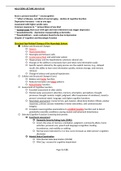
Know a persons baseline** neurocognitive ***effect of disease, not effect of normal aging – decline of cognitive function Depression increases – rate as one ages Associated with higher suicide rates Common response to **serious illness of any kind **normal losses that occur with agin and even retirement may trigger depression **pseudodementia – depression masquerading as dementia **Pseudodelirium – acute confusion found to be due to depression Chapter 27 Cognitive and Neurologic Function Structural Age-Related Changes of the Neurologic System Cellular and Structural Changes O Neuron O Neurotransmitters O Neuroglia and Schwann cells O Cerebrospinal fluid and ventricular system O Hippocampus and the hypothalamic–pituitary–adrenal axis O Changes in the ability to consciously learn and retain new information easily O Specific aspects altered by the aging process are the explicit memory (e.g., delayed recall), the ability to learn new information quickly, memory storage, and memory retrieval O Change in balance and postural hypotension O Cellular and Structural Changes (Cont.) O Balance and motor function O Reticular formation and sleep patterns O Sensorimotor function O Assessment of Cognitive Function O Essential assessment in older adults O Mental status assessment: attention, memory, orientation, perceptions, thought processes, thought content, insight, judgment, affect (expression of emotions), mood (a person’s emotional state), language, and higher cognitive functions O Neurologic assessment: cranial nerves, gait, balance, distal deep tendon reflexes, plantar responses, primary sensory modalities in lower extremities, and cerebrovascular integrity O Complete neurocognitive examinations to establish baseline function and to detect potentially reversible conditions causing mental and behavioral disturbances O Selected Cognitive Function Screening Instruments O Functional assessment O Dementia Severity Rating Scale (DSRS) O Covers the areas of memory, orientation, judgment, community affairs, home activities, personal care, speech and language recognition, feeding, incontinence, and mobility or walking O Normal score instrument is 4 or less; score increases as older person’s cognition decreases O Mental Status Examination O Mini-Mental State Examination (MMSE) O Mini Cog—screens for cognitive impairment Page 1 of 24 N212 GERO LECTURE 2019.09.05 O Blessed Dementia Scale or Short Blessed Test (SBT) screening tool for the assessment of dementia; aging and depression effect responses O Blessed Orientation-Memory-Concentration (BOMC) O Depression assessment O The Beck Depression Inventory (BDI) is a self or caretaker-administered 21-item instrument that is helpful for uncovering depression and for rating severity and intensity O Cognitive Function and Memory in Typical Aging O Myth: forgetfulness as an inevitable consequence of aging O Fact: memory and delayed recall are not substantially decreased in older persons O Decline in cognitive function is effect of disease, not effect of normal aging process O Depression O As one ages, the rate of depression increases O Associated with higher suicide rates than in younger depressed population, 19% of all suicide deaths O Clinical manifestations O Fatigue; constipation; psychomotor retardation; depressed mood; loss of interest, energy, libido, or pleasure; changes in appetite, weight, and sleep patterns; and agitation; anxiety; or crying O First seen as cognitive impairment, particularly in areas of attention and concentration O Common response to serious illness of any kind O Normal losses that occur with aging and even retirement may trigger depression O Pseudodementia = depression masquerading as dementia O Pseudodelirium = acute confusion found to be due to depression O Delirium Disturbance of consciousness (decreased awareness of the environment) with a reduced ability to focus, sustain, or shift attention Cognitive changes (poor memory, disorientation, speech disturbance) or perceptual disturbances are distinct from a preexisting, established, or evolving dementia The onset of the disturbance is rapid (hours to days ) and typically fluctuates over the course of the day Occurs in all settings, underlying illness may cause the delirium Emergent condition DELIRIUM Risk factors Advanced age, central nervous system (CNS) diseases, infection, polypharmacy, hypoalbuminemia, electrolyte imbalances, trauma history, gastrointestinal or genitourinary (UTI) disorders, cardiopulmonary disorders, and sensory changes Symptoms of Delirium Fluctuate Difficulty maintaining concentration or attention to external stimuli language disturbance, including slurred, forced, or rambling speech Disorganized thinking demonstrated by tangential reasoning and conversation often the presenting symptom DELIRIUM Management Focus on the timely identification of delirium using Confusion Assessment Method (CAM) Rapid diagnosis and treatment of underlying cause Page 2 of 24 N212 GERO LECTURE 2019.09.05 Provide a therapeutic environment Management of disruptive behaviors, and supportive care Medication is a last resort**** Dementia Syndrome of gradual and progressive cognitive decline Alteration in memory in addition to acquired persistent alteration in intellectual function compromising multiple cognitive domains May involve language deficits, apraxia, agnosia, agraphia, and impaired executive function Reversible Dementia Phenomenon that occurs when other pathologic conditions masquerade as dementia Identify and treat underlying causes of dementia symptoms; even if disorders are identified and treated, not all individuals with dementia symptoms will improve Alzheimer Disease Most common form of dementia*** Progressive, neurodegenerative disease Characterized by the presence of neurofibrillary tangles composed of misplaced proteins within brain, cortical amyloid plaques, and granulovascular degeneration of neurons in pyramidal cell layer of hippocampus Sixth leading cause of death in the United States, costing
Información del documento
- Subido en
- 18 de enero de 2023
- Número de páginas
- 24
- Escrito en
- 2022/2023
- Tipo
- Examen
- Contiene
- Desconocido