Unit 8 - Government microeconomic intervention
Introduction
As economies grow it is increasingly difficult for the free market to achieve the best
allocation of resources, which means it must be supported by government policies to
correct its failings. A common form of government intervention is through various
types of indirect taxation and subsidies.
Deadweight loss
Deadweight loss: The welfare loss when due to market failure desirable
consumption and production does not take place.
This term refers to the loss of economic welfare due to the fact that potentially
desirable production and consumption does not take place. There is not as much
consumer and producer surplus as there would be if all such desirable trade took
place.
Deadweight loss under monopoly
MC
P
2 Shaded area =
Deadweight loss
P
1
Price
AR
M
0 R
Q2
Q1
Quantity
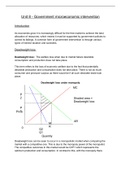
Deadweight loss can be seen to occur in a monopolistic market when comparing the
market with a competitive one. This is due to the monopoly power of the monopolist.
The competitive outcomes in this market would be Q1P1 which represents the
optimum production and consumption. In contrast to this, with the monopoly there
,would be underproduction and underconsumption at Q2P2. The shaded area
represents the deadweight loss, the loss of consumer and producer surplus.
Imposition of an indirect tax
S1
Price
S
P2
P1
D
0
Q2 Q1
Quantity
Deadweight loss can also be applied when a government imposes an indirect tax on
a product. S is the supply curve before the tax and then supply decreases to S1.
Government intervention to correct externalities
Intervention to correct externalities takes many forms including:
● use of indirect taxes
● various types of regulation
● property rights
● provision of information
● pollution permits
● subsidies.
There are four situations in which these are applied:
● negative production externalities
, ● negative consumption externalities
● positive production externalities
● positive consumption externalities
Negative production externalities
An indirect tax would usually be imposed on the producer of the negative externality.
This is consistent with the so-called ‘polluter pays’ principle.
External costs and use of indirect taxation
S2=MS
C
Price S1=MPC
P2 A
P1 C
E
P3 B
D=MPB
Q2 Q1
Quantity
S1 is the marginal private cost as it only takes into account the private costs. With
the imposition of the indirect tax supply decreases to S2, becoming the marginal
social cost. The difference between the initial supply curve and the curve after the
tax represents the external cost, as it is for the producer to pay for the negative
production externality. The intention of the tax is to make the producer pay through
that indirect tax which with tax revenue will be put towards correcting the external
cost. External cost = AB.
The price increases less than the tax per unit. The producer has borne the burden of
part of the tax, the producer pays the lower part of the tax, P1CBP3. If the PED is
Introduction
As economies grow it is increasingly difficult for the free market to achieve the best
allocation of resources, which means it must be supported by government policies to
correct its failings. A common form of government intervention is through various
types of indirect taxation and subsidies.
Deadweight loss
Deadweight loss: The welfare loss when due to market failure desirable
consumption and production does not take place.
This term refers to the loss of economic welfare due to the fact that potentially
desirable production and consumption does not take place. There is not as much
consumer and producer surplus as there would be if all such desirable trade took
place.
Deadweight loss under monopoly
MC
P
2 Shaded area =
Deadweight loss
P
1
Price
AR
M
0 R
Q2
Q1
Quantity
Deadweight loss can be seen to occur in a monopolistic market when comparing the
market with a competitive one. This is due to the monopoly power of the monopolist.
The competitive outcomes in this market would be Q1P1 which represents the
optimum production and consumption. In contrast to this, with the monopoly there
,would be underproduction and underconsumption at Q2P2. The shaded area
represents the deadweight loss, the loss of consumer and producer surplus.
Imposition of an indirect tax
S1
Price
S
P2
P1
D
0
Q2 Q1
Quantity
Deadweight loss can also be applied when a government imposes an indirect tax on
a product. S is the supply curve before the tax and then supply decreases to S1.
Government intervention to correct externalities
Intervention to correct externalities takes many forms including:
● use of indirect taxes
● various types of regulation
● property rights
● provision of information
● pollution permits
● subsidies.
There are four situations in which these are applied:
● negative production externalities
, ● negative consumption externalities
● positive production externalities
● positive consumption externalities
Negative production externalities
An indirect tax would usually be imposed on the producer of the negative externality.
This is consistent with the so-called ‘polluter pays’ principle.
External costs and use of indirect taxation
S2=MS
C
Price S1=MPC
P2 A
P1 C
E
P3 B
D=MPB
Q2 Q1
Quantity
S1 is the marginal private cost as it only takes into account the private costs. With
the imposition of the indirect tax supply decreases to S2, becoming the marginal
social cost. The difference between the initial supply curve and the curve after the
tax represents the external cost, as it is for the producer to pay for the negative
production externality. The intention of the tax is to make the producer pay through
that indirect tax which with tax revenue will be put towards correcting the external
cost. External cost = AB.
The price increases less than the tax per unit. The producer has borne the burden of
part of the tax, the producer pays the lower part of the tax, P1CBP3. If the PED is