
Tropical rainforests
Climate: warm and wet as it is along the equator. Annual temperature is around 26 degree
celsius. Annual rainfall usually exceeds 2500 millimetres.
Vegetation: tall trees - 30-40m, rich vegetation cover.
Soil: thin and poor as the warm, humid conditions cause the litter to decompose quickly. The
little rain that reaches the forest floor washes away litter nutrients before they become part of
the soil. It is red in colour because it is rich in iron.
Interdependence: The nutrient cycle
Biodiversity: Half of the world’s known animal species -
food and water available all year.
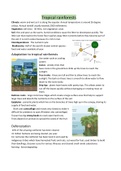
Adaptation to tropical rainforests
Use water cycle as cooling
system
Lianas - woody vines that
have roots in the ground but climb up the trees to reach the
sunlight.
Tree trunks - these are tall and thin to allow trees to reach the
sunlight. The bark on these trees is smooth to allow water to flow
down to the roots easily.
Drip tips - plants have leaves with pointy tips. This allows water to
run off the leaves quickly without damaging or creating moss on
them.
Buttress roots - large roots have ridges which create a large surface area that help to support
large trees and absorb the nutrients on the surface of the soil.
Epiphytes - parasitic plants which live on the branches of trees high up in the canopy, sharing its
supply of food and water.
Sloth uses camouflage and moves very slowly to make it
difficult for predators to spot.(Predator also camouflage)
Toucan has big strong beaks to crack open hard nuts.
Trees depend on animals to spread the seeds of the fruit
Deforestation
20% of the amazing rainforest has been cleared.
31 million hectares are being cleared per year.
For centuries the rainforest has been lived in and used by
indigenous tribes which have harvested fruits and nuts, cut wood for fuel, used timber to build
their dwellings, discover cures for various illnesses and cleared small rondo subsistence
farming.- forest degrading
,Case study:Tambopata Region - Peruvian Amazon
It is estimated that 50% of the deforestation of tropical rainforest is a result of illegal actions
such as logging, mining and agriculture
In 2012, the Inter-oceanic highway was built to link the heart of Amazônia to the Pacific coast of
Peru, which is about 4000 km long. It crossed two indigenous reserves and a National park. It
brought thousands of new immigrants annually to the region and made the forest easier to
access remote areas. The highway facilitates the logging of timber- mahogany, mining ,farming-
cattle ranching, soya plantations and oil and gas extraction which leads to global warming.
2012- Peru has GDP growth rate of 6.3% and has one of the fastest growing economy in
the world
Mining
Over 50,000 hectares of land in the Amazon are used for gold mining and other minerals.
- Mercury is used to separate goods from the ground but they enter the river which
poisoned the fish and people living there.
- Rivers are polluted by soil erosion. Ex: mining occurs extensively along the Madre de
Dios River- mostly illegal
- Creating lunar landscapes
Energy development
Unlimited supply of water encourages people to build hydroelectric power, which
involves flooding vast areas of the rainforest. Dams have a short life as rotten trees
corrode the turbines.
Commercial farming
Land can’t be used for long as the quality of pasture declines- farmers destroy more
rainforest.
Cattle
Cattle ranching is responsible for 80% of the tropical rainforest destruction in the
Amazon.
Crops
Palm oil, soya and sugar cane for biofuel
Settlement and population growth
All activity requires workers- families need home- clear the forest for settlement.
Climate change
- Felling of trees reduces evaporation of water- local climate becomes drier.
- reduce cooling system = climate becomes warmer, affects agriculture
Other impact
- topsoil is removed by heavy rainfall when there is no tree
- Soil erosion leads to the silting up of rivers
, Value and Management of tropical rainforest
Goods & Services
Goods: Native crops- fruits and nuts, meat, fish, timber, water, medicines
Services: Air purification- absorption of carbon dioxide, water and nutrient cycle, protection
against soil erosion, wildlife habitats, employment opportunities, biodiversity
Medicines
- 25% of all drugs derived from rainforest ingredients
- 2/3 of all drugs with cancer fighting properties come from the rainforest
- The tropical rainforest is reduced by 1 to 2% each year
Ex: frog-secretions tree infections mental health illness and HIV
Bat-saliva helps to prevent heart attack
Quinine-treat Malaria
Managing tropical rainforest
Inter-government agreement
- The international Tropical Timber Agreement: restrict the trade in hardwoods
taken from the tropical rainforest, all the timber needs to be felled in sustainably
managed forest, has to be marked with a registration number.
- International trade in Endangered species: block illegal trade of endangered and
rare animals and plants.
Debt reduction by HICs
- Most countries that have rainforests are LICs- lots of dept
- The USA signed an agreement to convert a Brazilian debt of £13.5m into funds to
protect large areas of tropical rainforests.
Conservation and education by non-governmental Organization (NGOs)
Fauna & Flora international
- Promote conservation through education programs in school
- Provide training for conservation workers
- Provide practical help to make programs one sustainable
- Buy up threatens areas and create a natural reserves
Government role
- creating protected areas
- Making subjects: ecology, environmental studies as a compulsory part of school
curriculum
- Stopping the abuse of the rainforest
Selective logging
- felling mature, trees letting younger trees grow
Replanting
- collect seeds from primary forest, grow in nurseries, then plating back in the deforested
area
, Agroforestry
- allow crops to be grown in clear areas and grow rainforest trees outside the rainforest.
Eco-tourism
- educate visitor to appreciate nature and local cultures
- Small-scale minimise the consumption in the local community of non-renewable
resources
- Provide income for local people
Making mining less destructive
- Once bauxite has been removed, covered with its topsoil and replant with native trees
Biosphere reverse
- leaving an area untouched except for research and plant breeding.
Hot deserts
Distribution: subtropical areas between 20 degree
to 30 degree north and south of the Equator.
On the borders of hot deserts are the world’s
semi-arid areas, also called dry lands and desert
fringe areas.
Physical characteristics: Rainfall can be
unpredictable, extreme high temperature- 57.8
degree Celsius was recorded in the northern
Sahara. Extreme range of temperature often experienced in a single day. The cloudless skies
that allow high levels of insolation in the daytime also allow rapid heat loss at night- can even
be sub-zero temperature
Soil: shortage of water, weathering creates deposits of
sand and loose material. There may be some organic
matter due to lack of vegetation. Sand dunes are not soil as
there is no organic matter. Some desert soils can be very
fertile- they have nutrients (calcium) which have not
been leached away over time.
Climate: warm and wet as it is along the equator. Annual temperature is around 26 degree
celsius. Annual rainfall usually exceeds 2500 millimetres.
Vegetation: tall trees - 30-40m, rich vegetation cover.
Soil: thin and poor as the warm, humid conditions cause the litter to decompose quickly. The
little rain that reaches the forest floor washes away litter nutrients before they become part of
the soil. It is red in colour because it is rich in iron.
Interdependence: The nutrient cycle
Biodiversity: Half of the world’s known animal species -
food and water available all year.
Adaptation to tropical rainforests
Use water cycle as cooling
system
Lianas - woody vines that
have roots in the ground but climb up the trees to reach the
sunlight.
Tree trunks - these are tall and thin to allow trees to reach the
sunlight. The bark on these trees is smooth to allow water to flow
down to the roots easily.
Drip tips - plants have leaves with pointy tips. This allows water to
run off the leaves quickly without damaging or creating moss on
them.
Buttress roots - large roots have ridges which create a large surface area that help to support
large trees and absorb the nutrients on the surface of the soil.
Epiphytes - parasitic plants which live on the branches of trees high up in the canopy, sharing its
supply of food and water.
Sloth uses camouflage and moves very slowly to make it
difficult for predators to spot.(Predator also camouflage)
Toucan has big strong beaks to crack open hard nuts.
Trees depend on animals to spread the seeds of the fruit
Deforestation
20% of the amazing rainforest has been cleared.
31 million hectares are being cleared per year.
For centuries the rainforest has been lived in and used by
indigenous tribes which have harvested fruits and nuts, cut wood for fuel, used timber to build
their dwellings, discover cures for various illnesses and cleared small rondo subsistence
farming.- forest degrading
,Case study:Tambopata Region - Peruvian Amazon
It is estimated that 50% of the deforestation of tropical rainforest is a result of illegal actions
such as logging, mining and agriculture
In 2012, the Inter-oceanic highway was built to link the heart of Amazônia to the Pacific coast of
Peru, which is about 4000 km long. It crossed two indigenous reserves and a National park. It
brought thousands of new immigrants annually to the region and made the forest easier to
access remote areas. The highway facilitates the logging of timber- mahogany, mining ,farming-
cattle ranching, soya plantations and oil and gas extraction which leads to global warming.
2012- Peru has GDP growth rate of 6.3% and has one of the fastest growing economy in
the world
Mining
Over 50,000 hectares of land in the Amazon are used for gold mining and other minerals.
- Mercury is used to separate goods from the ground but they enter the river which
poisoned the fish and people living there.
- Rivers are polluted by soil erosion. Ex: mining occurs extensively along the Madre de
Dios River- mostly illegal
- Creating lunar landscapes
Energy development
Unlimited supply of water encourages people to build hydroelectric power, which
involves flooding vast areas of the rainforest. Dams have a short life as rotten trees
corrode the turbines.
Commercial farming
Land can’t be used for long as the quality of pasture declines- farmers destroy more
rainforest.
Cattle
Cattle ranching is responsible for 80% of the tropical rainforest destruction in the
Amazon.
Crops
Palm oil, soya and sugar cane for biofuel
Settlement and population growth
All activity requires workers- families need home- clear the forest for settlement.
Climate change
- Felling of trees reduces evaporation of water- local climate becomes drier.
- reduce cooling system = climate becomes warmer, affects agriculture
Other impact
- topsoil is removed by heavy rainfall when there is no tree
- Soil erosion leads to the silting up of rivers
, Value and Management of tropical rainforest
Goods & Services
Goods: Native crops- fruits and nuts, meat, fish, timber, water, medicines
Services: Air purification- absorption of carbon dioxide, water and nutrient cycle, protection
against soil erosion, wildlife habitats, employment opportunities, biodiversity
Medicines
- 25% of all drugs derived from rainforest ingredients
- 2/3 of all drugs with cancer fighting properties come from the rainforest
- The tropical rainforest is reduced by 1 to 2% each year
Ex: frog-secretions tree infections mental health illness and HIV
Bat-saliva helps to prevent heart attack
Quinine-treat Malaria
Managing tropical rainforest
Inter-government agreement
- The international Tropical Timber Agreement: restrict the trade in hardwoods
taken from the tropical rainforest, all the timber needs to be felled in sustainably
managed forest, has to be marked with a registration number.
- International trade in Endangered species: block illegal trade of endangered and
rare animals and plants.
Debt reduction by HICs
- Most countries that have rainforests are LICs- lots of dept
- The USA signed an agreement to convert a Brazilian debt of £13.5m into funds to
protect large areas of tropical rainforests.
Conservation and education by non-governmental Organization (NGOs)
Fauna & Flora international
- Promote conservation through education programs in school
- Provide training for conservation workers
- Provide practical help to make programs one sustainable
- Buy up threatens areas and create a natural reserves
Government role
- creating protected areas
- Making subjects: ecology, environmental studies as a compulsory part of school
curriculum
- Stopping the abuse of the rainforest
Selective logging
- felling mature, trees letting younger trees grow
Replanting
- collect seeds from primary forest, grow in nurseries, then plating back in the deforested
area
, Agroforestry
- allow crops to be grown in clear areas and grow rainforest trees outside the rainforest.
Eco-tourism
- educate visitor to appreciate nature and local cultures
- Small-scale minimise the consumption in the local community of non-renewable
resources
- Provide income for local people
Making mining less destructive
- Once bauxite has been removed, covered with its topsoil and replant with native trees
Biosphere reverse
- leaving an area untouched except for research and plant breeding.
Hot deserts
Distribution: subtropical areas between 20 degree
to 30 degree north and south of the Equator.
On the borders of hot deserts are the world’s
semi-arid areas, also called dry lands and desert
fringe areas.
Physical characteristics: Rainfall can be
unpredictable, extreme high temperature- 57.8
degree Celsius was recorded in the northern
Sahara. Extreme range of temperature often experienced in a single day. The cloudless skies
that allow high levels of insolation in the daytime also allow rapid heat loss at night- can even
be sub-zero temperature
Soil: shortage of water, weathering creates deposits of
sand and loose material. There may be some organic
matter due to lack of vegetation. Sand dunes are not soil as
there is no organic matter. Some desert soils can be very
fertile- they have nutrients (calcium) which have not
been leached away over time.


