

BIOLOGY SPECIFICATION NOTES
Edexcel Biology Salters-Nuffield A AS/A-Level
Key:
Definitions are in turquoise
Core practicals are in orange
Equations are in green
Topic 8: Grey matter (GRM)
8.1 Know the structure and function of sensory, relay and motor neurons including the role of
Schwann cells and myelination.
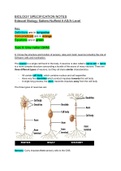
The neuron is a single cell found in the body. A neurone is also called a nerve cell. A nerve
is a more complex structure surrounding a bundle of the axons of many neurons. There are
three different types of neurons, but they all share similar characteristics:
- All contain cell body, which contains nucleus and cell organelles
- Have very fine dendrites which conduct impulses towards the cell body
- A single long process, the axon, transmits impulses away from the cell body
The three types of neurones are:
Sensory: Carry impulses from sensory cells to the CNS.
, Relay: Found mostly within CNS. Have a large number of connections with other nerve
cells.
Motor: cell body is situated in CNS. Axon extends out, conducts impulses from CNS to
effectors (muscles or glands). They are also known as effector neurones.
There is a fatty insulating layer called the myelin sheath around the axon. This is made
out of Schwann cells wrapped around the axon. This affects how quickly nerve impulses
travel along the axon. Invertebrate and some animals with vertebrae do not have a
myelinated axon.
8.2 i) Understand how the nervous systems of organisms can cause effectors to respond to
a stimulus. p.196
The nervous system is highly organised. It conducts nerve impulses between cells which
are passed between them. A nerve impulse is a wave of depolarisation that reverses the
potential difference across cell membranes.
The nervous system can be divided up into the central nervous system (CNS) and the
peripheral nervous system. The CNS consists of the brain and spinal cord. The
peripheral nervous system consists of sensory nerves (carries sensory information from the
receptors to CNS). It also contains motor nerves (carries motor commands from the CNS to
the effectors).
Edexcel Biology Salters-Nuffield A AS/A-Level
Key:
Definitions are in turquoise
Core practicals are in orange
Equations are in green
Topic 8: Grey matter (GRM)
8.1 Know the structure and function of sensory, relay and motor neurons including the role of
Schwann cells and myelination.
The neuron is a single cell found in the body. A neurone is also called a nerve cell. A nerve
is a more complex structure surrounding a bundle of the axons of many neurons. There are
three different types of neurons, but they all share similar characteristics:
- All contain cell body, which contains nucleus and cell organelles
- Have very fine dendrites which conduct impulses towards the cell body
- A single long process, the axon, transmits impulses away from the cell body
The three types of neurones are:
Sensory: Carry impulses from sensory cells to the CNS.
, Relay: Found mostly within CNS. Have a large number of connections with other nerve
cells.
Motor: cell body is situated in CNS. Axon extends out, conducts impulses from CNS to
effectors (muscles or glands). They are also known as effector neurones.
There is a fatty insulating layer called the myelin sheath around the axon. This is made
out of Schwann cells wrapped around the axon. This affects how quickly nerve impulses
travel along the axon. Invertebrate and some animals with vertebrae do not have a
myelinated axon.
8.2 i) Understand how the nervous systems of organisms can cause effectors to respond to
a stimulus. p.196
The nervous system is highly organised. It conducts nerve impulses between cells which
are passed between them. A nerve impulse is a wave of depolarisation that reverses the
potential difference across cell membranes.
The nervous system can be divided up into the central nervous system (CNS) and the
peripheral nervous system. The CNS consists of the brain and spinal cord. The
peripheral nervous system consists of sensory nerves (carries sensory information from the
receptors to CNS). It also contains motor nerves (carries motor commands from the CNS to
the effectors).


