WGU Biochemistry C 785 Study Guide | all units covered exclusively
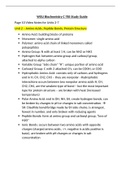
Unit 2 – Amino Acids, Peptide Bonds, Protein Structure Amino Acid: building blocks of proteins Monomer: single amino acid Polymer: amino acid chain of linked monomers called polypeptides Amino Group: N with at least 1 H, can be NH2 or NH3 Hydrogen Hat: between amino group and carboxyl group, attached to alpha carbon Variable Group “side chain” “R”: unique portion of amino acid Carboxyl Group: C with 2 attached O’s, can be COOH, or COO Hydrophobic Amino Acid: consists only of carbons and hydrogens end in H, CH, CH2, CH3 – they are nonpolar –Hydrophobic interactions occurs between two nonpolar amino acids H, CH, CH2, CH4, are the weakest type of bond – but the most important type for protein structure – are broken with heat (increased temperature) Polar Amino Acid: end in OH, NH, SH, create hydrogen bonds, can be broken by changes in pH or changes in salt concentration. SH: Disulfide bond/bridge made by SH side chains, is strongest, fewest in number, and only broken with reducing agents Peptide Bonds: form at amino group and carboxyl group, “loss of H2O” Ionic Bonds: occurs between two amino acids with opposite charges (charged amino acids, -/+, negative is acidic positive is basic), are broken with pH changes or changes in salt concentration Dehydration Synthesis: when two molecules are covalently bonded with loss of a water molecule (H20) one provides hydroxyl group OH and the other provides hydrogen H. Amino group and carboxyl group both give up something and then they bind and form a new bond polymer chain Hydrolysis: addition of a water molecule H2O to break a bond, breaks polymers 4 Levels of Protein Structure: Primary linear chain of amino acids, Secondary alpha helix and beta sheet shapes, create by Hydrogen bonds of polypeptide backbones Tertiary 3D, stabilized by side chains Quaternary consists of two or more polypeptide chains, more than one subunit – tertiary and quaternary are mature structures that are properly folded. Denaturation: high temperatures and various chemical treatments will denature a protein, causing it to lose its shape and ability to function “form=function” it may renature when chemical and physical aspects of environment are restored to normal.
Written for
- Institution
-
Chamberlain College Of Nursing
- Course
-
Biochemistry C 785
Document information
- Uploaded on
- January 2, 2023
- Number of pages
- 42
- Written in
- 2022/2023
- Type
- Exam (elaborations)
- Contains
- Questions & answers
Subjects
-
wgu biochemistry c 785 study guide
-
wgu biochemistry c 785 study guide | all units covered exclusively

Also available in package deal