PMHNP Exam Prep Questions and Answers Rated A+
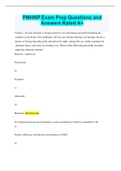
Conrad, a 26-year-old male, is being treated for cuts after being arrested for breaking the windows in the home of his girlfriend, who has just told him that they are through. He has a history of having been physically abused by his father, setting fires as a child, treatment for substance abuse, and arrest for stealing a car. Which of the following personality disorders might the clinician consider? Question 1 options:a) Narcissistic b) Paranoid c) Antisocial d) Histrionic Antisocial In a biopsychosocial case formulation, social contributions would be considered to be: a) Genetic influences and adverse circumstances of birth b) Substance use and medical disorders c) Cognitive deficits and dysregulation of emotions d) Religious/cultural factors and living situations Religious/cultural factors and living situations Which of the following criteria would preclude the use of brief dynamic therapy? a) Adequate ego strengths b) Psychological problems in multiple domains c) Use of mature defense mechanisms d) Adequate ability to process information Use of mature defense mechanisms In treatment of the acute phase of mania, the focus is on:a) Protecting the patient's biopsychosocial safety b) Educating the patient about social rhythms theory c) Interventions that address impairment of vocational functioning d) Interventions for self-management of finance Protecting the patient's biopsychosocial safety During an initial assessment, the relevant features of communication are its ability to: a) Promote a therapeutic alliance and increase understanding. b) Prompt a disclosure of past successes and failures. c) Bring about changes in behavior. d) Educate the patient about what is important to disclose. Symptoms of anxiety and panic are associated with a low level of which neurotransmitter? a) Cortisol b) Dopamine c) Gamma-aminobutyric acid d) Glutamate Gamma-aminobutyric acid Which class of antidepressants has the most anticholinergic side effects? a) Monoamine oxidase inhibitors (MAOIs) b) Selective serotonin reuptake inhibitors (SSRIs) c) Tricyclic antidepressants (TCAs) d) Serotonin norepinephrine reuptake inhibitors (SNRIs) Tricyclic antidepressants (TCAs) A 16-year-old male patient is hospitalized for depression after attempting suicide by overdose. Several days later, the patient reports feeling less depressed and having fewer suicidal thoughts, but begins to threaten suicide "if things do not work out." Nursing staff members report feeling resentful and manipulated, but fear for the patient's safety. The adult psychiatric and mental health nurse practitioner's intervention is to a) :assist the staff in developing a treatment plan that limits contact with the patient to one person per shift. b) develop a "no suicide" pact with the patient to decrease his helplessness and increase his feelings of control. c) encourage the patient to express his fears of improving and being abandoned or of leaving the safe environment. d) increase supervision and restrict milieu participation to decrease the secondary gain from manipulation. encourage the patient to express his fears of improving and being abandoned or of leaving the safe environment. A female client complains of an intense, overwhelming fear of driving a car. The fear has disrupted all elements of her life. She does not go to the grocery store unless someone transports her, has relinquished her job, and has few social contacts. Her treatment plan includes: assertiveness training. b) biofeedback. c) stress management assistance. d) systematic desensitization. A patient with borderline personality disorder experiences intense anxiety when an adult psychiatric and mental health nurse practitioner goes on vacation. The best explanation for this reaction is that the patient: has failed to develop clear ego boundaries. b) has failed to master object constancy. c) is employing primitive idealization. d) is employing projective identification. An outpatient mental health clinic-based adult psychiatric and mental health nurse practitioner treats a 32-year-old patient who has diabetes and a major depressive disorder. The patient reports an improved and stable mood on a trial of duloxetine (Cymbalta), but experiences continued neuropathic pain. The nurse practitioner's initial intervention is to: add gabapentin (Neurontin) to the treatment regimen. b) conduct additional diagnostic tests. c) contact the patient's endocrinologist. d) increase the dosage of duloxetine (Cymbalta). Among the following statements, which best describes the action of older typical antipsychotic medications such as Haldol? They block dopamine receptors in all four dopamine pathways. b) They decrease available amounts of serotonin and norepinephrine. c) They decrease the metabolism of dopamine in the synaptic cleft. d) They selectively block reuptake of dopamine. Which of the following structures provides for communication between the two hemispheres of the brain? ) Lateral ventricle b) Basal ganglia c) Corpus callosum d) Hypothalamus On evaluation, the patient appears to be having difficulty with working memory, planning, and insight into his problems. The psychiatric advanced practice nurse recognizes that these symptoms are associated with problems with the:) Frontal lobe b) Temporal lobe c) Parietal lobe d) Occipital lobe Frontal lobe n cognitive therapy, therapists focuses on patients':a) Use of immature defense mechanisms b) Learned behavior of helplessness c) Automatic negative thoughts d) Attachment patterns Automatic negative thoughts With regard to the biological markers for schizotypal personality disorder, all of the following have been reported except: a) Increased ventricles b) Increased cerebrospinal fluid c) Impaired smooth pursuit eye movements d) Impaired of executive functioning Impaired of executive functioning Serving as a member on a crisis team, an adult psychiatric and mental health nurse practitioner provides crisis intervention to the survivors of a plane crash. Forty-eight hours after the accident, the survivors describe vivid flashbacks, startle reactions, and disrupted sleep patterns. The nurse practitioner responds by: a) advising the survivors to consider using a hypnotic medication for a brief period. b) educating the survivors about prodromal symptoms of posttraumatic stress disorder. c) encouraging the survivors to rest during the day. d) suggesting that the survivors join a posttrauma support group. educating the survivors about prodromal symptoms of posttraumatic stress disorder. When lobbying a local congressional representative to include nurse practitioners in reimbursement for services in all areas of the country, an adult psychiatric and mental health nurse practitioner emphasizes the: ability of nurse practitioners to provide health care that patients need. b) fact that nurse practitioners are caring in their patient care delivery. c) importance of broadening the scope of nursing practice. d) necessity of offering equivalent services both to urban and rural patients .ability of nurse practitioners to provide health care that patients need. The primary function of a biopsychosocial case formulation is to: a) Generate an understanding of the person as a whole b) Identify comorbid medical illnesses c) Assess the maturity of the patient's defense mechanisms d) Determine patient's level of social support Generate an understanding of the person as a whole Which behavior reflects existentially oriented therapy? a) Attempting to understand a patient's subjective world b) Challenging a patient's irrational beliefs c) Developing specific plans for change d) Establishing general group goals Attempting to understand a patient's subjective world When a research study is based on a small sample size, the findings may: be statistically significant, but will be less generalizable than if the sample size had been larger. b) be statistically significant, but will not be clinically significant. c) not be statistically significant, because the research design was quasi-experimental instead of experimental. d) not be statistically significant, because the research was poorly conducted. Brain plasticity, which refers to the brain's capacity to change in response to an event,: )
Written for
- Institution
- PMHNP
- Course
- PMHNP
Document information
- Uploaded on
- December 31, 2022
- Number of pages
- 116
- Written in
- 2022/2023
- Type
- Exam (elaborations)
- Contains
- Questions & answers
Subjects
-
pmhnp exam prep questions and answers rated a

Also available in package deal