
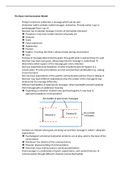
The Basic Communication Model
- Things in mind are coded into a message which can be sent
- Distinction within verbally coded messages: Semantics, Prosody (what I say) vs
paralanguage (how I say it)
- Receiver has to decode message in terms of (nonverbal channels):
➔ Proxemics: how close sender/receiver physically are
➔ Gestures
➔ Voice
➔ Facial expression
➔ Appearance
➔ Posture
➔ Haptics: Touching the other’s physical body during conversation
➔ Gaze
- Purpose of message determined by goals: they guide what is said and how it is said
- Receiver may have own goals, influencing how the message is understood →
determines which aspects of the message gets more attention
- Ppl have expectations/anticipations of what should/should not happen in a
conversation → some prescriptions are met and therefore predictable (e.g., talking
to your lecturer)
- Ppl may have expectations of the specific communication partner they’re talking to
- Receiver may have different expectations than the sender of the message & may
understand the message differently
- Different bandwidths of appropriate messages: when bandwidth passed (violated)
then message gets an additional meaning
➔ Depending on whether violation was positive/negative it may lead to
approach/avoidance communication
- Context can indicate what goals are being set and how message is coded + adequate
expectations
➔ Psychological: emotional style/what emotions are at play, what is the topic of the
conversation
➔ Relational: the relation of the communicators
➔ Physical: physical setting of communication
➔ Historical: have communicators communicated before
- Final message is a combination of goals, expectations, and context features →
communicated through different channels (nonverbal/verbal)
- Things in mind are coded into a message which can be sent
- Distinction within verbally coded messages: Semantics, Prosody (what I say) vs
paralanguage (how I say it)
- Receiver has to decode message in terms of (nonverbal channels):
➔ Proxemics: how close sender/receiver physically are
➔ Gestures
➔ Voice
➔ Facial expression
➔ Appearance
➔ Posture
➔ Haptics: Touching the other’s physical body during conversation
➔ Gaze
- Purpose of message determined by goals: they guide what is said and how it is said
- Receiver may have own goals, influencing how the message is understood →
determines which aspects of the message gets more attention
- Ppl have expectations/anticipations of what should/should not happen in a
conversation → some prescriptions are met and therefore predictable (e.g., talking
to your lecturer)
- Ppl may have expectations of the specific communication partner they’re talking to
- Receiver may have different expectations than the sender of the message & may
understand the message differently
- Different bandwidths of appropriate messages: when bandwidth passed (violated)
then message gets an additional meaning
➔ Depending on whether violation was positive/negative it may lead to
approach/avoidance communication
- Context can indicate what goals are being set and how message is coded + adequate
expectations
➔ Psychological: emotional style/what emotions are at play, what is the topic of the
conversation
➔ Relational: the relation of the communicators
➔ Physical: physical setting of communication
➔ Historical: have communicators communicated before
- Final message is a combination of goals, expectations, and context features →
communicated through different channels (nonverbal/verbal)


