CC practice Questions week 1.| LATEST SOLUTION
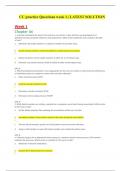
CC practice Questions week 1.| LATEST SOLUTION Week 1 Chapter 66 1. A 68-year-old patient has been in the intensive care unit for 4 days and has a nursing diagnosis of disturbed sensory perception related to sleep deprivation. Which action should the nurse include in the plan of care? a Administer prescribed sedatives or opioids at bedtime to promote sleep. . b Cluster nursing activities so that the patient has uninterrupted rest periods. . c. Silence the alarms on the cardiac monitors to allow 30- to 40-minute naps. d Eliminate assessments between 0100 and 0600 to allow uninterrupted sleep. . ANS: B 2. Which hemodynamic parameter is most appropriate for the nurse to monitor to determine the effectiveness of medications given to a patient to reduce left ventricular afterload? a Mean arterial pressure (MAP) . b Systemic vascular resistance (SVR) . c. Pulmonary vascular resistance (PVR) d Pulmonary artery wedge pressure (PAWP) . ANS: B 3. While family members are visiting, a patient has a respiratory arrest and is being resuscitated. Which action by the nurse is best? a Tell the family members that watching the resuscitation will be very stressful. . b Ask family members if they wish to remain in the room during the resuscitation. . c. Take the family members quickly out of the patient room and remain with them. d Assign a staff member to wait with family members just outside the patient room. . ANS: B 4. Following surgery for an abdominal aortic aneurysm, a patients central venous pressure (CVP) monitor indicates low pressures. Which action is a priority for the nurse to take? a Administer IV diuretic medications. . b Increase the IV fluid infusion per protocol. . c. Document the CVP and continue to monitor. d Elevate the head of the patients bed to 45 degrees. . ANS: B 5. When caring for a patient with pulmonary hypertension, which parameter is most appropriate for the nurse to monitor to evaluate the effectiveness of the treatment? a Central venous pressure (CVP) . b Systemic vascular resistance (SVR) . c. Pulmonary vascular resistance (PVR) d Pulmonary artery wedge pressure (PAWP) . ANS: C 6. The intensive care unit (ICU) nurse educator will determine that teaching about arterial pressure monitoring for a new staff nurse has been effective when the nurse a balances and calibrates the monitoring equipment every 2 hours. . b positions the zero-reference stopcock line level with the phlebostatic axis. . c. ensures that the patient is supine with the head of the bed flat for all readings. d rechecks the location of the phlebostatic axis when changing the patients position. . ANS: B 7. When monitoring for the effectiveness of treatment for a patient with a large anterior wall myocardial infarction, the most important information for the nurse to obtain is a central venous pressure (CVP). . b systemic vascular resistance (SVR). . c. pulmonary vascular resistance (PVR). d pulmonary artery wedge pressure (PAWP). . ANS: D 8. Which action is a priority for the nurse to take when the low pressure alarm sounds for a patient who has an arterial line in the left radial artery? a Fast flush the arterial line. . b Check the left hand for pallor.
Written for
- Institution
- CC practice
- Module
- CC practice
Document information
- Uploaded on
- December 19, 2022
- Number of pages
- 26
- Written in
- 2022/2023
- Type
- Exam (elaborations)
- Contains
- Questions & answers
Subjects
-
cc practice questions week 1| latest solution week 1 chapter 66 1 a 68 year old patient has been in the intensive care unit for 4 days and has a nursing diagnosis of disturbed sensory perceptio