The concept of health, wellness and illness correctly answered 2022
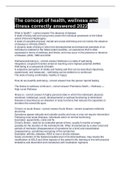
The concept of health, wellness and illness correctly answered 2022What is health? The absence of disease A state of being well and using every power the individual possesses to the fullest extent (Florence Nightingale) A state of complete physical, mental and social well-being and not merely the absence of disease or infirmity (WHO) A dynamic state of being in which the developmental and behavioral potentials of an individual is realized to the fullest extent possible...an experience that is often expressed in terms of wellness and illness, and may occur in the presence or absence of disease. (ANA, 1980 and 2004 Wellness/well-being is Wellness is a state of well-being Integrated, congruent function aimed at reaching one's highest potential (AHNA) Well-being is a component of health, A subjective perception of vitality and feeling well that can be described objectively, experienced, and measured... well-being can be plotted on a continuum The state of being comfortable, healthy or happy How do we quantify well-being how the person reports feeling The illness to wellness continuum Premature Death -- Wellness --- High Level Wellness Illness is A highly personal state in which the individual's physical, emotional, intellectual, social, developmental or spiritual functioning is diminished Disease is described as an alteration in body functions that reduces the capacities or shortens the normal life span. Chronic vs acute illness Acute illness - severe symptoms relatively short time Symptoms appear abruptly and subside quickly and may or may not require intervention Following most acute illnesses, individuals return to normal functioning Examples: appendicitis, colds and flu Chronic illness - lasts for an extended period of time, usually 6 months or longer, possibly for the duration of the individual's life. Often characterized by a slow onset and periods of remission (disappearance of symptoms for a time) and exacerbation (reappearance, sometimes worsening of the symptoms) Examples: arthritis, diabetes, AIDS is now a chronic disease Goals: promotion of the highest possible level of function/wellness, may require the modification of ADLS and other aspects of the patient's life, learning to live with physical limitations and discomfort and compliance with medication regimens Healing vs cure You can heal without curing and you can cure without healing. They are not the same thing. CURING is the elimination of all evidence of disease, tends to be externally mediated HEALING is the restoration of wholeness, occurs from within the person Nurses participate in both disability Disability is not illness. However, individuals with disabilities do get ill, they suffer with the same illnesses as the typical population, sometimes they experience more illnesses comorbid with their disability societal constraints that magnify disability and/or make disability a potent divider among people. An example of this is curbs alongside the road. Health promotion The concept of health promotion began with the Healthy People movement in 1979 nurse's role in health promotion Assessment - nurses are responsible for assessment of communities, groups and individuals. Assessment helps in planning programs and screening for health risks and conditions Intervention - lifestyle and behavior programs offer education and support. Nurses are involved in stop smoking, obesity, stress management, nutrition and other lifestyle related programs Environmental control programs - these are a response to the continuing increase of contaminants in our environment. These may be nuclear power plants and waste disposal, herbicide and pesticide use, air quality, etc. These involve public planning and policymaking, education of the "offenders" and the public, cleaning up contaminated environments, etc. Response - to health and environmental emergencies such as natural disasters, outbreaks, attacks, other catastrophic events (such as the massive financial fall recently experienced in the US and the world) Important factors when working with health promotion and communities/individuals Culture Characteristics of the target population Literacy Access to resources Identification of the risk Quality of available interventions Evaluation and planning once it's completed Creating change - External variables are under the individual's control and are the results of choices Examples of these fall into the categories of health behaviors and healthy vs unhealthy activites - Internal variables are not under the individual's control, they also may or may not be conscious More about these on the next slide Internal variables (Biological) Biological (physical) dimension Genetics, gender, age, developmental level These can impact on susceptibility to disease, distribution of disease, health status Internal variables (Psychological) emotional dimension Mind/body interactions, including emotional responses to stress, use of relaxation, "placebo effect" and self concept Affects how individuals handle stressors which interacts with the biological responses to stress Internal variables (Cognitive) intellectual dimension Lifestyle, health beliefs (does culture go here?), spiritual or religious beliefs These affect locus of control, response to risk factors, decisions (for example on blood transfusions for Jehovah's Witnesses, or food choices for Seventh Day Adventists) also hope, and other factors The nursing Process - Assessment Health history and examination - detection of health problems Physical fitness assessment - components of the body's physical functioning including muscle endurance, flexibility, body composition and cardiorespiratory endurance Lifestyle assessment - personal lifestyle and habits and their affects on the client's health Spiritual health assessment - ability to develop one's inner being to its fullest potential including one's purpose in life or the meaning of one's life Social support systems review - understanding the context of one's life, support, coping, group affiliations Life stress review - assesses the impact of stress on well-being nursing process - planning The nurse is a resource person in the health promotion domain. This means that the nurse provides information when asked, emphasizes the importance of small steps in behavior change, and reviews the client's goals and plans to make sure they are realistic, measurable and acceptable to the client. The nurse also explores the available resources and the client's ability to access them Nursing process - implementation This is the Doing The main goal of the nurse is to support the client's efforts to create change Nursing process - Evaluation Ongoing, begins early, don't wait until the end
Written for
- Institution
- Health, wellness and Illness
- Course
- Health, wellness and Illness
Document information
- Uploaded on
- December 12, 2022
- Number of pages
- 3
- Written in
- 2022/2023
- Type
- Exam (elaborations)
- Contains
- Questions & answers
Subjects
- the concept of health
-
wellness and illness correctly answered 2022
-
what is health the absence of disease a state of being well and using every power the individual possesses to the fullest extent f

Also available in package deal