

Digital Marketing and Analytics
WEEK 1
Main challenge of digital marketing & analytics = measuring real impact. No speculation, no wishful thinking.
Know what really matters
Online data are getting more and more complex and challenging, but data is also getting rich and diverse to
have a better understanding and then, predict and manage customers’ behavior.
Personalization (individualization) and User Generated Content make today’s digital platforms substantially
different than traditional offline marketing
traditional media: same message to all
new digital media: personalized messages, more info exchange between customers
customers actively generate content and impact other customers and firms’ behavior
All goals/benefits can be achieved through designing and managing seamless customer journeys on digital
platforms – by using right digital touchpoints synchronized with offline platforms & touchpoints
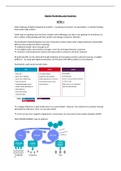
Touchpoints: paid owned earned media
a vlogger/influencer is paid media since it is a paid medium. However, the customer-to-customer sharing
stimulated by influencer, then is an earned activity
a firm can also earn negative engagement: earned does not necessarily mean positive (negative WOM)
PAID-OWNED-EARNED: type of audience
1
,PAID-OWNED-EARNED: marketing objective & communication
PAID-OWNED-EARNED: extension category media
Category media = relates to the category that do not mention the advertiser’s brand neither published by the
focal brand. Captures competitors’ own, paid and earned media and independent publications related to the
product category.
Digital data types: classification 1 – structure
- Structured data: mostly quantitative, numeric (sales, clicks, session time, likes)
- Unstructured data: mostly qualitative, textual or visual (insta videos, reviews, social media posts)
importance of unstructured data is rapidly increasing. It is over 80% of all business-marketing data
Digital data types: classification 2 – source
- On-site data = data available on the web (data/web scraping) visible to anyone
2
, - Clickstream/ session data = behavioral data: what, when and how people do online (google analytics)
not visible to visitor
touch-point data = when and where did this IP-address see or click on content
session data = everything you do when you visit a website
- CRM data = customer’ online history with the firm (purchases, demographics)
On-site data – web scraping
= collecting data from websites, social media platforms on certain content such as product information/listings,
customer reviews, ratings, comments, social media posts, through (scraper) softwares and importing to your
local data base in xls, sql or other format
legal, because it is publicly available online data. On-site data, that is available to everyone. As long as you
do not use it to reproduce, commercialize or re-sell
Scrapers = used by many firms, researchers and analytics agencies
Web scraper will only give you data on what is on the website: product features, listings, emails, ratings,
reviews, comments, address, telephone etc
web scraper does not give you customer data (what they do, what and how they click). No non visible
information
scraped data is different from data you get from google analytics, BigQuery
Scrapers
- Data miner
- Python & R (scraping from social media & other websites) = more advanced, larger data sets
Scraping web data in list format – 3 main steps (no matter which tool you use)
1. Define the CONTAINER (main unit) that makes up the data on website.
o the ROW structure of your data.
o Voorbeeld: Hotels elk hotel een eigen row
2. Define the SUB-ELEMENTS you wish to scrape data about (price, rating, name, etc)
o each of them makes each colum in your data
3. Define the PAGINATION (next page: function) so scraper can automatically “click” and go the
subsequent pages and keep scraping.
Scraping tips
- Keep it simple
- 3-5 column data is sufficient
- Think of marketing question first
Clickstream/ session data
Google analytics is used to review/analyze click-stream online data on web traffic
who visited the website. When. How. What kind of touchpoints are preceding?
- Individual level data = what does each customer do step by step?
- Aggregate data = total numbers.
Google analytics: aggregate data total number of visitor and clicks
mostly for small/medium businesses
- General traffic from different devices, locations, occasions and time-slots
- customer journeys: attribution & paths-to-purchase for your website
- Developed for every-day use of practitioners-managers: no statistics or coding needed
- Simple questions
- Easy to use
3
, Google big query: individual level data, so you can see each visitor individual journey and visiting behavior
mostly for large scale online multichannel firms in depth information on individual journeys
CRM & complementary data
= mostly Backoffice data of the company, historical-retrospective data on customer relational history
- Purchase/relation history with firm
- Campaign history, feedback, support queries, demographic info, address, location
Digital data with emotions and behavior
= digital data can also include business outcomes and customer attitudes/emotions
Emotions and attitudes are non-observable, but this link can be built by
1. Integrating survey (online marketing research)
2. Integrating/drawing conclusions on possible emotional outcomes as a result of online behavior (bijv.
Analyzing emojis on social media)
First, second and third party data
- First party data = firm obtains data directly from own sources. Valuable because you get info firsthand
from consumers, eliminating misinterpretations and errors
google analytics, surveys, interviews, email
- Second party data = data is obtained from trustworthy third party data sources and then customized
for specific target. Mostly from partnerships
google big query, media publishers selling to advertisers, supermarket. Selling to credit
card company
- Third party = any data that is not its own (or customized). Third party does the work
salesforce, google, facebook, amazon, visa
- (zero party) = data that a customer intentionally and proactively shares with a brand
personal context, purchase intentions, recognitions
Digital marketing metrics = tools helping companies quantify, compare and interpret their own performance
from marketing activities Key performance indicators (KPIs)
Top 10 metrics marketers are using
- Conversion rates
- Response rates
- Click-through rates
- Campaign ROI
- Website performance data (traffic)
- Customer acquisition
- Cost per lead/click
4
WEEK 1
Main challenge of digital marketing & analytics = measuring real impact. No speculation, no wishful thinking.
Know what really matters
Online data are getting more and more complex and challenging, but data is also getting rich and diverse to
have a better understanding and then, predict and manage customers’ behavior.
Personalization (individualization) and User Generated Content make today’s digital platforms substantially
different than traditional offline marketing
traditional media: same message to all
new digital media: personalized messages, more info exchange between customers
customers actively generate content and impact other customers and firms’ behavior
All goals/benefits can be achieved through designing and managing seamless customer journeys on digital
platforms – by using right digital touchpoints synchronized with offline platforms & touchpoints
Touchpoints: paid owned earned media
a vlogger/influencer is paid media since it is a paid medium. However, the customer-to-customer sharing
stimulated by influencer, then is an earned activity
a firm can also earn negative engagement: earned does not necessarily mean positive (negative WOM)
PAID-OWNED-EARNED: type of audience
1
,PAID-OWNED-EARNED: marketing objective & communication
PAID-OWNED-EARNED: extension category media
Category media = relates to the category that do not mention the advertiser’s brand neither published by the
focal brand. Captures competitors’ own, paid and earned media and independent publications related to the
product category.
Digital data types: classification 1 – structure
- Structured data: mostly quantitative, numeric (sales, clicks, session time, likes)
- Unstructured data: mostly qualitative, textual or visual (insta videos, reviews, social media posts)
importance of unstructured data is rapidly increasing. It is over 80% of all business-marketing data
Digital data types: classification 2 – source
- On-site data = data available on the web (data/web scraping) visible to anyone
2
, - Clickstream/ session data = behavioral data: what, when and how people do online (google analytics)
not visible to visitor
touch-point data = when and where did this IP-address see or click on content
session data = everything you do when you visit a website
- CRM data = customer’ online history with the firm (purchases, demographics)
On-site data – web scraping
= collecting data from websites, social media platforms on certain content such as product information/listings,
customer reviews, ratings, comments, social media posts, through (scraper) softwares and importing to your
local data base in xls, sql or other format
legal, because it is publicly available online data. On-site data, that is available to everyone. As long as you
do not use it to reproduce, commercialize or re-sell
Scrapers = used by many firms, researchers and analytics agencies
Web scraper will only give you data on what is on the website: product features, listings, emails, ratings,
reviews, comments, address, telephone etc
web scraper does not give you customer data (what they do, what and how they click). No non visible
information
scraped data is different from data you get from google analytics, BigQuery
Scrapers
- Data miner
- Python & R (scraping from social media & other websites) = more advanced, larger data sets
Scraping web data in list format – 3 main steps (no matter which tool you use)
1. Define the CONTAINER (main unit) that makes up the data on website.
o the ROW structure of your data.
o Voorbeeld: Hotels elk hotel een eigen row
2. Define the SUB-ELEMENTS you wish to scrape data about (price, rating, name, etc)
o each of them makes each colum in your data
3. Define the PAGINATION (next page: function) so scraper can automatically “click” and go the
subsequent pages and keep scraping.
Scraping tips
- Keep it simple
- 3-5 column data is sufficient
- Think of marketing question first
Clickstream/ session data
Google analytics is used to review/analyze click-stream online data on web traffic
who visited the website. When. How. What kind of touchpoints are preceding?
- Individual level data = what does each customer do step by step?
- Aggregate data = total numbers.
Google analytics: aggregate data total number of visitor and clicks
mostly for small/medium businesses
- General traffic from different devices, locations, occasions and time-slots
- customer journeys: attribution & paths-to-purchase for your website
- Developed for every-day use of practitioners-managers: no statistics or coding needed
- Simple questions
- Easy to use
3
, Google big query: individual level data, so you can see each visitor individual journey and visiting behavior
mostly for large scale online multichannel firms in depth information on individual journeys
CRM & complementary data
= mostly Backoffice data of the company, historical-retrospective data on customer relational history
- Purchase/relation history with firm
- Campaign history, feedback, support queries, demographic info, address, location
Digital data with emotions and behavior
= digital data can also include business outcomes and customer attitudes/emotions
Emotions and attitudes are non-observable, but this link can be built by
1. Integrating survey (online marketing research)
2. Integrating/drawing conclusions on possible emotional outcomes as a result of online behavior (bijv.
Analyzing emojis on social media)
First, second and third party data
- First party data = firm obtains data directly from own sources. Valuable because you get info firsthand
from consumers, eliminating misinterpretations and errors
google analytics, surveys, interviews, email
- Second party data = data is obtained from trustworthy third party data sources and then customized
for specific target. Mostly from partnerships
google big query, media publishers selling to advertisers, supermarket. Selling to credit
card company
- Third party = any data that is not its own (or customized). Third party does the work
salesforce, google, facebook, amazon, visa
- (zero party) = data that a customer intentionally and proactively shares with a brand
personal context, purchase intentions, recognitions
Digital marketing metrics = tools helping companies quantify, compare and interpret their own performance
from marketing activities Key performance indicators (KPIs)
Top 10 metrics marketers are using
- Conversion rates
- Response rates
- Click-through rates
- Campaign ROI
- Website performance data (traffic)
- Customer acquisition
- Cost per lead/click
4


