
Les 1
DISFUNCTIES VOOR PELVISCHE REEDUCATIE
o Urologische disfuncties:
urine-incontinentie, retentie (= niet kunnen plassen), dysurie (= moeilijk
kunnen plassen), pijn, drang, frequency, nadruppelen, cystocoele (=
verzakking van de blaas), nocturia (= s’nachts moeten opstaan om te plassen)
o Gynaecologische disfuncties:
Prolaps (= verzakking van de baarmoeder), pijn
o Proctologische disfuncties:
faecaal verlies, urge (=drang), soiling (veeg in de broek, maw niet goed
kunnen vegen), rectocoele (= verzakking van het rectum)
o Seksuele disfuncties:
erectiestoornissen, ejaculatiestoornissen, vaginisme, dyspareunie
(= pijnstoornis bij seks)
CASUS 1: VROUW MET INSPANNINGSVERLIES
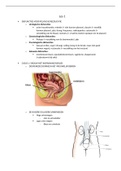
o DOORSNEDE DOORHEEN HET VROUWELIJK BEKKEN
o DE HOGERE EN LAGERE URINEWEGEN
Hoge urinewegen
- nier en urineleider
Lage urine wegen
- Blaas en urinebuis
,o BLAAS BINNENZIJDE: CYSTOSCOPIE
o BLAAS: MUCOSA, DETRUSOR, EPITHELIUM
o DOORSNEDE DOOR MANNELIJK BEKKEN
Mannen zijn beter resistent tegen urine-incontinentie, doordat we maar 2
openingen hebben en daardoor onze spieren beter zijn, we maken geen
bevalling mee
,o BLAAS, PROSTAAT EN URETHRA: BUITENZIJDE
URETHRA BINNENZIJDE: URETHRASCOPIE
- Lengte: 2,5-5 cm vrouw, +/- 20 cm man
- STRICTUUR VAN URETHRA
We zien een vernauwing van de urethra
o BLAAS, BAARMOEDER, DARM
ONDERSTEUNING (SPIEREN) EN OPHANGING (LIGAMENTEN)
Schip = organen
Trossen = ligamenten
Water = spieren
, o BEKKENBODEMSPIEREN
Sluitfunctie
Steunfunctie
Seksuele functie
Zorgen voor 1/3 van sluiting urethra
- Ook gladde spieren en mucosa, bloedvaten en zenuwen zorgen voor
sluiting
ZIJ, ONDER- EN VOORAANZICHT
- Coronale/ frontale vlak
- Sagittale vlak
- Transversale/axiale vlak
o SPIEREN VAN HET OPPERVLAKKIG PLAN
M. Sphincter ani externus (subcutaan en oppervlakkig deel)
- Doel: ophouden van stoelgang
M. Bulbospongiosus (M. bulbocavernosus)
- Vrouw: compressie diepe dorsale vene
- Man: tijdens ejaculatie door ritmische contracties het sperma langs
de urethra naar buiten stuwen
M. Ischiocavernosus
- Doel: veneuze reflux verhinderen
M. Transversus perinei superficialis
- Doel: stabiliseren van het centrum (centrum tendineum)
DISFUNCTIES VOOR PELVISCHE REEDUCATIE
o Urologische disfuncties:
urine-incontinentie, retentie (= niet kunnen plassen), dysurie (= moeilijk
kunnen plassen), pijn, drang, frequency, nadruppelen, cystocoele (=
verzakking van de blaas), nocturia (= s’nachts moeten opstaan om te plassen)
o Gynaecologische disfuncties:
Prolaps (= verzakking van de baarmoeder), pijn
o Proctologische disfuncties:
faecaal verlies, urge (=drang), soiling (veeg in de broek, maw niet goed
kunnen vegen), rectocoele (= verzakking van het rectum)
o Seksuele disfuncties:
erectiestoornissen, ejaculatiestoornissen, vaginisme, dyspareunie
(= pijnstoornis bij seks)
CASUS 1: VROUW MET INSPANNINGSVERLIES
o DOORSNEDE DOORHEEN HET VROUWELIJK BEKKEN
o DE HOGERE EN LAGERE URINEWEGEN
Hoge urinewegen
- nier en urineleider
Lage urine wegen
- Blaas en urinebuis
,o BLAAS BINNENZIJDE: CYSTOSCOPIE
o BLAAS: MUCOSA, DETRUSOR, EPITHELIUM
o DOORSNEDE DOOR MANNELIJK BEKKEN
Mannen zijn beter resistent tegen urine-incontinentie, doordat we maar 2
openingen hebben en daardoor onze spieren beter zijn, we maken geen
bevalling mee
,o BLAAS, PROSTAAT EN URETHRA: BUITENZIJDE
URETHRA BINNENZIJDE: URETHRASCOPIE
- Lengte: 2,5-5 cm vrouw, +/- 20 cm man
- STRICTUUR VAN URETHRA
We zien een vernauwing van de urethra
o BLAAS, BAARMOEDER, DARM
ONDERSTEUNING (SPIEREN) EN OPHANGING (LIGAMENTEN)
Schip = organen
Trossen = ligamenten
Water = spieren
, o BEKKENBODEMSPIEREN
Sluitfunctie
Steunfunctie
Seksuele functie
Zorgen voor 1/3 van sluiting urethra
- Ook gladde spieren en mucosa, bloedvaten en zenuwen zorgen voor
sluiting
ZIJ, ONDER- EN VOORAANZICHT
- Coronale/ frontale vlak
- Sagittale vlak
- Transversale/axiale vlak
o SPIEREN VAN HET OPPERVLAKKIG PLAN
M. Sphincter ani externus (subcutaan en oppervlakkig deel)
- Doel: ophouden van stoelgang
M. Bulbospongiosus (M. bulbocavernosus)
- Vrouw: compressie diepe dorsale vene
- Man: tijdens ejaculatie door ritmische contracties het sperma langs
de urethra naar buiten stuwen
M. Ischiocavernosus
- Doel: veneuze reflux verhinderen
M. Transversus perinei superficialis
- Doel: stabiliseren van het centrum (centrum tendineum)


