

Wildfires review notes
What are wildfires?
Wildfires are unplanned, uncontrolled rural fires.
They are known as bushfires in Australia and brush fires in the USA.
What are the 3 ingredients of a fire triangle?
Oxygen, heat and fuel
What is a material’s flashpoint?
Everything has a temperature at which it will burst into flames. This
temperature is called a material's flash point.
Wood's flash point is 300°C. When wood is heated to this temperature, it
releases hydrocarbon gases that mix with oxygen in the air, combust and create
fire.
What is the difference between crown fires, surface fires and ground
fires?
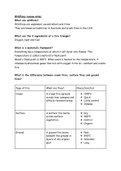
Type of fire What are they? Characteristics
Crown A crown fire spreads ❖ 1100°C
across tree canopies and ❖ Quick
affects forested areas. ❖ Little control
❖ Intense
Surface A surface fire burns ❖ Dry
across surface ❖ 900°C
vegetation. ❖ Control
❖ Organic
Ground A ground fire burns ❖ Peat
beneath the ground in ❖ 540°C
layers of dry organic ❖ Smoulder
peat. ❖ Long
, Create a mind map to show the factors affecting wildfires. Include the
following:-
Factors
Vegetation type ❖ Trees – juniper and pine are very flammable
❖ Understorey plants – density increases, meaning
fire will spread
❖ Leaf litter – surface fuel will increase fire
Small fuel materials (flashy fuels), such as dry grass,
pine needles, dry leaves and twigs, burn faster than
large logs or stumps.
As the fire progresses, heat and smoke dry out
potential fuel just ahead. This makes the fuel easier
to ignite when the fire finally reaches it. Fuels that
are somewhat spaced out will also dry out faster than
fuels that are packed tightly together.
Weather conditions ❖ Temperature
❖ Relative Humidity
❖ Wind Speed
❖ Wind Direction
❖ Cloud Cover
❖ Rainfall
❖ Chance of Lightning
Wind probably has the biggest impact on a wildfire's
behaviour. It also the most unpredictable factor.
Winds supply the fire with additional oxygen, further
dry potential fuel and push the fire across the land at
a faster rate
Research has found that not only does wind affect
how the fire develops, but that fires themselves can
develop wind patterns. Large, violent wildfires can
generate winds, called fire whirls. Fire whirls have
been known to hurl flaming logs and burning debris
What are wildfires?
Wildfires are unplanned, uncontrolled rural fires.
They are known as bushfires in Australia and brush fires in the USA.
What are the 3 ingredients of a fire triangle?
Oxygen, heat and fuel
What is a material’s flashpoint?
Everything has a temperature at which it will burst into flames. This
temperature is called a material's flash point.
Wood's flash point is 300°C. When wood is heated to this temperature, it
releases hydrocarbon gases that mix with oxygen in the air, combust and create
fire.
What is the difference between crown fires, surface fires and ground
fires?
Type of fire What are they? Characteristics
Crown A crown fire spreads ❖ 1100°C
across tree canopies and ❖ Quick
affects forested areas. ❖ Little control
❖ Intense
Surface A surface fire burns ❖ Dry
across surface ❖ 900°C
vegetation. ❖ Control
❖ Organic
Ground A ground fire burns ❖ Peat
beneath the ground in ❖ 540°C
layers of dry organic ❖ Smoulder
peat. ❖ Long
, Create a mind map to show the factors affecting wildfires. Include the
following:-
Factors
Vegetation type ❖ Trees – juniper and pine are very flammable
❖ Understorey plants – density increases, meaning
fire will spread
❖ Leaf litter – surface fuel will increase fire
Small fuel materials (flashy fuels), such as dry grass,
pine needles, dry leaves and twigs, burn faster than
large logs or stumps.
As the fire progresses, heat and smoke dry out
potential fuel just ahead. This makes the fuel easier
to ignite when the fire finally reaches it. Fuels that
are somewhat spaced out will also dry out faster than
fuels that are packed tightly together.
Weather conditions ❖ Temperature
❖ Relative Humidity
❖ Wind Speed
❖ Wind Direction
❖ Cloud Cover
❖ Rainfall
❖ Chance of Lightning
Wind probably has the biggest impact on a wildfire's
behaviour. It also the most unpredictable factor.
Winds supply the fire with additional oxygen, further
dry potential fuel and push the fire across the land at
a faster rate
Research has found that not only does wind affect
how the fire develops, but that fires themselves can
develop wind patterns. Large, violent wildfires can
generate winds, called fire whirls. Fire whirls have
been known to hurl flaming logs and burning debris


