

ATI TEAS TEST 2022–LATEST GUIDE
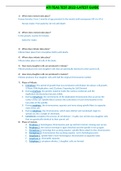
1) When does meiosis take place? Human females: From 3 months of age prenatal (in the womb) until menopause (40's to 50's) Human males: From puberty (12-13) until death 2) Where does meiosis take place? In the gonads: ovaries for females testes for males. 3) When does mitosis take place? Mitosis takes place from conception (birth) until death. 4) Where does mitosis take place? Mitosis takes place in all cells of the body. 5) How many daughter cells are produced in mitosis? Mitosis produces two new daughter cells that are genetically identical to their parent cell. 6) How many daughter cells are produced in meiosis? Meiosis produces four daughter cells with half the original chromosome number. 7) Phase of Mitosis A. Interphase: The period of growth that occurs between cell division (G1 phase: cell growth, S Phase: DNA Replication, and G2 phase: Preparing for Cell Division) B. During prophase, the genetic material inside the nucleus condenses and the duplicated chromosomes become visible. C. During metaphase, the centromeres of the duplicated chromosomes line up across the center of the cell. Spindle fibers connect the centromere of each chromosome to the two poles of the spindle. D. During anaphase, the chromosomes separate and move along spindle fibers to opposite ends of the cell. E. During telophase, the chromosomes, which were distinct and condensed, begin to spread out into a tangle of chromatin. F. Cytokinesis completes the process of cell division—it splits one cell into two daughter cells that are genetically identical to their parent cell. 8) Phase of meiosis A. Prophase 1, homologous chromosomes pair up and form tetrad; crossing over occurs B. Prophase 2, the nuclear envelope is again dissolved and the spindle is set up again. C. Metaphase 1, homologs line up along equator, spindle fibers attach to the chromosomes D. Metaphase 2, chromosomes line up along equator, not in homologous pairs E. Anaphase 1, spindle fibers move homologous chromosomes to opposite sides F. Anaphase 2, chromatids separate G. Telophase 1, cytoplasm divides, 2 daughter cells are formed H. Telophase 2/Cytokinesis, nuclear membrane reforms, cytoplasm divides, 4 daughter cells formed 9) What muscle is used for goosebumps? Smooth muscles are also involuntary. Smooth muscles are found within the walls of organs and structures such as the esophagus, stomach, intestines, bladder, blood vessels, and skin. A type of smooth muscle in the skin, known as the erector pili, is responsible for forming goose bumps. 10) Where gametes were produced? Cells in the reproductive organs (testes and ovaries in humans) divide to form gametes. Gametes are sex cells: Male gametes are sperm (produced in the testes) Female gametes are eggs (produced in the ovaries) 11) What are DNA strands? The two DNA strands are termed polynucleotides since they are composed of simpler monomer units called nucleotides. Each nucleotide is composed of one of four nitrogen-containing nucleobases — cytosine (C), guanine (G), adenine (A), or thymine (T) — a sugar called deoxyribose, and a phosphate group. 12) What is Fertilization? At fertilization, the sperm binds to a receptor on the surface of the egg and fuses with the egg plasma membrane, initiating the development of a new diploid organism containing genetic information derived from both parents. Not only does fertilization lead to the mixing of paternal and maternal chromosomes, but it also induces a number of changes in the egg cytoplasm that are critical for further development. These alterations activate the egg, leading to the completion of oocyte meiosis and initiation of the mitotic cell cycles of the early embryo. Almost all the cells in your body were produced by mitosis. The only exception is sperm or eggs which are produced by a different type of cell division called meiosis. During fertilization, the sperm and egg unite to form a single cell called the zygote which contains chromosomes from both the sperm and egg. 13) Which layer of skin produce sebum? Dermis. The dermis, the skin's next layer, is a thick layer of fibrous and elastic tissue (made mostly of collagen, elastin, and fibrillin) that gives the skin its flexibility and strength. The dermis contains nerve endings, sweat glands and oil (sebaceous) glands, hair follicles, and blood vessels. ................................................................................................CONTINUE
Document information
- Uploaded on
- December 1, 2022
- Number of pages
- 7
- Written in
- 2022/2023
- Type
- Exam (elaborations)
- Contains
- Questions & answers


