Student Exploration: Waves GIZMO
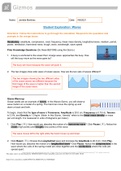
Student Exploration: Waves Directions: Follow the instructions to go through the simulation. Respond to the questions and prompts in the orange boxes. Vocabulary: amplitude, compression, crest, frequency, linear mass density, longitudinal wave, medium, period, power, rarefaction, transverse wave, trough, wave, wavelength, wave speed Prior Knowledge Questions (Do these BEFORE using the Gizmo.) 1. A buoy is anchored to the ocean floor. A large wave approaches the buoy. How will the buoy move as the wave goes by? The buoy will move because the wave will push it. 2. The two images show side views of ocean waves. How are the two sets of waves different? The two images showing the two different sides of the ocean waves are different because the first image of the wave is higher than the second image of the ocean wave. Gizmo Warm-up Ocean swells are an example of waves. In the Waves Gizmo, you will observe wave motion on a model of a spring. The hand can move the spring up and down or back and forth. To begin, check that the type of wave is Transverse, Amplitude is 20.0 cm, Frequency is 0.75 Hz, Tension is 3.0 N, and Density is 1.0 kg/m. (Note: In this Gizmo, “density” refers to the linear mass density or mass per unit length. It is measured in units of kilograms per meter.) 1. Click Play ( ). How would you describe the motion of a transverse wave? Click Pause ( ). Notice the crests (high points) and troughs (low points) of the wave. The wave moves left to the right while the hand moves up and down. 2. Click Reset ( ). Choose the Longitudinal wave and increase the Amplitude to 20.0 cm. Click Play. How would you describe the motion of a longitudinal wave? Click Pause. Notice the compressions in the wave where the coils of the spring model are close together and the rarefactions where the coils are spread apart. Question: How do we measure and describe waves? 1. Observe: Click Play. Observe the motions of the hand and the green dot in the middle. A. What is the motion of the hand? it goes up and down in an easy way u could say. B. Turn off the Lights on the checkbox and observe the green dot. What is the motion of the green dot? it leaves a trail of a straight line up and down. C. Follow the motion of a single crest of the wave. How does the crest move?
Document information
- Uploaded on
- December 1, 2022
- Number of pages
- 8
- Written in
- 2022/2023
- Type
- Exam (elaborations)
- Contains
- Questions & answers