The macroeconomy
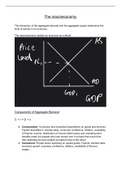
The interaction of the aggregate demand and the aggregate supply determines the
level of activity in an economy.
The macroeconomy studies an economy as a whole.
Components of Aggregate Demand
C+I+G+x
● Consumption: Consumer and household expenditure on goods and services.
Factors that affect it: interest rates, consumer confidence, inflation, availability
of finance, income, distribution of income (direct taxes and unemployment
benefits mean rich people who lose money won’t cut back that much from
their spending but poor people will spend most of the extra)
● Investment: Private sector spending on capital goods. Factors: interest rates,
economic growth, business confidence, inflation, availability of finance,
wages…
, ● Government spending: Government expenditure on goods and services.
Factors: income elasticity, inflation…
● Exports: Net exports, the difference between the value of exports and the
value of imports. Factors: inflation, exchange rates, trade policies…
Key terms
Aggregate demand: The total demand of all the goods and services in an economy.
Aggregate supply: The total supply of goods and services in an economy.
Short-run aggregate supply: The total output of an economy that will be supplied
when there has not been enough time for the prices of factors of production to
change.
Long-run aggregate supply: The total output of a country supplied in the period
when prices of factors of production have fully adjusted.
Reasons why aggregate demand falls when the price level rises
1. Wealth effect: A rise in price will reduce the amount of goods people’s wealth
can buy.
2. International effect: A rise in price will reduce demand for net exports, while
imports will become more price competitive.
3. Interest rate effect: A rise in the price will increase demand for money to pay
higher prices. Therefore, the interest rate will increase. This will result in a
reduction in consumption and investment.
Reasons for shifts in aggregate demand
● Consumption: Changes in consumer confidence, income tax, wealth/income,
money supply (increase in money supply -> increase in AD) and a change in
population.
● Investment: Changes in business confidence, corporation tax and
technology.
● Government spending: A desire to stimulate economic activity and a desire
to win political support.
● Net exports: Changes in the exchange rate (decrease -> increase in net
exports), the quality of domestically produced goods and a change in incomes
abroad.
Reasons why aggregate supply increases when the price level rises
, 1. Profit effect: As the price level increases, the prices of factors of production
such as wages do not change. So the price level rises, the gap between the
output and input prices widens and the amount of profit increases.
2. Cost effect: Although the wage rates and raw material costs remain
unchanged in the short run, average costs may increase as output increases.
This is because, for example, overtime payments may have to be paid and
costs will be involved in recruiting more members. To cover any extra costs
that may be involved in producing a higher output, producers will require
higher prices.
3. Misinterpretation effect: Producers may confuse changes in the price level
with changes in relative prices. They may think that a rise in the price they
receive for their products indicates that their own product is becoming more
popular. As a result they may be encouraged to produce more.
Reasons for shifts in the short-run aggregate supply curve (SRAS)
● Price of factors of production: Wage rates, land costs and capital costs.
● Taxes on firms: Changing corporation tax or indirect tax.
● Factor productivity/quality of resources: Labour productivity, capital
productivity and the quality of natural resources.
● Quantity of resources
Reasons for shifts in the long-run aggregate supply curve (LRAS)
The reasons for shifts in the LRAS curve are a change in the quality and/or quantity
of resources. The causes of an increase in LRAS are:
● Net immigration: If the immigrants are of working age, this will increase the
size of the labour force.
● An increase in the retirement age: This will increase the size of the labour
force.
● More women entering the labour force
● Net investment: If gross investment exceeds depreciation (capital goods that
have to be replaced) there will be additions to the capital stock.
● Discovery of new resources: The discovery of more raw materials or natural
resources.
Inflation
Inflation can be caused by two reasons:
The interaction of the aggregate demand and the aggregate supply determines the
level of activity in an economy.
The macroeconomy studies an economy as a whole.
Components of Aggregate Demand
C+I+G+x
● Consumption: Consumer and household expenditure on goods and services.
Factors that affect it: interest rates, consumer confidence, inflation, availability
of finance, income, distribution of income (direct taxes and unemployment
benefits mean rich people who lose money won’t cut back that much from
their spending but poor people will spend most of the extra)
● Investment: Private sector spending on capital goods. Factors: interest rates,
economic growth, business confidence, inflation, availability of finance,
wages…
, ● Government spending: Government expenditure on goods and services.
Factors: income elasticity, inflation…
● Exports: Net exports, the difference between the value of exports and the
value of imports. Factors: inflation, exchange rates, trade policies…
Key terms
Aggregate demand: The total demand of all the goods and services in an economy.
Aggregate supply: The total supply of goods and services in an economy.
Short-run aggregate supply: The total output of an economy that will be supplied
when there has not been enough time for the prices of factors of production to
change.
Long-run aggregate supply: The total output of a country supplied in the period
when prices of factors of production have fully adjusted.
Reasons why aggregate demand falls when the price level rises
1. Wealth effect: A rise in price will reduce the amount of goods people’s wealth
can buy.
2. International effect: A rise in price will reduce demand for net exports, while
imports will become more price competitive.
3. Interest rate effect: A rise in the price will increase demand for money to pay
higher prices. Therefore, the interest rate will increase. This will result in a
reduction in consumption and investment.
Reasons for shifts in aggregate demand
● Consumption: Changes in consumer confidence, income tax, wealth/income,
money supply (increase in money supply -> increase in AD) and a change in
population.
● Investment: Changes in business confidence, corporation tax and
technology.
● Government spending: A desire to stimulate economic activity and a desire
to win political support.
● Net exports: Changes in the exchange rate (decrease -> increase in net
exports), the quality of domestically produced goods and a change in incomes
abroad.
Reasons why aggregate supply increases when the price level rises
, 1. Profit effect: As the price level increases, the prices of factors of production
such as wages do not change. So the price level rises, the gap between the
output and input prices widens and the amount of profit increases.
2. Cost effect: Although the wage rates and raw material costs remain
unchanged in the short run, average costs may increase as output increases.
This is because, for example, overtime payments may have to be paid and
costs will be involved in recruiting more members. To cover any extra costs
that may be involved in producing a higher output, producers will require
higher prices.
3. Misinterpretation effect: Producers may confuse changes in the price level
with changes in relative prices. They may think that a rise in the price they
receive for their products indicates that their own product is becoming more
popular. As a result they may be encouraged to produce more.
Reasons for shifts in the short-run aggregate supply curve (SRAS)
● Price of factors of production: Wage rates, land costs and capital costs.
● Taxes on firms: Changing corporation tax or indirect tax.
● Factor productivity/quality of resources: Labour productivity, capital
productivity and the quality of natural resources.
● Quantity of resources
Reasons for shifts in the long-run aggregate supply curve (LRAS)
The reasons for shifts in the LRAS curve are a change in the quality and/or quantity
of resources. The causes of an increase in LRAS are:
● Net immigration: If the immigrants are of working age, this will increase the
size of the labour force.
● An increase in the retirement age: This will increase the size of the labour
force.
● More women entering the labour force
● Net investment: If gross investment exceeds depreciation (capital goods that
have to be replaced) there will be additions to the capital stock.
● Discovery of new resources: The discovery of more raw materials or natural
resources.
Inflation
Inflation can be caused by two reasons: