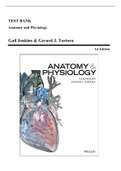
TEST BANK
Anatomy and Physiology
Gail Jenkins & Gerard J. Tortora
1st Edition
,Table of Contents
Chapter 01 An Introduction to the Human Body 2
Chapter 02 The Chemical Level of Organization 52
Chapter 03 The Cellular Level of Organization 86
Chapter 04 The Tissue Level of Organization 141
Chapter 05 The Integumentary System 182
Chapter 06 Introduction to the Skeletal System 222
Chapter 07 The Axial Skeleton 267
Chapter 08 The Appendicular Skeleton 333
Chapter 09 Articulations 403
Chapter 10 Muscle Tissue 444
Chapter 11 The Muscular System 499
Chapter 12 Introduction to the Nervous System 570
Chapter 13 The Central Nervous System 631
Chapter 14 The Peripheral Nervous System 668
Chapter 15 Sensory, Motor, and Integrative Systems 701
Chapter 16 The Special Senses 729
Chapter 17 The Endocrine System 762
Chapter 18 The Cardiovascular System-The Blood 787
Chapter 19 The Cardiovascular System-The Heart 811
Chapter 20 The Cardiovascular System-Blood Vessels 843
Chapter 21 The Lymphatic System and Immunity 868
Chapter 22 The Respiratory System 895
Chapter 23 The Digestive System 934
Chapter 24 The Urinary System 973
Chapter 25 The Reproductive Systems and Development 1015
,______________________________________________________________________________________________
Test Bank - Anatomy and Physiology, 1e (Jenkins, 2016)
Package Title: Test Bank
Course Title: Jenkins 1e
Chapter Number: 1
Chapter 01
Question type: Multiple Choice
1) When the examiner uses a stethoscope to amplify the sound of breathing into the lungs,
this is called ____.
a) inspection
b) percussion
c) auscultation
d) palpation
e) ultrasonography
Answer: c
Difficulty: Easy
Bloom’s: Knowledge
Learning Objective: LO 1.1 Describe the six levels of structural organization and the eleven
systems of the human body.
Section Reference: 1.1 The human body is composed of six levels of structural organization
and contains eleven systems.
2) When an examiner feels the body surfaces with hands, for example to detect enlarged
or tender organs, this is called ___.
a) inspection
b) percussion
c) auscultation
d) palpation
e) ultrasonography
Answer: d
Difficulty: Easy
Bloom’s: Knowledge
Learning Objective: LO 1.1 Describe the six levels of structural organization and the eleven
systems of the human body.
Section Reference: 1.1 The human body is composed of six levels of structural organization
and contains eleven systems.
______________________________________________________________________________________________
1|Page
,______________________________________________________________________________________________
Test Bank - Anatomy and Physiology, 1e (Jenkins, 2016)
3) The spleen, thymus, and tonsils are all organs that function within the ____.
a) urinary system
b) digestive system
c) endocrine system
d) lymphatic system
e) cardiovascular system
Answer: d
Difficulty Easy
Bloom’s: Comprehension
Learning Objective: LO 1.1 Describe the six levels of structural organization and the eleven
systems of the human body.
Section Reference: 1.1 The human body is composed of six levels of structural organization
and contains eleven systems.
4) Which of the following statements BEST describes the location of the radius bone
anatomically?
a) It is proximal to the carpal region and inferior to the manual region.
b) It is the lateral bone of the antebrachium.
c) It is located in the crural region.
d) It is inferior to the femoral region and superior to the tarsal region.
e) It is distal to the antecubital region, and is the medial bone of the crural region.
Answer: b
Difficulty: Medium
Bloom’s: Application
Learning Objective: LO 1.4 Describe the human body using the anatomical position and
specific terms.
Section Reference: 1.4 The human body is described using the anatomical position and
specific terms.
5) Two organs on the same side of the body, such as the spleen and the descending colon,
are ___.
a) distal
b) ipsilateral
c) proximal
d) contralateral
e) intermediate
______________________________________________________________________________________________
2|Page
,______________________________________________________________________________________________
Test Bank - Anatomy and Physiology, 1e (Jenkins, 2016)
Answer: b
Difficulty: Easy
Bloom’s: Comprehension
Learning Objective: LO 1.4 Describe the human body using the anatomical position and
specific terms.
Section Reference: 1.4 The human body is described using the anatomical position and
specific terms.
6) Two organs on the opposite side of the body, such as the spleen and the gallbladder, are
___.
a) distal
b) ipsilateral
c) proximal
d) contralateral
e) intermediate
Answer: d
Difficulty: Easy
Bloom’s: Knowledge
Learning Objective: LO 1.4 Describe the human body using the anatomical position and
specific terms.
Section Reference: 1.4 The human body is described using the anatomical position and
specific terms.
7) The heart is ___ to the lungs.
a) distal
b) proximal
c) ipsilateral
d) medial
e) contralateral
Answer: d
Difficulty: Easy
Bloom’s: Comprehension
Learning Objective: LO 1.4 Describe the human body using the anatomical position and
specific terms.
Section Reference: 1.4 The human body is described using the anatomical position and
specific terms.
______________________________________________________________________________________________
3|Page
,______________________________________________________________________________________________
Test Bank - Anatomy and Physiology, 1e (Jenkins, 2016)
8) A good example of a positive feedback mechanism would be
a) strengthening of labor contraction
b) blood calcium regulation
c) increasing blood pressure
d) blood glucose regulation
e) decreasing body temperature
Answer: a
Difficulty: Medium
Bloom’s: Comprehension
Learning Objective: LO 1.3 Explain how homeostasis is maintained through negative and
positive feedback systems, and how it can be disrupted by diseases and disorders.
Section Reference: 1.3 Homeostasis is controlled through feedback systems.
9) Which of the following anatomical terms best describes the indicated region?
a) popliteal
b) mental
c) crural
d) olecranal
e) occipital
______________________________________________________________________________________________
4|Page
,______________________________________________________________________________________________
Test Bank - Anatomy and Physiology, 1e (Jenkins, 2016)
Answer: d
Difficulty: Easy
Bloom’s: Comprehension
Learning Objective: LO 1.4 Describe the human body using the anatomical position and
specific terms.
Section Reference: 1.4 The human body is described using the anatomical position and
specific terms.
10) This component of a feedback system provides input directly to the control center.
a) effector
b) receptor
c) brain
d) stimulus
e) efferent
Answer: b
Difficulty: Easy
Bloom’s: Comprehension
Learning Objective: LO 1.3 Explain how homeostasis is maintained through negative and
positive feedback systems, and how it can be disrupted by diseases and disorders.
Section Reference: 1.3 Homeostasis is controlled through feedback systems.
11) A 24 year old female presents to the emergency room complaining of the following
symptoms:
• Acute lower right quadrant abdominal pain rated at an 9 out of 10 on the pain scale (10
being the worst pain ever!), that she characterizes as “burning and stabbing” in quality
• Feelings of nausea, dizziness and weakness.
• No difficulty breathing
As her physician, you notice that she exhibits the following signs:
• A very high fever (104ºF)
• High blood pressure (146/90)
• A rapid heart rate (110 beats per minute)
• Clear lung sounds- although her respiratory rate is rapid.
Which of the following choices is the most likely the correct diagnosis?
a) hypoglycemia (low blood sugar)
b) pulmonary embolus (blood clot in the lungs)
c) acute appendicitis
d) meningitis
e) pneumonia
______________________________________________________________________________________________
5|Page
, ______________________________________________________________________________________________
Test Bank - Anatomy and Physiology, 1e (Jenkins, 2016)
Answer: c
Difficulty: Hard
Bloom’s: Analysis
Learning Objective: LO 1.7 Distinguish between the regions and quadrants of the
abdominopelvic cavity.
Section Reference: 1.7 The abdominopelvic cavity is divided into regions or quadrants.
12) This component of a feedback system receives output from the control center.
a) effector
b) stimulus
c) receptor
d) central nervous system
e) afferent
Answer: a
Difficulty: Easy
Bloom’s: Comprehension
Learning Objective: LO 1.3 Explain how homeostasis is maintained through negative and
positive feedback systems, and how it can be disrupted by diseases and disorders.
Section Reference: 1.3 Homeostasis is controlled through feedback systems.
13) The study of body structures and relationships among structures is called ___.
a) physiology
b) histology
c) embryology
d) biology
e) anatomy
Answer: e
Difficulty: Easy
Bloom’s: Knowledge
Learning Objective: LO 1.1 Describe the six levels of structural organization and the eleven
systems of the human body.
Section Reference: 1.1 The human body is composed of six levels of structural organization
and contains eleven systems.
14) The study of body function, how the body parts work, is called ____.
______________________________________________________________________________________________
6|Page
Anatomy and Physiology
Gail Jenkins & Gerard J. Tortora
1st Edition
,Table of Contents
Chapter 01 An Introduction to the Human Body 2
Chapter 02 The Chemical Level of Organization 52
Chapter 03 The Cellular Level of Organization 86
Chapter 04 The Tissue Level of Organization 141
Chapter 05 The Integumentary System 182
Chapter 06 Introduction to the Skeletal System 222
Chapter 07 The Axial Skeleton 267
Chapter 08 The Appendicular Skeleton 333
Chapter 09 Articulations 403
Chapter 10 Muscle Tissue 444
Chapter 11 The Muscular System 499
Chapter 12 Introduction to the Nervous System 570
Chapter 13 The Central Nervous System 631
Chapter 14 The Peripheral Nervous System 668
Chapter 15 Sensory, Motor, and Integrative Systems 701
Chapter 16 The Special Senses 729
Chapter 17 The Endocrine System 762
Chapter 18 The Cardiovascular System-The Blood 787
Chapter 19 The Cardiovascular System-The Heart 811
Chapter 20 The Cardiovascular System-Blood Vessels 843
Chapter 21 The Lymphatic System and Immunity 868
Chapter 22 The Respiratory System 895
Chapter 23 The Digestive System 934
Chapter 24 The Urinary System 973
Chapter 25 The Reproductive Systems and Development 1015
,______________________________________________________________________________________________
Test Bank - Anatomy and Physiology, 1e (Jenkins, 2016)
Package Title: Test Bank
Course Title: Jenkins 1e
Chapter Number: 1
Chapter 01
Question type: Multiple Choice
1) When the examiner uses a stethoscope to amplify the sound of breathing into the lungs,
this is called ____.
a) inspection
b) percussion
c) auscultation
d) palpation
e) ultrasonography
Answer: c
Difficulty: Easy
Bloom’s: Knowledge
Learning Objective: LO 1.1 Describe the six levels of structural organization and the eleven
systems of the human body.
Section Reference: 1.1 The human body is composed of six levels of structural organization
and contains eleven systems.
2) When an examiner feels the body surfaces with hands, for example to detect enlarged
or tender organs, this is called ___.
a) inspection
b) percussion
c) auscultation
d) palpation
e) ultrasonography
Answer: d
Difficulty: Easy
Bloom’s: Knowledge
Learning Objective: LO 1.1 Describe the six levels of structural organization and the eleven
systems of the human body.
Section Reference: 1.1 The human body is composed of six levels of structural organization
and contains eleven systems.
______________________________________________________________________________________________
1|Page
,______________________________________________________________________________________________
Test Bank - Anatomy and Physiology, 1e (Jenkins, 2016)
3) The spleen, thymus, and tonsils are all organs that function within the ____.
a) urinary system
b) digestive system
c) endocrine system
d) lymphatic system
e) cardiovascular system
Answer: d
Difficulty Easy
Bloom’s: Comprehension
Learning Objective: LO 1.1 Describe the six levels of structural organization and the eleven
systems of the human body.
Section Reference: 1.1 The human body is composed of six levels of structural organization
and contains eleven systems.
4) Which of the following statements BEST describes the location of the radius bone
anatomically?
a) It is proximal to the carpal region and inferior to the manual region.
b) It is the lateral bone of the antebrachium.
c) It is located in the crural region.
d) It is inferior to the femoral region and superior to the tarsal region.
e) It is distal to the antecubital region, and is the medial bone of the crural region.
Answer: b
Difficulty: Medium
Bloom’s: Application
Learning Objective: LO 1.4 Describe the human body using the anatomical position and
specific terms.
Section Reference: 1.4 The human body is described using the anatomical position and
specific terms.
5) Two organs on the same side of the body, such as the spleen and the descending colon,
are ___.
a) distal
b) ipsilateral
c) proximal
d) contralateral
e) intermediate
______________________________________________________________________________________________
2|Page
,______________________________________________________________________________________________
Test Bank - Anatomy and Physiology, 1e (Jenkins, 2016)
Answer: b
Difficulty: Easy
Bloom’s: Comprehension
Learning Objective: LO 1.4 Describe the human body using the anatomical position and
specific terms.
Section Reference: 1.4 The human body is described using the anatomical position and
specific terms.
6) Two organs on the opposite side of the body, such as the spleen and the gallbladder, are
___.
a) distal
b) ipsilateral
c) proximal
d) contralateral
e) intermediate
Answer: d
Difficulty: Easy
Bloom’s: Knowledge
Learning Objective: LO 1.4 Describe the human body using the anatomical position and
specific terms.
Section Reference: 1.4 The human body is described using the anatomical position and
specific terms.
7) The heart is ___ to the lungs.
a) distal
b) proximal
c) ipsilateral
d) medial
e) contralateral
Answer: d
Difficulty: Easy
Bloom’s: Comprehension
Learning Objective: LO 1.4 Describe the human body using the anatomical position and
specific terms.
Section Reference: 1.4 The human body is described using the anatomical position and
specific terms.
______________________________________________________________________________________________
3|Page
,______________________________________________________________________________________________
Test Bank - Anatomy and Physiology, 1e (Jenkins, 2016)
8) A good example of a positive feedback mechanism would be
a) strengthening of labor contraction
b) blood calcium regulation
c) increasing blood pressure
d) blood glucose regulation
e) decreasing body temperature
Answer: a
Difficulty: Medium
Bloom’s: Comprehension
Learning Objective: LO 1.3 Explain how homeostasis is maintained through negative and
positive feedback systems, and how it can be disrupted by diseases and disorders.
Section Reference: 1.3 Homeostasis is controlled through feedback systems.
9) Which of the following anatomical terms best describes the indicated region?
a) popliteal
b) mental
c) crural
d) olecranal
e) occipital
______________________________________________________________________________________________
4|Page
,______________________________________________________________________________________________
Test Bank - Anatomy and Physiology, 1e (Jenkins, 2016)
Answer: d
Difficulty: Easy
Bloom’s: Comprehension
Learning Objective: LO 1.4 Describe the human body using the anatomical position and
specific terms.
Section Reference: 1.4 The human body is described using the anatomical position and
specific terms.
10) This component of a feedback system provides input directly to the control center.
a) effector
b) receptor
c) brain
d) stimulus
e) efferent
Answer: b
Difficulty: Easy
Bloom’s: Comprehension
Learning Objective: LO 1.3 Explain how homeostasis is maintained through negative and
positive feedback systems, and how it can be disrupted by diseases and disorders.
Section Reference: 1.3 Homeostasis is controlled through feedback systems.
11) A 24 year old female presents to the emergency room complaining of the following
symptoms:
• Acute lower right quadrant abdominal pain rated at an 9 out of 10 on the pain scale (10
being the worst pain ever!), that she characterizes as “burning and stabbing” in quality
• Feelings of nausea, dizziness and weakness.
• No difficulty breathing
As her physician, you notice that she exhibits the following signs:
• A very high fever (104ºF)
• High blood pressure (146/90)
• A rapid heart rate (110 beats per minute)
• Clear lung sounds- although her respiratory rate is rapid.
Which of the following choices is the most likely the correct diagnosis?
a) hypoglycemia (low blood sugar)
b) pulmonary embolus (blood clot in the lungs)
c) acute appendicitis
d) meningitis
e) pneumonia
______________________________________________________________________________________________
5|Page
, ______________________________________________________________________________________________
Test Bank - Anatomy and Physiology, 1e (Jenkins, 2016)
Answer: c
Difficulty: Hard
Bloom’s: Analysis
Learning Objective: LO 1.7 Distinguish between the regions and quadrants of the
abdominopelvic cavity.
Section Reference: 1.7 The abdominopelvic cavity is divided into regions or quadrants.
12) This component of a feedback system receives output from the control center.
a) effector
b) stimulus
c) receptor
d) central nervous system
e) afferent
Answer: a
Difficulty: Easy
Bloom’s: Comprehension
Learning Objective: LO 1.3 Explain how homeostasis is maintained through negative and
positive feedback systems, and how it can be disrupted by diseases and disorders.
Section Reference: 1.3 Homeostasis is controlled through feedback systems.
13) The study of body structures and relationships among structures is called ___.
a) physiology
b) histology
c) embryology
d) biology
e) anatomy
Answer: e
Difficulty: Easy
Bloom’s: Knowledge
Learning Objective: LO 1.1 Describe the six levels of structural organization and the eleven
systems of the human body.
Section Reference: 1.1 The human body is composed of six levels of structural organization
and contains eleven systems.
14) The study of body function, how the body parts work, is called ____.
______________________________________________________________________________________________
6|Page