

Talent identification and development – hoorcolleges
College 1 – introduction: model of talent identification and development
Talent identification: how can we avoid to miss talents and how can
we keep them? This is dependent on the population in the country
(large population = more talents).
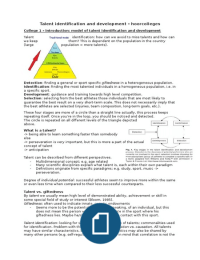
Detection: finding a general or sport specific giftedness in a heterogeneous population.
Identification: finding the most talented individuals in a homogeneous population, i.e. in
a specific sport.
Development: guidance and training towards high level competition.
Selection: selecting from the best athletes those individuals that are most likely to
guarantee the best result on a very short-term scale. This does not necessarily imply that
the best athletes are selected (injuries, team composition, long-term goals, etc.).
These four stages are more of a circle than a straight line actually, this process keeps
repeating itself. Once you’re in the loop, you should be noticed and detected.
The circle is repeated on all different levels of the triangle depicted
above.
What is a talent?
-> being able to learn something faster than somebody
else
-> perseveration is very important, but this is more a part of the actual
concept of talent
-> anticipation
Talent can be described from different perspectives.
- Multidimensional concept; e.g. age related
- Many scientific disciplines explain what talent is, each within their own paradigm
- Definitions originate from specific paradigms; e.g. study, sport, music ->
perseveration.
Degree of individual potential: successful athletes seem to improve more within the same
or even less time when compared to their less successful counterparts.
Talent vs. giftedness
By talent we usually mean high level of demonstrated ability, achievement or skill in
some special field of study or interest (Bloom, 1985).
Giftedness: often used to indicate innate, genetic endowments
- Seems more to be the potential, genetically speaking, of an individual, but this
does not mean this person will actually participate in the sport where his
giftedness lies. Maybe he/she does not come into contact with this sport.
Talent identification: looking for similarities within a group of talents; commonalities used
for identification. Problem with this line of thought: correlation vs. causation. All talents
may have similar characteristics, but all these characteristics may also be shared by
many other persons (e.g. self-regulation). Need to keep in mind that correlation is not the
, same as causation; when is something really the cause of something? For example,
people who do a lot of sports get high grades. Does this mean that you should begin in
sports and then your grades will immediately rise? No.
Nature vs. nurture
Nurture: physical environment, money, parents (very important!), (co)incidental
circumstances (birth month, relative age effect, family, availability).
- Relative age effect seems to disappear on the top level (soccer, tennis).
- For example, in a small town there’s more chance to be noticed as a talent, to be
discovered.
- Influence of significant others (e.g. family).
Nurture: discussion.
- Marginal role for innate factors.
- Even deliberate practice cannot be just nurture.
- Those who are able and willing to spend many hours for a number of successive
years practicing might be genetically predisposed to do so (Bouchard et al., 1997).
Nature: anthropometric testing, what kind of evidence is there?
- Nearly all sprinters from West African descent
- Why are Jamaicans so fast? Genes + sociology?
- Nearly all distance races won by runners from a small part of Kenya.
This turns out not to be all genetics. It is not as simple that you just need one particular
gene to be good in a certain sport.
Nature: gene testing
The process of talent identification could, in principle, be revolutionized by the discovery
and characterization of genetic variants that strongly influence athletic performance, with
routine genetic analysis being added to the existing battery of physiological, biochemical,
and psychological tests.
Nature: twin studies (monozygotic, identical heredity).
Conclusion nature vs. nurture
- It is not either nature or nurture alone.
- Biased towards nature, because of accountability; easier to explain.
- Complex interactions and models are necessary.
Video on talent identification: how can it be that some talents are overlooked?
Shouting talent: high potential, high performance
Whispering talent: high potential, but low performance
1. Great talent is not always the right talent. What talent do you need? What
determines it?
2. What you see is not necessarily what you get. Training, development, it’s about
the story and not the result.
3. Never overrate certificates and never underrate character. It’s all about the mind-
set, what are you willing to do for it?
Goldmine effect: right genes does not mean you will be good in a certain sport, you need
to invest a lot too.
Talent – expertise
Performance factors: not only physical (muscle properties etc.) but also cognitive
(decision making etc.).
Expert:
- Pattern recognition and recall
College 1 – introduction: model of talent identification and development
Talent identification: how can we avoid to miss talents and how can
we keep them? This is dependent on the population in the country
(large population = more talents).
Detection: finding a general or sport specific giftedness in a heterogeneous population.
Identification: finding the most talented individuals in a homogeneous population, i.e. in
a specific sport.
Development: guidance and training towards high level competition.
Selection: selecting from the best athletes those individuals that are most likely to
guarantee the best result on a very short-term scale. This does not necessarily imply that
the best athletes are selected (injuries, team composition, long-term goals, etc.).
These four stages are more of a circle than a straight line actually, this process keeps
repeating itself. Once you’re in the loop, you should be noticed and detected.
The circle is repeated on all different levels of the triangle depicted
above.
What is a talent?
-> being able to learn something faster than somebody
else
-> perseveration is very important, but this is more a part of the actual
concept of talent
-> anticipation
Talent can be described from different perspectives.
- Multidimensional concept; e.g. age related
- Many scientific disciplines explain what talent is, each within their own paradigm
- Definitions originate from specific paradigms; e.g. study, sport, music ->
perseveration.
Degree of individual potential: successful athletes seem to improve more within the same
or even less time when compared to their less successful counterparts.
Talent vs. giftedness
By talent we usually mean high level of demonstrated ability, achievement or skill in
some special field of study or interest (Bloom, 1985).
Giftedness: often used to indicate innate, genetic endowments
- Seems more to be the potential, genetically speaking, of an individual, but this
does not mean this person will actually participate in the sport where his
giftedness lies. Maybe he/she does not come into contact with this sport.
Talent identification: looking for similarities within a group of talents; commonalities used
for identification. Problem with this line of thought: correlation vs. causation. All talents
may have similar characteristics, but all these characteristics may also be shared by
many other persons (e.g. self-regulation). Need to keep in mind that correlation is not the
, same as causation; when is something really the cause of something? For example,
people who do a lot of sports get high grades. Does this mean that you should begin in
sports and then your grades will immediately rise? No.
Nature vs. nurture
Nurture: physical environment, money, parents (very important!), (co)incidental
circumstances (birth month, relative age effect, family, availability).
- Relative age effect seems to disappear on the top level (soccer, tennis).
- For example, in a small town there’s more chance to be noticed as a talent, to be
discovered.
- Influence of significant others (e.g. family).
Nurture: discussion.
- Marginal role for innate factors.
- Even deliberate practice cannot be just nurture.
- Those who are able and willing to spend many hours for a number of successive
years practicing might be genetically predisposed to do so (Bouchard et al., 1997).
Nature: anthropometric testing, what kind of evidence is there?
- Nearly all sprinters from West African descent
- Why are Jamaicans so fast? Genes + sociology?
- Nearly all distance races won by runners from a small part of Kenya.
This turns out not to be all genetics. It is not as simple that you just need one particular
gene to be good in a certain sport.
Nature: gene testing
The process of talent identification could, in principle, be revolutionized by the discovery
and characterization of genetic variants that strongly influence athletic performance, with
routine genetic analysis being added to the existing battery of physiological, biochemical,
and psychological tests.
Nature: twin studies (monozygotic, identical heredity).
Conclusion nature vs. nurture
- It is not either nature or nurture alone.
- Biased towards nature, because of accountability; easier to explain.
- Complex interactions and models are necessary.
Video on talent identification: how can it be that some talents are overlooked?
Shouting talent: high potential, high performance
Whispering talent: high potential, but low performance
1. Great talent is not always the right talent. What talent do you need? What
determines it?
2. What you see is not necessarily what you get. Training, development, it’s about
the story and not the result.
3. Never overrate certificates and never underrate character. It’s all about the mind-
set, what are you willing to do for it?
Goldmine effect: right genes does not mean you will be good in a certain sport, you need
to invest a lot too.
Talent – expertise
Performance factors: not only physical (muscle properties etc.) but also cognitive
(decision making etc.).
Expert:
- Pattern recognition and recall


