
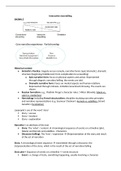
Interactive storytelling
Lecture 1
Historical context
Aristotle’s Poetica: tragedy versus comedy, narrative forms (epic/dramatic), dramatic
structure (beginning/middle/end; from complication to unravelling)
o Epic narrative form: focus on physical aspects and action. Represented
through diegesis, narration/telling, the events are told.
o Dramatic narrative form: Focus on mental aspects and human relations.
Represented through mimesis, imitation/enactment/showing. The events are
shown.
Russian formalism: e.g., Vladimir Propp’s character roles | Viktor Sklovskij: fabula vs.
sujet vs. media/text
Narratology including French structuralism: discipline studying narrative principles
and narrative representations (e.g. Seymour Chatman’s kernels vs. satellites, Gérard
Genette’s focalization)
Laypeople’s use of the word ‘story’
Story = excuse
Story = incident
Story = explanation
Narrative = an attribute of the text
Story: The ‘what’ / content chronological sequence of events on a timeline (plot,
fabula) and Kernels and satellites - Characters
Discourse (telling): The ‘how’ / expression (Re)presentation of the story and result
of the act of narration
Story: A chronological event sequence transmitted through a discourse: the
(re)presentation of the story, which is the result of the act of narration/telling
Story plot = Sequence of events on a timeline => event structure
Event = a change of state, something happening, usually involving a character
, Plot = plot point = narrative turn | dramatically significant
Causality = ‘a cause-and-effect chain of events’
Discourse structure: the order of narrated events
E.g., chronological, in media res, flashbacks, flashforwards
Discourse structures can evoke certain emotions: surprise, curiosity and suspense
Narrativity factors (NFs) = narrative elements
Three levels
1. Story
2. Discourse
3. Structure
Freytag’s dramatic arc (pyramid)
Labov and Waletzky’s (1967) story structure
Orientation = opening story world: who/what/where/when
Complication actions = sequence of unfolding events, moving the story forward
Critical event = tellable event, central in the story
Resolution = outcome of the story: how did it end?
Evaluation = Comments on the significance and meaning of the events – take-home
message.
o The narrator’s comments on the significance and meaning of the events.
o Answering questions like: ‘what does this all mean?’ or ‘so what?’
Coda = transition to the here and now
Tellability = Newsworthiness/reportability of the story
A tellable event is a critical event in the story structure. The event that makes the story
worth telling and worthy of the audience’s attention. Something must be extraordinary,
remarkable, unexpected or wonderful.
Kernels vs. satellites story structure
Kernel: an obligatory event that guarantees the story’s coherence/logic.
o Essential content of the story
o Part of a story’s identity
o Initiates, increases, or concludes an uncertainty, so it advances or outlines a
sequence of transformations.
, o Plot points
Satellite: serves to embellish the basic plot
o Content that can be omitted without changing the identity of the story
o Amplify or fill in the outline of a sequence by maintaining, retarding, or
prolonging the kernel events that accompany or surround
o Pinch points
Characters = a continuum from flat to round
A flat character = one who has only one distinctive characteristic exists only to
exhibit that characteristic, and is incapable of varying from that characteristic – one-
dimensional
A round character = multi-faceted, psychologically more lifelike and develops and
changes over time.
Propp’s Character Theory:
Hero = ‘agrees to liquidate the misfortune’ or ‘directly suffers from the action of the
villain’
Dispatcher = after the villain has committed a terrible deed and brought misfortune
to the land, the dispatcher calls for help
Donor = the hero’s sort of agent to defeat the villain
Helper = uses their force or cunning to help the hero acquire the object needed to
remove the misfortune from their lives
Villain = causes some ‘form of misfortune, damage or harm’
Princess = the hero sets off on a quest to rescue a princess
False hero = when the hero finishes their quest and the evil is defeated, the false
hero takes credit for the victory
Narrator who tells the story
Intradiegetic narrator: character, 1st person perspective
Extradiegetic narrator: above the story, 3rd person perspective
Focalization through whose senses do we perceive the events
Zero focalization: omniscient focalizator. Focalizator knows more than the character.
Internal focalization (invasion) = character and focalizator know the same, invasion
into an internal world of the character.
External focalization (demonstration) = character knows more than the focalizator,
demonstration of character’s actions and external appearance, no insight into the
thoughts and feelings of the character.
Conflict: struggle between opposing entities
Lecture 1
Historical context
Aristotle’s Poetica: tragedy versus comedy, narrative forms (epic/dramatic), dramatic
structure (beginning/middle/end; from complication to unravelling)
o Epic narrative form: focus on physical aspects and action. Represented
through diegesis, narration/telling, the events are told.
o Dramatic narrative form: Focus on mental aspects and human relations.
Represented through mimesis, imitation/enactment/showing. The events are
shown.
Russian formalism: e.g., Vladimir Propp’s character roles | Viktor Sklovskij: fabula vs.
sujet vs. media/text
Narratology including French structuralism: discipline studying narrative principles
and narrative representations (e.g. Seymour Chatman’s kernels vs. satellites, Gérard
Genette’s focalization)
Laypeople’s use of the word ‘story’
Story = excuse
Story = incident
Story = explanation
Narrative = an attribute of the text
Story: The ‘what’ / content chronological sequence of events on a timeline (plot,
fabula) and Kernels and satellites - Characters
Discourse (telling): The ‘how’ / expression (Re)presentation of the story and result
of the act of narration
Story: A chronological event sequence transmitted through a discourse: the
(re)presentation of the story, which is the result of the act of narration/telling
Story plot = Sequence of events on a timeline => event structure
Event = a change of state, something happening, usually involving a character
, Plot = plot point = narrative turn | dramatically significant
Causality = ‘a cause-and-effect chain of events’
Discourse structure: the order of narrated events
E.g., chronological, in media res, flashbacks, flashforwards
Discourse structures can evoke certain emotions: surprise, curiosity and suspense
Narrativity factors (NFs) = narrative elements
Three levels
1. Story
2. Discourse
3. Structure
Freytag’s dramatic arc (pyramid)
Labov and Waletzky’s (1967) story structure
Orientation = opening story world: who/what/where/when
Complication actions = sequence of unfolding events, moving the story forward
Critical event = tellable event, central in the story
Resolution = outcome of the story: how did it end?
Evaluation = Comments on the significance and meaning of the events – take-home
message.
o The narrator’s comments on the significance and meaning of the events.
o Answering questions like: ‘what does this all mean?’ or ‘so what?’
Coda = transition to the here and now
Tellability = Newsworthiness/reportability of the story
A tellable event is a critical event in the story structure. The event that makes the story
worth telling and worthy of the audience’s attention. Something must be extraordinary,
remarkable, unexpected or wonderful.
Kernels vs. satellites story structure
Kernel: an obligatory event that guarantees the story’s coherence/logic.
o Essential content of the story
o Part of a story’s identity
o Initiates, increases, or concludes an uncertainty, so it advances or outlines a
sequence of transformations.
, o Plot points
Satellite: serves to embellish the basic plot
o Content that can be omitted without changing the identity of the story
o Amplify or fill in the outline of a sequence by maintaining, retarding, or
prolonging the kernel events that accompany or surround
o Pinch points
Characters = a continuum from flat to round
A flat character = one who has only one distinctive characteristic exists only to
exhibit that characteristic, and is incapable of varying from that characteristic – one-
dimensional
A round character = multi-faceted, psychologically more lifelike and develops and
changes over time.
Propp’s Character Theory:
Hero = ‘agrees to liquidate the misfortune’ or ‘directly suffers from the action of the
villain’
Dispatcher = after the villain has committed a terrible deed and brought misfortune
to the land, the dispatcher calls for help
Donor = the hero’s sort of agent to defeat the villain
Helper = uses their force or cunning to help the hero acquire the object needed to
remove the misfortune from their lives
Villain = causes some ‘form of misfortune, damage or harm’
Princess = the hero sets off on a quest to rescue a princess
False hero = when the hero finishes their quest and the evil is defeated, the false
hero takes credit for the victory
Narrator who tells the story
Intradiegetic narrator: character, 1st person perspective
Extradiegetic narrator: above the story, 3rd person perspective
Focalization through whose senses do we perceive the events
Zero focalization: omniscient focalizator. Focalizator knows more than the character.
Internal focalization (invasion) = character and focalizator know the same, invasion
into an internal world of the character.
External focalization (demonstration) = character knows more than the focalizator,
demonstration of character’s actions and external appearance, no insight into the
thoughts and feelings of the character.
Conflict: struggle between opposing entities



