

Pulmonary System
A) Structure & Function
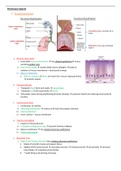
Structural Classification Functional Classification
a. Nose & nasal cavity
i. Lined with mucous membrane → has ciliated epithelium & mucus
secreting goblet cells
ii. Rich blood supply → vessels dilate due to allergies → leads to
oedema of mucus membrane = obstructed airways
iii. Mucus membrane
1. Warms, moistens & filters air (nose hair, mucus traps particles)
→ protects alveoli
b. Pharynx (throat)
i. Transports food from oral cavity → oesophagus
ii. Transports air from nasal cavity → larynx
iii. Soft palate raises during swallowing & larynx elevates → prevents food from entering nasal cavity &
trachea
c. Larynx (voice box)
i. Continuous to trachea
ii. Switching mechanism → routes air & food into proper channels
iii. Voice production
iv. Inner surface = mucus membrane
d. Trachea (windpipe)
i. Leads to Primary Bronchi
ii. C-shaped cartilaginous rings → prevent trachea collapse
iii. Mucus membrane → has ciliated columnar epithelium
iv. Filters incoming air
e. Bronchial Tree
i. Right & left Primary bronchi have ciliated columnar epithelium
1. Made of smooth muscle and elastic fibres
2. Right/Left Primary bronchi → secondary bronchi → tertiary bronchi → bronchioles → terminal
bronchioles → respiratory bronchioles
3. * walls thing as branching increases
, ii. Conducting airways
1. Function
a. Warms air → protect alveoli & maintain body core temperature
b. Adds water vapor
c. Filters air → removes bacteria, viruses, foreign particles
2. Cells
a. Ciliated columnar epithelial → mucociliary movement (sweeps foreign substances upwards)
b. Mucus secreting goblet cells → produce mucins (play role in innate immunity in mucosa)
c. Serous cells → in airway epithelium – produces lysozymes (IgA)
d. Clara cells → in bronchioles – produce anti-inflammatory substances
e. Other cells → neuroendocrine cells (regulate smooth muscle function + growth)
f. Lungs
i. Exchange surface → Large surface area, thin walls, moist, enclosed by pleural membrane
ii. Occupy most of thoracic cavity
iii. Ribs + skin = protection
iv. Right lung = 3 lobes
v. Left lung = 2 lobes
g. Pleura
i. Double layered sac surrounding each lung
1. Parietal pleura → outer mem. attached to inner surface of thoracic cavity
2. Visceral pleura → inner mem. covering surface of each lung
ii. Pleural fluid in pleural sac
1. Decreases friction between pleural mem.
2. Forms pleural seal → holds pleural against inner surface of thoracic cavity
h. Respiratory Zone
i. Site of gaseous exchange
1. Respiratory bronchioles, Alveolar duct, alveoli
ii. Alveoli
1. Series of interconnected air sacs
2. Rich supply of pulmonary capillaries
3. Arrangement allows MAX exchange
4. Each has:
a. Single layer epithelium = thin
b. No muscle
c. Connective tissue → collagen + elastin fibres → creates elastic recoil if stretched
d. Respiratory mem.
→ Separates air in alveoli & blood in pulmonary capillary
→ Air-blood barrier (alveoli + capillary walls)
5. Main epithelial cell types
a. Type I alveolar cells
→ Larger, occupy 95% of surface area
→ Barrier between blood + air
→ Very thin → diffuses rapidly
b. Type II alveolar cells
→ Smaller but thicker
→ Make + secrete Surfactant
, c. Alveolar macrophages
→ Remove dust particles + other debris from alveolar space
6. Special cell types
a. Capillary endothelial cells → forms walls of capillary (blood exchange surface)
b. Alveolar epithelial cells (Type I pneumocytes)
→ have low enzymatic activity, low O2 expenditure, low resistance to gaseous exchange
c. Large alveolar cells (Type II pneumocytes)
→ Secrete surfactant
→ Increase metabolic activity
→ Contain lysozyme, microvilli, endoplasmic reticulum, vesicles
→ Contain phagocytes
→ Aid recovery of alveolar mem. after injury
d. Alveolar macrophages or dust cells
→ Phagocytise inhaled dust particles (coughed out)
→ Cells enter lymphatics get sent to lymph nodes in hilum of lung
e. Lymphocytes
→ T-cells, B-cells, natural killer cells → part of adaptive immune system
f. Pulmonary dendritic cells
→ Antigen presenting cells of lungs → part of immune system
g. Neutrophils and mast cells
→ innate immune system of respiratory apparatus
B) Functions
a. Respiratory
i. Gaseous exchange → supplies O2 to body & disposes of CO2
ii. Respiration has 4 processes:
1. Pulmonary ventilation → exchange air between lungs +
external environment
2. External respiration → exchange O2 + CO2 between lungs
& blood in pulmonary capillaries
3. Transport of respiratory gases → transport O2 + CO2
between lungs & tissues
4. Internal respiration → exchange O2 + CO2 between tissues
cells & blood in systemic capillaries
A) Structure & Function
Structural Classification Functional Classification
a. Nose & nasal cavity
i. Lined with mucous membrane → has ciliated epithelium & mucus
secreting goblet cells
ii. Rich blood supply → vessels dilate due to allergies → leads to
oedema of mucus membrane = obstructed airways
iii. Mucus membrane
1. Warms, moistens & filters air (nose hair, mucus traps particles)
→ protects alveoli
b. Pharynx (throat)
i. Transports food from oral cavity → oesophagus
ii. Transports air from nasal cavity → larynx
iii. Soft palate raises during swallowing & larynx elevates → prevents food from entering nasal cavity &
trachea
c. Larynx (voice box)
i. Continuous to trachea
ii. Switching mechanism → routes air & food into proper channels
iii. Voice production
iv. Inner surface = mucus membrane
d. Trachea (windpipe)
i. Leads to Primary Bronchi
ii. C-shaped cartilaginous rings → prevent trachea collapse
iii. Mucus membrane → has ciliated columnar epithelium
iv. Filters incoming air
e. Bronchial Tree
i. Right & left Primary bronchi have ciliated columnar epithelium
1. Made of smooth muscle and elastic fibres
2. Right/Left Primary bronchi → secondary bronchi → tertiary bronchi → bronchioles → terminal
bronchioles → respiratory bronchioles
3. * walls thing as branching increases
, ii. Conducting airways
1. Function
a. Warms air → protect alveoli & maintain body core temperature
b. Adds water vapor
c. Filters air → removes bacteria, viruses, foreign particles
2. Cells
a. Ciliated columnar epithelial → mucociliary movement (sweeps foreign substances upwards)
b. Mucus secreting goblet cells → produce mucins (play role in innate immunity in mucosa)
c. Serous cells → in airway epithelium – produces lysozymes (IgA)
d. Clara cells → in bronchioles – produce anti-inflammatory substances
e. Other cells → neuroendocrine cells (regulate smooth muscle function + growth)
f. Lungs
i. Exchange surface → Large surface area, thin walls, moist, enclosed by pleural membrane
ii. Occupy most of thoracic cavity
iii. Ribs + skin = protection
iv. Right lung = 3 lobes
v. Left lung = 2 lobes
g. Pleura
i. Double layered sac surrounding each lung
1. Parietal pleura → outer mem. attached to inner surface of thoracic cavity
2. Visceral pleura → inner mem. covering surface of each lung
ii. Pleural fluid in pleural sac
1. Decreases friction between pleural mem.
2. Forms pleural seal → holds pleural against inner surface of thoracic cavity
h. Respiratory Zone
i. Site of gaseous exchange
1. Respiratory bronchioles, Alveolar duct, alveoli
ii. Alveoli
1. Series of interconnected air sacs
2. Rich supply of pulmonary capillaries
3. Arrangement allows MAX exchange
4. Each has:
a. Single layer epithelium = thin
b. No muscle
c. Connective tissue → collagen + elastin fibres → creates elastic recoil if stretched
d. Respiratory mem.
→ Separates air in alveoli & blood in pulmonary capillary
→ Air-blood barrier (alveoli + capillary walls)
5. Main epithelial cell types
a. Type I alveolar cells
→ Larger, occupy 95% of surface area
→ Barrier between blood + air
→ Very thin → diffuses rapidly
b. Type II alveolar cells
→ Smaller but thicker
→ Make + secrete Surfactant
, c. Alveolar macrophages
→ Remove dust particles + other debris from alveolar space
6. Special cell types
a. Capillary endothelial cells → forms walls of capillary (blood exchange surface)
b. Alveolar epithelial cells (Type I pneumocytes)
→ have low enzymatic activity, low O2 expenditure, low resistance to gaseous exchange
c. Large alveolar cells (Type II pneumocytes)
→ Secrete surfactant
→ Increase metabolic activity
→ Contain lysozyme, microvilli, endoplasmic reticulum, vesicles
→ Contain phagocytes
→ Aid recovery of alveolar mem. after injury
d. Alveolar macrophages or dust cells
→ Phagocytise inhaled dust particles (coughed out)
→ Cells enter lymphatics get sent to lymph nodes in hilum of lung
e. Lymphocytes
→ T-cells, B-cells, natural killer cells → part of adaptive immune system
f. Pulmonary dendritic cells
→ Antigen presenting cells of lungs → part of immune system
g. Neutrophils and mast cells
→ innate immune system of respiratory apparatus
B) Functions
a. Respiratory
i. Gaseous exchange → supplies O2 to body & disposes of CO2
ii. Respiration has 4 processes:
1. Pulmonary ventilation → exchange air between lungs +
external environment
2. External respiration → exchange O2 + CO2 between lungs
& blood in pulmonary capillaries
3. Transport of respiratory gases → transport O2 + CO2
between lungs & tissues
4. Internal respiration → exchange O2 + CO2 between tissues
cells & blood in systemic capillaries



