
Au nome de Dien (
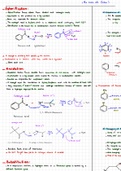
-> Asterification:
- Esterification forms esters from alcohol and
carboxylic acids. 2) substitution of
H20/ water It's the substitu
- is also produced as a
by-product. -
Esters are responsible for pleasant odors. - The reagents
The catalyst need H2S04 which acid heat.) (
-
is is a
sulphoric undergoing -> CI -
-
Esterification is also known as a condensation reaction because water's formed.
Carboxylic acid 8
& -> Alcohol
Alcohel The
-
catalysts c
j Heso4
I A
->
H20 heat (b) cond
the
&
If -
- -H20 > Ester bond
I
H
If
benzoin acid
cyclobutand
I
If
H
H If BUz
H If I
↓ reagent
*
A catalyst is
something that speeds up
the reaction. benzene
* Condensation is a reaction which has water as a
byproduct.
-
Esters smell nice Rea
->
HNOz
- Amidation:
-
Amidation reaction forms amides from ammonia or an amine with
carboxylic acid. ↳ benzene
(Toluene (
120/water makes the reaction condensation
- is a
by product which a reaction.
- Amides are
responsible for unpleasant odors.
-
A
catalyst used for amidation is H2s04/sulphuric acid with the condition of heat.(
-
Only ammonia, I and 20 amines can undergo amidation because 30 amine does not Deravatives
*
of benze
have a
hydrogen required for the reaction.
NH2
Amine 21°
Carboxylic acid -> Aromatic a
&a
cviline
#N H230% j
I
~1 I
H20 ⑧H
j - -
-
F
~ -> f
off
I one
f ~ Amide bond
-
↳ water hydrogen -> Aromatic alco
phene
1, 1, differe ethanamine
benzoic acid
acid
carboxylic
Amine (2']
CI
a
3)
Swapping of fu
Cl Cl
*
H · N
*
H2S04
m
+
U
3 - H20 -
swap of an a
↳ c
water Bo -
Mostly COHS and
*
8 Br
~ Amide bond
2 2-dichloro propanol N-methyl-2-brom-ethanamine -
No
hydrogen is
bein
-
The reagents can
-
Amides have a lot of resonance. -
The catalyst w
Do Not
*
forget love pairs on
nitrogen atoms if needed -
While
swapping
* Mest of the time
-substitution: o
ww
-
In a substitution reaction, a
hydrogen atom or a functional group is replaced by a
different functional
group. He < C


