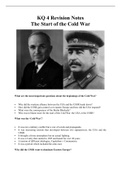
KQ 4 Revision Notes
The Start of the Cold War
What are the most important questions about the beginnings of the Cold War?
Why did the wartime alliance between the USA and the USSR break down?
How did the USSR gain control over eastern Europe and how did the USA respond?
What were the consequences of the Berlin Blockade?
Who was to blame more for the start of the Cold War: the USA or the USSR?
What was the ‘Cold War’?
It was not a military conflict but a war of words and propaganda.
It was increasing tension that developed between two superpowers, the USA and the
USSR.
It brought a frosty atmosphere but no actual fighting.
It was a rivalry that started in 1945 and lasted for over 40 years.
A tension of different ideologies, Capitalism v Communism.
It was a period which included the arms race.
Why did the USSR want to dominate Eastern Europe?
, After the Second World War, Stalin wanted a line of states which he could influence and
control from the Baltic to the Black Sea. This was the ‘Iron Curtain’ referred to by
Churchill in his speech of 1946 in Fulton.
Stalin wanted communist governments bordering the USSR. They would take their orders
from Moscow and they were likely to be compliant.
Russia had been invaded twice during the twentieth century by Germany. Stalin wanted to
ensure that the USSR would not be invaded again. He wanted a buffer zone of friendly
states facing the West. These would act as an early warning system to the USSR.
It wanted communism to spread.
What was agreed at the Yalta Conference in February 1945?
The USSR would enter the war against Japan.
Germany would be divided into American, British, French and Soviet occupation zones.
Berlin was to be temporarily divided into four occupation zones.
Nazi war criminals responsible for genocide would be hunted down and punished.
Liberated countries should be allowed to hold free elections.
The USA, USSR and Britain would join the new UN and work through it to keep peace.
Eastern Europe would be considered a Soviet sphere of influence.
In return for fixing the Soviet border with Poland further westwards than Churchill or
Roosevelt wanted, the Soviets would not interfere in Greece, where the British were
trying to stop a communist takeover.
The German surrender was to be unconditional. Germany was to pay reparations.
A provisional government was to be established in Poland. It was to comprise the Lublin
Poles and the exiled London Poles. Poland’s border was to be moved westwards into
German territory.
Stalin agreed to intervene in the war with Japan after Germany’s defeat. In return, Russia
would receive land in Manchuria and territory lost in the Russo-Japanese War of 1904–
05.
What important events occurred in between Yalta (February) and Potsdam (July)?
Soviet troops moved in to occupy most of eastern Europe – Estonia, Latvia, Lithuania,
Poland, Czechoslovakia, Hungary, Bulgaria, Romania.
Soviet troops had liberated countries in Eastern Europe but, instead of withdrawing his
troops, Stalin had left them there. By the time of the Conference, Stalin’s troops
controlled the Baltic States. Refugees were fleeing from these states fearing a Communist
take-over. Stalin had set up a Communist government in Poland ignoring the wishes of
the majority of Poles. Britain and the U.S.A. protested but Stalin insisted it was a
defensive measure against possible future attacks.
Roosevelt died in April 1945, to be replaced by Truman, who was more anti-communist
and more suspicious of Soviet intentions in eastern Europe.
The USA successfully tested its first atomic bomb – a potential threat to the USSR.
Truman told Stalin on the eve of the Potsdam Conference that the USA had developed an
atomic bomb. This was a major source of worry to Stalin throughout the conference, who
feared the USA might use the threat of the bomb to prevent the spread of communism.
Half way through the Potsdam Conference Churchill was defeated in the British General
Election and replaced by Clement Attlee.
The Start of the Cold War
What are the most important questions about the beginnings of the Cold War?
Why did the wartime alliance between the USA and the USSR break down?
How did the USSR gain control over eastern Europe and how did the USA respond?
What were the consequences of the Berlin Blockade?
Who was to blame more for the start of the Cold War: the USA or the USSR?
What was the ‘Cold War’?
It was not a military conflict but a war of words and propaganda.
It was increasing tension that developed between two superpowers, the USA and the
USSR.
It brought a frosty atmosphere but no actual fighting.
It was a rivalry that started in 1945 and lasted for over 40 years.
A tension of different ideologies, Capitalism v Communism.
It was a period which included the arms race.
Why did the USSR want to dominate Eastern Europe?
, After the Second World War, Stalin wanted a line of states which he could influence and
control from the Baltic to the Black Sea. This was the ‘Iron Curtain’ referred to by
Churchill in his speech of 1946 in Fulton.
Stalin wanted communist governments bordering the USSR. They would take their orders
from Moscow and they were likely to be compliant.
Russia had been invaded twice during the twentieth century by Germany. Stalin wanted to
ensure that the USSR would not be invaded again. He wanted a buffer zone of friendly
states facing the West. These would act as an early warning system to the USSR.
It wanted communism to spread.
What was agreed at the Yalta Conference in February 1945?
The USSR would enter the war against Japan.
Germany would be divided into American, British, French and Soviet occupation zones.
Berlin was to be temporarily divided into four occupation zones.
Nazi war criminals responsible for genocide would be hunted down and punished.
Liberated countries should be allowed to hold free elections.
The USA, USSR and Britain would join the new UN and work through it to keep peace.
Eastern Europe would be considered a Soviet sphere of influence.
In return for fixing the Soviet border with Poland further westwards than Churchill or
Roosevelt wanted, the Soviets would not interfere in Greece, where the British were
trying to stop a communist takeover.
The German surrender was to be unconditional. Germany was to pay reparations.
A provisional government was to be established in Poland. It was to comprise the Lublin
Poles and the exiled London Poles. Poland’s border was to be moved westwards into
German territory.
Stalin agreed to intervene in the war with Japan after Germany’s defeat. In return, Russia
would receive land in Manchuria and territory lost in the Russo-Japanese War of 1904–
05.
What important events occurred in between Yalta (February) and Potsdam (July)?
Soviet troops moved in to occupy most of eastern Europe – Estonia, Latvia, Lithuania,
Poland, Czechoslovakia, Hungary, Bulgaria, Romania.
Soviet troops had liberated countries in Eastern Europe but, instead of withdrawing his
troops, Stalin had left them there. By the time of the Conference, Stalin’s troops
controlled the Baltic States. Refugees were fleeing from these states fearing a Communist
take-over. Stalin had set up a Communist government in Poland ignoring the wishes of
the majority of Poles. Britain and the U.S.A. protested but Stalin insisted it was a
defensive measure against possible future attacks.
Roosevelt died in April 1945, to be replaced by Truman, who was more anti-communist
and more suspicious of Soviet intentions in eastern Europe.
The USA successfully tested its first atomic bomb – a potential threat to the USSR.
Truman told Stalin on the eve of the Potsdam Conference that the USA had developed an
atomic bomb. This was a major source of worry to Stalin throughout the conference, who
feared the USA might use the threat of the bomb to prevent the spread of communism.
Half way through the Potsdam Conference Churchill was defeated in the British General
Election and replaced by Clement Attlee.