

Lecture 1
Value creation
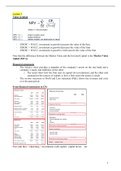
- If ROIC > WACC, investment in growth increases the value of the firm.
- If ROIC < WACC, investment in growth decreases the value of the firm
- If ROIC = WACC, investment in growth is irrelevant for the value of the firm
Note that the difference between the Market Value and the Invested Capital is the Market Value
Added (MVA).
Financial statements
- The balance sheet provides a snapshot of the company’s assets on the one hand and a
company’s equity and liabilities on the other.
o The assets show how the firm uses its capital (its investments), and the other side
summarizes the sources of capital, or how a firm raises the money it needs.
- The income statement or Profit and Loss statement (P&L) shows the revenues and costs
over the past period.
From financial statements to CFs
Free cash flow = Operating + investments work capital - capital invest. – tax
1
,Lecture 2 capital budgeting
When is an investment attractive?
- When NPV > 0, otherwise better to invest in financing market.
- Balance sheet based on market values = NPV of project on balance sheet instead of
investment à 121/1.1 = 110 (not the 100 invested, that is book value)
- Economic EVA = value project - value invested in market
o Project 121 (PV of CF, not NPV)
o Market 100 * (1 + r) = 110 (r=10%)
o EVA = 121 – 110 = 11
o MVA = EVA / (1+r) (today value) = .1 = 10
How to choose between mutually exclusive investments?
Choose the highest NPV
Invest in market gives NPV of 0
Complications
1. Choosing between long- and short-lived equipment
a. Make the timeline equal (2 and 3 years à calculate for 6 years)
b. Or choose the lowest EAC
2. Replacement of machinery
a. Again, make timelines equal, if sell one machine after four years is that better than
two machines sold after two years
b. Or highest EAC
3. Inflation
a. Discount nominal CF with k (nominal rate)
b. Discount real CF with r
c. Real interest rate = NIC/PIC = RIC
i. PIC = inflation
How to choose with a limited budget
Capital rationing: the amount of capital to invest is limited.
- Rule without capital rationing: invest in all positive NPV projects.
- Problem of capital rationing: which project should you and which should you not invest in?
Solution: Create all combination, eliminate unrealistic combinations and choose highest NPV
Alternative decision methods à capital budgeting techniques
1. Payback Period = number years it takes to repay initial cash outlay on project
Problem:
o Doesn’t discount CF at opportunity cost
o Not all CF are considered
2
, 2. Internal Rate of Return (IRR): equates the present value of cash outflows and inflows. In
other words, it is the rate that makes the computed NPV exactly zero.
IRR > r à NPV > 0, want as high as possible
When positive cash flow at t=1, after that negative CFs à want IRR as low as possible
Problems:
o If project’s first cash flow(s) is(are) positive then the IRR can lead to incorrect
decisions.
o For some projects you can calculate more than 1 IRR.
o For mutually exclusive projects: project with highest IRR is not – per definition -
the best project. IRR ignores the scale of a project.
3. Profitability Index (PI): PV / I
PI > 1 à NPV > 0
4. Return-on-Investment (ROI) = net profit / invested capital
Problems:
o influenced by accounting procedure; not based on CFs;
o ignores opportunity cost of capital.
Investment decision rules are usually referred to as capital budgeting techniques. The best
technique will possess the following essential property: it will maximize shareholders’ wealth. This
essential property can be broken down into separate criteria:
1. All cash flows should be considered.
2. The CFs should be discounted at the opportunity cost of funds.
3. The technique should select from a set of mutually exclusive projects the one that maximizes
shareholders’ wealth.
Real options
Standard NPV ignores the strategic value of a project (option to grow) à
the valuable second-stage investment is used to justify the negative NPV project. This second stage
investment is an option! You are not obliged to invest in this investment. You have the right. The
price you pay is the negative NPV of the first stage project.
Standard NPV also ignores the managerial flexibility (option to wait and option to abandon)
3
, Lecture 3 Capital structure and valuation
V = E + D = Assets
Ra = WACC = required return on assets
Miller and Modigliani Proposition 1
In a perfect capital market, the market value of a firm (D+E) is independent of the capital structure.
Levered is with debt, unlevered only equity. The cash flows should be the same for unlevered and
levered.
Miller and Modigliani Proposition 2
The higher the debt, the higher the required return on equity, this is due to the financial risk that
increases with it (compensation).
Company cost of capital = weighted average of returns that investors expect from the various debt
and equity securities issued by the firm.
- Related to the risk of the firm’s assets.
- Changes in financial leverage, changes the risk and expected returns of the individual
securities. The company cost of capital does not change.
Capital structure is relevant with tax!!
4
Value creation
- If ROIC > WACC, investment in growth increases the value of the firm.
- If ROIC < WACC, investment in growth decreases the value of the firm
- If ROIC = WACC, investment in growth is irrelevant for the value of the firm
Note that the difference between the Market Value and the Invested Capital is the Market Value
Added (MVA).
Financial statements
- The balance sheet provides a snapshot of the company’s assets on the one hand and a
company’s equity and liabilities on the other.
o The assets show how the firm uses its capital (its investments), and the other side
summarizes the sources of capital, or how a firm raises the money it needs.
- The income statement or Profit and Loss statement (P&L) shows the revenues and costs
over the past period.
From financial statements to CFs
Free cash flow = Operating + investments work capital - capital invest. – tax
1
,Lecture 2 capital budgeting
When is an investment attractive?
- When NPV > 0, otherwise better to invest in financing market.
- Balance sheet based on market values = NPV of project on balance sheet instead of
investment à 121/1.1 = 110 (not the 100 invested, that is book value)
- Economic EVA = value project - value invested in market
o Project 121 (PV of CF, not NPV)
o Market 100 * (1 + r) = 110 (r=10%)
o EVA = 121 – 110 = 11
o MVA = EVA / (1+r) (today value) = .1 = 10
How to choose between mutually exclusive investments?
Choose the highest NPV
Invest in market gives NPV of 0
Complications
1. Choosing between long- and short-lived equipment
a. Make the timeline equal (2 and 3 years à calculate for 6 years)
b. Or choose the lowest EAC
2. Replacement of machinery
a. Again, make timelines equal, if sell one machine after four years is that better than
two machines sold after two years
b. Or highest EAC
3. Inflation
a. Discount nominal CF with k (nominal rate)
b. Discount real CF with r
c. Real interest rate = NIC/PIC = RIC
i. PIC = inflation
How to choose with a limited budget
Capital rationing: the amount of capital to invest is limited.
- Rule without capital rationing: invest in all positive NPV projects.
- Problem of capital rationing: which project should you and which should you not invest in?
Solution: Create all combination, eliminate unrealistic combinations and choose highest NPV
Alternative decision methods à capital budgeting techniques
1. Payback Period = number years it takes to repay initial cash outlay on project
Problem:
o Doesn’t discount CF at opportunity cost
o Not all CF are considered
2
, 2. Internal Rate of Return (IRR): equates the present value of cash outflows and inflows. In
other words, it is the rate that makes the computed NPV exactly zero.
IRR > r à NPV > 0, want as high as possible
When positive cash flow at t=1, after that negative CFs à want IRR as low as possible
Problems:
o If project’s first cash flow(s) is(are) positive then the IRR can lead to incorrect
decisions.
o For some projects you can calculate more than 1 IRR.
o For mutually exclusive projects: project with highest IRR is not – per definition -
the best project. IRR ignores the scale of a project.
3. Profitability Index (PI): PV / I
PI > 1 à NPV > 0
4. Return-on-Investment (ROI) = net profit / invested capital
Problems:
o influenced by accounting procedure; not based on CFs;
o ignores opportunity cost of capital.
Investment decision rules are usually referred to as capital budgeting techniques. The best
technique will possess the following essential property: it will maximize shareholders’ wealth. This
essential property can be broken down into separate criteria:
1. All cash flows should be considered.
2. The CFs should be discounted at the opportunity cost of funds.
3. The technique should select from a set of mutually exclusive projects the one that maximizes
shareholders’ wealth.
Real options
Standard NPV ignores the strategic value of a project (option to grow) à
the valuable second-stage investment is used to justify the negative NPV project. This second stage
investment is an option! You are not obliged to invest in this investment. You have the right. The
price you pay is the negative NPV of the first stage project.
Standard NPV also ignores the managerial flexibility (option to wait and option to abandon)
3
, Lecture 3 Capital structure and valuation
V = E + D = Assets
Ra = WACC = required return on assets
Miller and Modigliani Proposition 1
In a perfect capital market, the market value of a firm (D+E) is independent of the capital structure.
Levered is with debt, unlevered only equity. The cash flows should be the same for unlevered and
levered.
Miller and Modigliani Proposition 2
The higher the debt, the higher the required return on equity, this is due to the financial risk that
increases with it (compensation).
Company cost of capital = weighted average of returns that investors expect from the various debt
and equity securities issued by the firm.
- Related to the risk of the firm’s assets.
- Changes in financial leverage, changes the risk and expected returns of the individual
securities. The company cost of capital does not change.
Capital structure is relevant with tax!!
4



