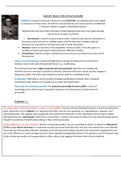
Eysenck’s theory of the criminal criminality
Definition: A feature of Eysenck’s theory of crime(1950s-60s), an individual who scores highly
on measures of extraversion, neuroticism and psychoticism and cannot easily be conditioned,
is cold and is likely to engage in offending behaviour.
Believed that each personality trait had an innate biological basis and come about through
type of nervous system we inherit.
Extraversion: related to cortical arousal levels. Extraverts seek external stimulation to
increase arousal, tend not to condition easily so do not learn from mistakes whereas
Introverts are naturally over-aroused and want to avoid stimulation.
Neurotic: relates to reactivity in the sympathetic nervous system. A neurotic person is
unstable and gets easily upset, making behaviour difficult to predict.
Psychoticism: related to higher testosterone levels-men are more likely to be at the end of
the spectrum.
Links to criminal behaviour: Eysenck thought that criminality developed from an interaction
between innate traits and environmental factors e.g., conditioning.
The criminal personality is high in neurotic-extravert-psychotic. Neurotics are unstable and
therefore prone to overreact to situations of threat. Extraverts seek more arousal and thus engage in
dangerous activity. Psychotics lack empathy so feel less guilt for committing crimes.
Socialisation: Offending is concerned with immediate gratification (criminals often impatient)
socialisation helps children to be taught how to delay their gratification.
Measuring the criminal personality: The Eysenck’s personality inventory (EPI) is a form of
psychological test which locates respondents along the P-E-N dimensions to determine their
personality.
Evaluation +/-:
This explanation of offending behaviour could be oversimplified. Eysenck reduced offending behaviour to just three dimensions
other researchers such as Digman et al. proposed that other traits are also important e.g., agreeableness, openness, and
conscientiousness. This suggests that an approach more holistic than Eysenck’s is more appropriate when trying to explain
offending behaviour. (Developed) Furthermore, Eysenck didn’t consider the timings of offences or how long offending persists,
though this would be of benefit when looking at ‘the criminal personality.
Cultural differences are not considered, but the ‘criminal personality’ may vary according to culture. As shown by Holanchock
(1979) studied African American in a maximum-security prison and found that they were less extroverted than a non-offender
control group, whereas these offenders should be more extroverted according to Eysenck. The researchers suggested this was
due to the difference in cultural background from those typically investigated by Eysenck. This questions how far Eysenck’s idea
of the criminal personality can be generalised to other cultures and suggests his theory holds cultural relativism.
Definition: A feature of Eysenck’s theory of crime(1950s-60s), an individual who scores highly
on measures of extraversion, neuroticism and psychoticism and cannot easily be conditioned,
is cold and is likely to engage in offending behaviour.
Believed that each personality trait had an innate biological basis and come about through
type of nervous system we inherit.
Extraversion: related to cortical arousal levels. Extraverts seek external stimulation to
increase arousal, tend not to condition easily so do not learn from mistakes whereas
Introverts are naturally over-aroused and want to avoid stimulation.
Neurotic: relates to reactivity in the sympathetic nervous system. A neurotic person is
unstable and gets easily upset, making behaviour difficult to predict.
Psychoticism: related to higher testosterone levels-men are more likely to be at the end of
the spectrum.
Links to criminal behaviour: Eysenck thought that criminality developed from an interaction
between innate traits and environmental factors e.g., conditioning.
The criminal personality is high in neurotic-extravert-psychotic. Neurotics are unstable and
therefore prone to overreact to situations of threat. Extraverts seek more arousal and thus engage in
dangerous activity. Psychotics lack empathy so feel less guilt for committing crimes.
Socialisation: Offending is concerned with immediate gratification (criminals often impatient)
socialisation helps children to be taught how to delay their gratification.
Measuring the criminal personality: The Eysenck’s personality inventory (EPI) is a form of
psychological test which locates respondents along the P-E-N dimensions to determine their
personality.
Evaluation +/-:
This explanation of offending behaviour could be oversimplified. Eysenck reduced offending behaviour to just three dimensions
other researchers such as Digman et al. proposed that other traits are also important e.g., agreeableness, openness, and
conscientiousness. This suggests that an approach more holistic than Eysenck’s is more appropriate when trying to explain
offending behaviour. (Developed) Furthermore, Eysenck didn’t consider the timings of offences or how long offending persists,
though this would be of benefit when looking at ‘the criminal personality.
Cultural differences are not considered, but the ‘criminal personality’ may vary according to culture. As shown by Holanchock
(1979) studied African American in a maximum-security prison and found that they were less extroverted than a non-offender
control group, whereas these offenders should be more extroverted according to Eysenck. The researchers suggested this was
due to the difference in cultural background from those typically investigated by Eysenck. This questions how far Eysenck’s idea
of the criminal personality can be generalised to other cultures and suggests his theory holds cultural relativism.