Endogeous pacemakers and exogenous zeitgebers
Endogenous pacemakers: Internal body clocks that regulate many of our biological rhythms such as
the influence of the SCN (One of the main EPs in mammalian life) on circadian rhythms such as
sleep/wake cycle.
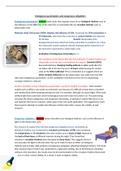
Relevant study- DeCoursey (2000): Displays the influence of SCN: Destroyed the SCN connections in
30 chipmunks, who were then returned to natural habitat and observed
for 80 days. Results: Sleep/wake cycle
disappeared and many died from being vulnerable to predators (at a time
the chipmunks would usually be asleep) Emphasising the importance of
the SCN when maintaining a sleep/wake cycle.
Evaluation of Endogenous Pacemakers (+/-)
One weakness of the theory that the SCN maintains circadian rhythms e.g.
sleep/wake cycle has been contradicted by research. Damiola (2002)
demonstrated how changing feeding patterns in mice could alter the
circadian cells in the liver by up to 12 hours whilst leaving the master
clock of the SCN unaffected. This is a limitation as it suggests there are
other complex influences on the sleep/wake cycle aside from the SCN
(the main endogenous pacemaker). So the credibility in the theory of the SCN in maintaining
circadian rhythms is reduced.
Another limitation is that endogenous pacemakers cannot be studied in isolation. Total isolation
studies such as Siffre’s cave study are extremely rare because it is difficult to keep them controlled
and standardised whilst keeping participants safe. For example, although no natural light, Siffre used
artificial light that could have reset his biological clock every time he turned it on. The point being,
everyday life shows endogenous and exogenous interacting, so perhaps it makes little sense to try
and separate the two for research, which gives it less real world application. This suggests the more
that research attempts to isolate the influence of their interaction, lowers the validity of said
research.
Exogenous zeitgebers: External factors that affect our biological rhythms, such as the influence of
light on the sleep/wake cycle.
Key research to support the role that exogenous zeitgebers has in controlling our
biological rhythms was conducted by Campbell and Murphy (1998) who monitored
the temperature of 15 volunteers who were woken up to a beam of light exposed to
the back of their knee at different intervals during the night. They found that
volunteer’s circadian rhythms were disrupted by three hours. This suggests that it is
not necessary for light to directly enter the eye in order to have an effect on biological
rhythms and provides solid evidence of exogenous zeitgebers affecting biological rhythms. This study
does however flaw in that it was conducted in a laboratory setting, due to this being an unfamiliar
setting to the volunteers, the results may not be representative of the circadian rhythms that would
occur in their natural setting. As a result, it lacks ecological validity.
Endogenous pacemakers: Internal body clocks that regulate many of our biological rhythms such as
the influence of the SCN (One of the main EPs in mammalian life) on circadian rhythms such as
sleep/wake cycle.
Relevant study- DeCoursey (2000): Displays the influence of SCN: Destroyed the SCN connections in
30 chipmunks, who were then returned to natural habitat and observed
for 80 days. Results: Sleep/wake cycle
disappeared and many died from being vulnerable to predators (at a time
the chipmunks would usually be asleep) Emphasising the importance of
the SCN when maintaining a sleep/wake cycle.
Evaluation of Endogenous Pacemakers (+/-)
One weakness of the theory that the SCN maintains circadian rhythms e.g.
sleep/wake cycle has been contradicted by research. Damiola (2002)
demonstrated how changing feeding patterns in mice could alter the
circadian cells in the liver by up to 12 hours whilst leaving the master
clock of the SCN unaffected. This is a limitation as it suggests there are
other complex influences on the sleep/wake cycle aside from the SCN
(the main endogenous pacemaker). So the credibility in the theory of the SCN in maintaining
circadian rhythms is reduced.
Another limitation is that endogenous pacemakers cannot be studied in isolation. Total isolation
studies such as Siffre’s cave study are extremely rare because it is difficult to keep them controlled
and standardised whilst keeping participants safe. For example, although no natural light, Siffre used
artificial light that could have reset his biological clock every time he turned it on. The point being,
everyday life shows endogenous and exogenous interacting, so perhaps it makes little sense to try
and separate the two for research, which gives it less real world application. This suggests the more
that research attempts to isolate the influence of their interaction, lowers the validity of said
research.
Exogenous zeitgebers: External factors that affect our biological rhythms, such as the influence of
light on the sleep/wake cycle.
Key research to support the role that exogenous zeitgebers has in controlling our
biological rhythms was conducted by Campbell and Murphy (1998) who monitored
the temperature of 15 volunteers who were woken up to a beam of light exposed to
the back of their knee at different intervals during the night. They found that
volunteer’s circadian rhythms were disrupted by three hours. This suggests that it is
not necessary for light to directly enter the eye in order to have an effect on biological
rhythms and provides solid evidence of exogenous zeitgebers affecting biological rhythms. This study
does however flaw in that it was conducted in a laboratory setting, due to this being an unfamiliar
setting to the volunteers, the results may not be representative of the circadian rhythms that would
occur in their natural setting. As a result, it lacks ecological validity.