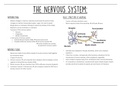
- Detects changes in internal / external environment & reacts to these - 3 parts: cell body, dendrites, axon
changes to maintain homeostasis (water, sugar, CO2 and O2 levels) - Nerve impulse travels from dendrites → cell body → axon.
- Brings about co-ordination (linking of systems & activities of the body).
- Reactions can be involuntary or voluntary
- Functions of the nervous system:
٭Sensory
٭Integrative
٭Motor (movement)
- 2 main parts of nervous system:
o Central Nervous System (CNS) → brain & spinal cord neurilemma
o Peripheral Nervous System (PNS) → all nerves outside CNS
→ further divided into somatic
& autonomic nervous system
٭ Cell body has cytoplasmic threads, dendrites, which carry impulses
- Nerves are made of nerve fibres (made of neurons) and are held together towards it.
by connective tissue. ٭ It also has a nucleus, nissl granules which produce substances for the
- 3 types of neurons: transmission of nerve impulses, other cytoplasmic organelles.
1. Sensory neurons → carry impulses from receptors (nerve endings or sense ٭ Axon conducts impulses away from cell body & ends in terminal branches.
organs) to Central Nervous System (CNS) ٭ It’s covered by 2 membranes: neurilemma & myelin sheath (myelin sheath
2. Motor neurons → carry impulses from CNS to effectors (muscles & glands) provides electrical insulation & speeds up transmission of impulses).
3. Connector neurons / interneurons → carry impulses inside the CNS from a
sensory neuron to motor neuron.
, hCENTRAL NERVOUS SYSTEM:
- Neurons are lined up so that axon terminals of one neuron lie next to
dendrites of another neuron with a synapse (microscopic gap) between
them → NOT IN DIRECT CONTACT!
- Nerve impulses are carried along the neuron by electrical impulses but - Upper, enlarged part of the spinal cord
communication across the synapse, synaptic contact, is done by means of - Protected by cranium and by a system of 3 membranes called meninges.
chemicals called neurotransmitters. - Inside are hollow cavities called ventricles, filled with cerebrospinal fluid.
- The brain gives rise to 12 pairs of nerves → cranial nerves.
- FUNCTIONS:
> Receives & interprets all sensations (sight, touch, hearing, taste,
smell)
> Controls higher thought processes (memory, judgement,
reasoning)
> Controls all voluntary actions & involuntary actions
> Co-ordinates voluntary movements
> Maintains muscle tone, balance & equilibrium
- 3 PARTS:
> Cerebrum
> Cerebellum
> Brain stem / lower brain
changes to maintain homeostasis (water, sugar, CO2 and O2 levels) - Nerve impulse travels from dendrites → cell body → axon.
- Brings about co-ordination (linking of systems & activities of the body).
- Reactions can be involuntary or voluntary
- Functions of the nervous system:
٭Sensory
٭Integrative
٭Motor (movement)
- 2 main parts of nervous system:
o Central Nervous System (CNS) → brain & spinal cord neurilemma
o Peripheral Nervous System (PNS) → all nerves outside CNS
→ further divided into somatic
& autonomic nervous system
٭ Cell body has cytoplasmic threads, dendrites, which carry impulses
- Nerves are made of nerve fibres (made of neurons) and are held together towards it.
by connective tissue. ٭ It also has a nucleus, nissl granules which produce substances for the
- 3 types of neurons: transmission of nerve impulses, other cytoplasmic organelles.
1. Sensory neurons → carry impulses from receptors (nerve endings or sense ٭ Axon conducts impulses away from cell body & ends in terminal branches.
organs) to Central Nervous System (CNS) ٭ It’s covered by 2 membranes: neurilemma & myelin sheath (myelin sheath
2. Motor neurons → carry impulses from CNS to effectors (muscles & glands) provides electrical insulation & speeds up transmission of impulses).
3. Connector neurons / interneurons → carry impulses inside the CNS from a
sensory neuron to motor neuron.
, hCENTRAL NERVOUS SYSTEM:
- Neurons are lined up so that axon terminals of one neuron lie next to
dendrites of another neuron with a synapse (microscopic gap) between
them → NOT IN DIRECT CONTACT!
- Nerve impulses are carried along the neuron by electrical impulses but - Upper, enlarged part of the spinal cord
communication across the synapse, synaptic contact, is done by means of - Protected by cranium and by a system of 3 membranes called meninges.
chemicals called neurotransmitters. - Inside are hollow cavities called ventricles, filled with cerebrospinal fluid.
- The brain gives rise to 12 pairs of nerves → cranial nerves.
- FUNCTIONS:
> Receives & interprets all sensations (sight, touch, hearing, taste,
smell)
> Controls higher thought processes (memory, judgement,
reasoning)
> Controls all voluntary actions & involuntary actions
> Co-ordinates voluntary movements
> Maintains muscle tone, balance & equilibrium
- 3 PARTS:
> Cerebrum
> Cerebellum
> Brain stem / lower brain