
Nurs 6550 Midterm-Psych Graded A
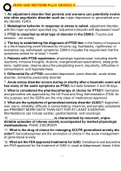
NURS 6550 MIDTERM-Psych GRADED A 1. An adjustment disorder that persists and worsens can potentially evolve into other psychiatric disorder such as: major depression or generalized anxi- ety disorder (GAD). 2. Maladaptive behavior in response to stress is called: adjustment disorder, with the major symptom specified (eg, "adjustment disorder with depressed mood" 3. PTSD is classified as what type of disorder in the DSM-5: Trauma and stressor - not anxiety 4. The key to establishing the diagnosis of PTSD lies: in the history of exposure to a life-threatening event followed by intrusive (eg, flashbacks, nightmares) or avoidance (eg, withdrawal) symptoms. DSM-5 includes the requirement that the symptoms persist for at least 1 month. 5. Patients with PTSD experience: physiologic hyperarousal, including startle reactions, intrusive thoughts, illusions, overgeneralized associations, sleep prob- lems, nightmares, dreams about the precipitating event, impulsivity, difficulties in concentration, and hyperalertness. 6. Differential Dx of PTSD: comorbid depression, panic disorder, acute stress disorder, borderline personality disorder 7. Acute stress disorder occurs during or shortly after a traumatic event and has many of the same symptoms as PTSD: but lasts between 2 and 28 days. 8. What is considered the pharmacotherapy of choice for PTSD?: Sertraline and paroxetine are approved by the US Food and Drug Administration (FDA) for this purpose, and the SSRIs are the only class of medications approved 9. What are the symptoms of generalized anxiety disorder (GAD)?: Apprehen- sion, worry, irritability, difficulty in concentrating, insomnia, and somatic complaints are PRESENT MORE DAYS THAN NOT FOR AT LEAST 6 MONTHS. Manifestations can include cardiac, gastrointestinal, and neurologic 10. is characterized by recurrent, unpre- dictable episodes of intense anxiety accompanied by marked physiologic manifestations: PANIC DISORDER 11. What is the drug of choice for managing ACUTE generalized anxiety dis- order?: benzodiazepines are the anxiolytics of choice in the acute management of generalized anxiety 12. What are the FDA approved treatments for GAD: Venlafaxine and duloxetine are FDA-approved for the treatment of GAD in usual antidepressant doses. Initial daily dosing should start low (37.5-75 mg for venlafaxine and 30 mg for duloxetine) and be titrated upward as needed. SSRIs, such as paroxetine, are also used. 13. has no clear usefulness in the treatment of anxiety dis- orders.: Bupropion (pg. 14. SSRIs, that are approved for the treatment of panic disorder.: fluoxetine, paroxetine, and sertraline 15. The SNRI that is FDA approved for treatment of panic disorder.: venlafax- ine 16. OD of benzo's are: Overdosage results in respiratory depression, hypoten- sion, shock syndrome, coma, and death 17. What are the side effects of high dose benzodiazepines?: sedation & disinhibition, ataxia, dysarthria, nystagmus, and delirium. 18. Reversal of benzo OD (benzodiazepine antagonist): Flumazenil 19. Classification of low-mod benzo use: somatic , psychological & perceptual 20. Panic disorder drug of choice: SSRIs sertraline, paroxetine, and fluoxetine. In addition, the SNRI venlafaxine is approved by the FDA 21. Phobic disorder tx: SSRIs & SNRIs 22. Both GAD, panic disorder & phobias appear to respond as well to therapy as they do to medications.: cognitive behavioral 23. What are some behavioral techniques for GAD and panic disorder?: Re- laxation, desensitization, emotive imagery 24. What is a TCA that is used in combination with SSRIs for Tx of OCD: - clomipramine ..and in low dose adjunct to SSRIs 25. What is the hallmark of SOMATIC SYMPTOM DISORDERS?: 1. Physical symptoms may i
Document information
- Uploaded on
- October 24, 2022
- Number of pages
- 18
- Written in
- 2022/2023
- Type
- Exam (elaborations)
- Contains
- Questions & answers


