Written by students who passed Immediately available after payment Read online or as PDF Wrong document? Swap it for free 4.6 TrustPilot
logo-home
Document preview thumbnail
Preview 3 out of 26 pages
Summary

Summary Comparative Analysis of Political Systems Notes on *SOME* Readings - GRADE 6,0

Document preview thumbnail
Preview 3 out of 26 pages

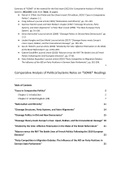
Summary of *SOME* of the material for the final exam (2022) for Comparative Analysis of Political Systems. INCLUDES notes from (Total: 26 pages): Patrick H. O’Neil, Karl Fields and Don Share’s book (7th edition, 2020) “Cases in Comparative Politics”, chapters 1-2. Craig Calhoun’s journal article (1993) “Nationalism and Ethnicity”, pp. 211-239. Seymour Martin Lipset and Stein Rokkan’s chapter (1967) “Cleavage Structures, Party Systems, and Voter Alignments” in Peter Mair’s book (1990) “The West European Party System”, pp. 91-138. Simon Bornschier’s journal article (2009) “Cleavage Politics in Old and New Democracies”, pp. 1-13. Liesbet Hooghe and Gary Marks’ journal article (2017) “Cleavage theory meets Europe’s crises: Lipset, Rokkan, and the transnational cleavage”, pp. 109-135. Sara B. Hobolt’s journal article (2020) “Divided by the Vote: Affective Polarisation in the Wake of the Brexit Referendum”, pp. . Gabriel Goodliffe’s journal article (2020) “Macron versus the RN? The Battle Lines of French Politics Following the 2019 European Elections”, pp. 57-68. Dana Siobhan Atzpodien’s journal article (2020) “Party Competition in Migration Debates: The Influence of the AfD on Party Positions in German State Parliaments”, pp. 381-398.

Content preview

Summary of *SOME* of the material for the final exam (2022) for Comparative Analysis of Political
Systems. INCLUDES notes from (Total: 26 pages):
● Patrick H. O’Neil, Karl Fields and Don Share’s book (7th edition, 2020) “Cases in Comparative
Politics”, chapters 1-2.
● Craig Calhoun’s journal article (1993) “Nationalism and Ethnicity”, pp. 211-239.
● Seymour Martin Lipset and Stein Rokkan’s chapter (1967) “Cleavage Structures, Party
Systems, and Voter Alignments” in Peter Mair’s book (1990) “The West European Party
System”, pp. 91-138.
● Simon Bornschier’s journal article (2009) “Cleavage Politics in Old and New Democracies”, pp.
1-13.
● Liesbet Hooghe and Gary Marks’ journal article (2017) “Cleavage theory meets Europe’s
crises: Lipset, Rokkan, and the transnational cleavage”, pp. 109-135.
● Sara B. Hobolt’s journal article (2020) “Divided by the Vote: Affective Polarisation in the Wake
of the Brexit Referendum”, pp. 1476-1493.
● Gabriel Goodliffe’s journal article (2020) “Macron versus the RN? The Battle Lines of French
Politics Following the 2019 European Elections”, pp. 57-68.
● Dana Siobhan Atzpodien’s journal article (2020) “Party Competition in Migration Debates:
The Influence of the AfD on Party Positions in German State Parliaments”, pp. 381-398.
1


Comparative Analysis of Political Systems Notes on *SOME* Readings


Table of Contents

“Cases in Comparative Politics” 2
Chapter 1: Introduction 2
Chapter 2: United Kingdom (UK) 7

“Nationalism and Ethnicity” 11

“Cleavage Structures, Party Systems, and Voter Alignments” 14

“Cleavage Politics in Old and New Democracies” 15

“Cleavage theory meets Europe’s crises: Lipset, Rokkan, and the transnational cleavage” 18

“Divided by the Vote: Affective Polarisation in the Wake of the Brexit Referendum” 21

“Macron versus the RN? The Battle Lines of French Politics Following the 2019 European
Elections” 23

“Party Competition in Migration Debates: The Influence of the AfD on Party Positions in
German State Parliaments” 25

, 2


“Cases in Comparative Politics”

Chapter 1: Introduction
What is Comparative Politics?
Comparative Politics: The study + comparison of politics across countries.

States
States: National organisation that maintains a monopoly of violence over a territory (narrower than a
country). Wide differences in:
● Ability to preserve their sovereignty/function of maintaining law + order:
➔ Strong = perform basic tasks of border + authority defence from external/internal
rivals.
➔ Weak = struggle to carry out basic tasks against rivals.
➔ Failed = have a complete loss of legitimacy/power, overwhelmed by anarchy +
violence.
● Degree to centralise/diapers political power.
➔ Unitary = concentrate most political power in the national capital.
➔ Federal = power is divided between the central state + regional/local authorities.
◆ Devolution: Process by which central states hand down power to lower levels
of government.

Country: Encompasses the territory + people living within a state.

Government: Leadership/elite that administers the state.

Legitimacy: Extent in which the state is obeyed due to tradition.
● Traditional = due to a long tradition of being obeyed.
● Charismatic = based on a state’s identification with an important individual.
● Rational-legal = based on laws/procedures that become highly institutionalised.

Regimes
Political Regimes: Norms/rules regarding individual freedom/collective equality, locus of power, use
of power. Types include:

1. Democratic = emphasise a large role for the public in governance (protect basic rights). Political
institutions:
● Executive = carries out a state’s laws + policies.
● Head of state = individual who symbolises/represents the people (nationally +
internationally) embodying and articulating the regime’s goals.
● Head of government = individual dealing with the everyday tasks of running the state.
● Legislature = formally charged with making laws.
➔ Unicameral = 1 chamber.
➔ Bicameral = 2 chambers consisting of population representation (lower house) +
chamber reflecting certain geographic subunits (upper house).

, 3


● Judiciary = concerned with dispensing justice.
➔ Constitutional Court: Highest judicial body ruling on the constitutionality of laws +
other government actions, formally oversees the entire judicial structure.
➔ Judicial Review: Court can review laws/policies + overturn those that are seen as
violations of the state’s constitution. 2 types:
◆ Concrete = allows the high court to rule on constitutional issues ONLY on the
basis of disputes brought before it.
◆ Abstract = allows courts to decide on questions that do NOT arise from
actual legal cases.
● Electoral system = system that determines how votes are cast and counted
➔ Proportional Representation (PR): % of votes a party receives in a district determines
how many of that district’s seats the party will win. Relies on MMDs (better = more
democratic, waste fewer votes, foster multiple parties, wider range of interest).
◆ Multimember Districts (MMDs): Districts in which more than 1 legislative
seat is contested.
➔ Single-Member Districts (SMDs): Districts in which there is only 1 representative for
each constituency = ‘winner takes all’ (worse = tends to discriminate against small
parties, better = eliminated extremist parties, produces more stable majorities).
➔ Mixed Electoral System: Combines single-member districts + PR.


3 models of legislative-executive relations in democratic regimes:
1. Parliamentary System: Features an executive head of
government (prime minister) who is typically elected from
within the legislature.
➔ Cabinet: The chief government ministers in charge
of policy areas.
➔ Vote of No Confidence: Legislative check on
government where a government deems a
measure to be of high importance, if that measure
fails to pass the legislature, the government must
resign in favour of another leader or new
parliamentary elections must be called =
flexibility.

➔ Coalition Governments: Negotiation/compromise between political parties, often resolving
political deadlocks.
◆ Parliamentary systems with a strong majority can produce unchecked, dominant
governments.
◆ In factitious legislation, difficulty may arise in creating a majority government =
instability.

Connected book
 image
Patrick H. O`Neil, Karl J. Fields Cases in Comparative Politics
Publisher: Unknown ISBN: 9780393624595 Edition: Unknown

Document information

Study
Summarized whole book?
No
Which chapters are summarized?
Chapters 1 and 2.
Uploaded on
October 19, 2022
File latest updated on
October 27, 2022
Number of pages
26
Written in
2022/2023
Type
Summary
$10.15

Wrong document? Swap it for free Within 14 days of purchase and before downloading, you can choose a different document. You can simply spend the amount again.
Written by students who passed
Immediately available after payment
Read online or as PDF

Seller avatar
Reputation scores are based on the amount of documents a seller has sold for a fee and the reviews they have received for those documents. There are three levels: Bronze, Silver and Gold. The better the reputation, the more your can rely on the quality of the sellers work.
giacomoef
4.6
(142)
Sold
941
Followers
285
Items
82
Last sold
1 month ago


Why students choose Stuvia

Created by fellow students, verified by reviews

Quality you can trust: written by students who passed their tests and reviewed by others who've used these notes.

Didn't get what you expected? Choose another document

No worries! You can instantly pick a different document that better fits what you're looking for.

Pay as you like, start learning right away

No subscription, no commitments. Pay the way you're used to via credit card and download your PDF document instantly.

Student with book image

“Bought, downloaded, and aced it. It really can be that simple.”

Alisha Student

Working on your references?

Create accurate citations in APA, MLA and Harvard with our free citation generator.

Working on your references?

Frequently asked questions