

Evolution
1. INTRODUCTION:
• Evolution:
✓ Evolution is the gradual change or development of something.
• Biological evolution:
✓ Any genetic change in a population that is inherited over several generations.
• Hypothesis:
✓ A hypothesis is a possible solution to a problem.
• Theory:
✓ A theory is an explanation of something that has been observed in nature which can
be supported by facts, generalisations, tested hypotheses, models, and laws.
2. EVIDENCE OF EVOLUTION:
• Fossil record:
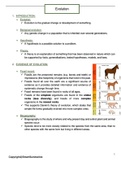
✓ Fossils are the preserved remains (e.g. bones and teeth) or
impressions (like footprints) of organisms that lived in the past.
✓ Fossils found all over the earth are a significant source of
evidence as it provides detailed information and evidence of
systematic change through time.
✓ Fossil remains have been found in rocks of all ages.
✓ Fossils of the simplest organisms are found in the oldest
rocks (less diversity), and fossils of more complex
organisms in the newest rocks.
✓ This supports Darwin's theory of evolution, which states that
simple life forms gradually evolved into more complex ones.
• Biogeography:
✓ Biogeography is the study of where and why present day and extinct plant and animal
species occur.
✓ Species tend to be more closely related to the species from the same area, than to
other species with the same form but living in different areas.
1
Copyright@SmartSummaries
, • Modification by descent:
✓ Modification by descent deals with similarities and differences in the anatomy of
different species.
✓ Organisms that develop from a common ancestor should have certain characteristics
in common.
✓ Organisms with the same ancestor have the same anatomical plan (pentdactyl limbs).
But they are different due to divergent evolution.
1: Pentdactyl limbs
• Genetics:
✓ One of the strongest pieces of evidence for common descent comes from gene
sequences.
✓ This evidence is used to indicate how closely organisms are related.
✓ Scientists state that organisms are closely related and are likely to have a common
ancestor if they have:
➢ Identical DNA structure
➢ Similar sequence of genes
➢ Similar portions of DNA with no functions and
➢ Similar mutations (mitochondrial DNA)
✓ Species that are closely related have a greater similarity to each other than distant
species.
3. VARIATION
• Population:
✓ A group of organisms of the same species living in the same habitat at the same
time.
• Biological species:
✓ A group of organisms which can interbreed to produce fertile offspring.
2
Copyright@SmartSummaries
, • Sources of variation: (CRRRM)
✓ Meiosis:
➢ Crossing over:
▪ When homologous chromosomes form pairs during
prophase I of meiosis I, crossing-over can occur.
▪ Which leads to new combinations of maternal and
paternal genetic material in each new cell.
➢ Random arrangements of chromosomes:
▪ The random arrangement of chromosomes during metaphase results in
gametes with a unique combination of alleles.
▪ At the equator during metaphase allows different combinations of
chromosomes/chromatids to go into each new cell resulting from meiosis,
making them different.
✓ Random fertilisation:
▪ Any sperm cell stands a chance of fertilising any ovum.
▪ Random fertilization between different ovum and different sperm cells formed by
meiosis result in offspring that are different from each other.
✓ Random mating:
▪ Mating takes place randomly within species.
▪ Random mating between organisms within a species leads to a
different set of offspring from each mating pair.
✓ Mutations:
▪ A mutation changes the structure of a gene or chromosome and therefore, the
organism’s genotype changes too.
▪ Since the genotype influences the phenotype, it creates organisms with new,
different characteristics from one generation to the next.
▪ Mutations could be harmless, harmful, or beneficial.
3
Copyright@SmartSummaries
1. INTRODUCTION:
• Evolution:
✓ Evolution is the gradual change or development of something.
• Biological evolution:
✓ Any genetic change in a population that is inherited over several generations.
• Hypothesis:
✓ A hypothesis is a possible solution to a problem.
• Theory:
✓ A theory is an explanation of something that has been observed in nature which can
be supported by facts, generalisations, tested hypotheses, models, and laws.
2. EVIDENCE OF EVOLUTION:
• Fossil record:
✓ Fossils are the preserved remains (e.g. bones and teeth) or
impressions (like footprints) of organisms that lived in the past.
✓ Fossils found all over the earth are a significant source of
evidence as it provides detailed information and evidence of
systematic change through time.
✓ Fossil remains have been found in rocks of all ages.
✓ Fossils of the simplest organisms are found in the oldest
rocks (less diversity), and fossils of more complex
organisms in the newest rocks.
✓ This supports Darwin's theory of evolution, which states that
simple life forms gradually evolved into more complex ones.
• Biogeography:
✓ Biogeography is the study of where and why present day and extinct plant and animal
species occur.
✓ Species tend to be more closely related to the species from the same area, than to
other species with the same form but living in different areas.
1
Copyright@SmartSummaries
, • Modification by descent:
✓ Modification by descent deals with similarities and differences in the anatomy of
different species.
✓ Organisms that develop from a common ancestor should have certain characteristics
in common.
✓ Organisms with the same ancestor have the same anatomical plan (pentdactyl limbs).
But they are different due to divergent evolution.
1: Pentdactyl limbs
• Genetics:
✓ One of the strongest pieces of evidence for common descent comes from gene
sequences.
✓ This evidence is used to indicate how closely organisms are related.
✓ Scientists state that organisms are closely related and are likely to have a common
ancestor if they have:
➢ Identical DNA structure
➢ Similar sequence of genes
➢ Similar portions of DNA with no functions and
➢ Similar mutations (mitochondrial DNA)
✓ Species that are closely related have a greater similarity to each other than distant
species.
3. VARIATION
• Population:
✓ A group of organisms of the same species living in the same habitat at the same
time.
• Biological species:
✓ A group of organisms which can interbreed to produce fertile offspring.
2
Copyright@SmartSummaries
, • Sources of variation: (CRRRM)
✓ Meiosis:
➢ Crossing over:
▪ When homologous chromosomes form pairs during
prophase I of meiosis I, crossing-over can occur.
▪ Which leads to new combinations of maternal and
paternal genetic material in each new cell.
➢ Random arrangements of chromosomes:
▪ The random arrangement of chromosomes during metaphase results in
gametes with a unique combination of alleles.
▪ At the equator during metaphase allows different combinations of
chromosomes/chromatids to go into each new cell resulting from meiosis,
making them different.
✓ Random fertilisation:
▪ Any sperm cell stands a chance of fertilising any ovum.
▪ Random fertilization between different ovum and different sperm cells formed by
meiosis result in offspring that are different from each other.
✓ Random mating:
▪ Mating takes place randomly within species.
▪ Random mating between organisms within a species leads to a
different set of offspring from each mating pair.
✓ Mutations:
▪ A mutation changes the structure of a gene or chromosome and therefore, the
organism’s genotype changes too.
▪ Since the genotype influences the phenotype, it creates organisms with new,
different characteristics from one generation to the next.
▪ Mutations could be harmless, harmful, or beneficial.
3
Copyright@SmartSummaries



