Stuvia.com - The Marketplace to Buy and Sell your Study Material
RNSG 2301 HESI Case Study – Postpartum.
Downloaded by: Kayyh |
Distribution of this document is illegal
, Stuvia.com - The Marketplace to Buy and Sell your Study Material
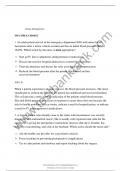
HESI Case Study – Postpartum
Prior to discontinuing the IV oxytocin (Pitocin), which assessment is most important for the
nurse to obtain?
C) Uterine firmness.
Hormone used to stimulate uterine contractions and prevent hemorrhage from the placental
site.
Mari has minimal sensation in her lower extremities, die to the effects of the epidural
anesthesia. What is the priority nursing diagnosis for Mari, who is experiencing residual effects
of epidural anesthesia?
A) Risk for injury.
Causes temporary loss of voluntary movement and muscle strength in the lower extremities.
m
Serious injury could be incurred if Mari attempts to get out of bed on her own because her legs
er as
will be unable to sustain her weight.
co
eH w
What is the priority nursing actions to address Mari's needs related to the repair of her 4th
o.
degree perineal laceration?
rs e
C) Apply perineal ice packs consistently for the first 24 to 48 hours.
ou urc
Cause local vasoconstriction, resulting in decreased swelling and tissue congestion, preventing a
hematoma, as well as prmoting comfort. Application of ice packs is the priority nursing action
o
for the first 24 to 48 hours, which is the period that the tissue is most vulnerable to swelling
aC s
resulting from the trauma. A hematoma formation could contribute to hypovolemia and needs
vi y re
to be prevented.
The nurse performs the first assessment upon arrival to the postpartum unit. Where would the
ed d
nurse expect to palpate the fundus?
ar stu
D) 1 cm above the umbilicus.
For the first 12 hours, the fundus should be 1 to 2 cm above the umbilicus.
is
Which action is most important for the nurse to implement immediately?
Th
A) Massage the fundus.
Since a boggy fundus is the ost likely reason for this client's hemorrhaging, massaging the
sh
fundus is the most important intervention. The nurse should also call for assistance die to the
amount of blood that has pooled unde the client.
This study source was downloaded by 100000826342158 from CourseHero.com on 10-07-2021 14:56:43 GMT -05:00
https://www.coursehero.com/file/29884151/HESI-Case-Study-Postpartumdocx/
Downloaded by: Kayyh |
Distribution of this document is illegal
RNSG 2301 HESI Case Study – Postpartum.
Downloaded by: Kayyh |
Distribution of this document is illegal
, Stuvia.com - The Marketplace to Buy and Sell your Study Material
HESI Case Study – Postpartum
Prior to discontinuing the IV oxytocin (Pitocin), which assessment is most important for the
nurse to obtain?
C) Uterine firmness.
Hormone used to stimulate uterine contractions and prevent hemorrhage from the placental
site.
Mari has minimal sensation in her lower extremities, die to the effects of the epidural
anesthesia. What is the priority nursing diagnosis for Mari, who is experiencing residual effects
of epidural anesthesia?
A) Risk for injury.
Causes temporary loss of voluntary movement and muscle strength in the lower extremities.
m
Serious injury could be incurred if Mari attempts to get out of bed on her own because her legs
er as
will be unable to sustain her weight.
co
eH w
What is the priority nursing actions to address Mari's needs related to the repair of her 4th
o.
degree perineal laceration?
rs e
C) Apply perineal ice packs consistently for the first 24 to 48 hours.
ou urc
Cause local vasoconstriction, resulting in decreased swelling and tissue congestion, preventing a
hematoma, as well as prmoting comfort. Application of ice packs is the priority nursing action
o
for the first 24 to 48 hours, which is the period that the tissue is most vulnerable to swelling
aC s
resulting from the trauma. A hematoma formation could contribute to hypovolemia and needs
vi y re
to be prevented.
The nurse performs the first assessment upon arrival to the postpartum unit. Where would the
ed d
nurse expect to palpate the fundus?
ar stu
D) 1 cm above the umbilicus.
For the first 12 hours, the fundus should be 1 to 2 cm above the umbilicus.
is
Which action is most important for the nurse to implement immediately?
Th
A) Massage the fundus.
Since a boggy fundus is the ost likely reason for this client's hemorrhaging, massaging the
sh
fundus is the most important intervention. The nurse should also call for assistance die to the
amount of blood that has pooled unde the client.
This study source was downloaded by 100000826342158 from CourseHero.com on 10-07-2021 14:56:43 GMT -05:00
https://www.coursehero.com/file/29884151/HESI-Case-Study-Postpartumdocx/
Downloaded by: Kayyh |
Distribution of this document is illegal