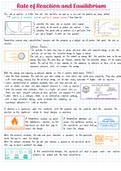
Rate of Reaction and Eauilibrium
The rateofreaction is eitherhowfastthe reactants areusedup orhowfasttheproducts arebeingformed
quantity of reactants usedor quantityof productsformed timetaken s
To calculatethemean rateofreactionfrom agraph
yousimplydotheamountofproductandreactant time
Tocalculatetheactualrateofreaction at aparticulartime
youusea tangent toworkoutthegradient
Temperature surfacearea concentration pressureand thepresence of acatalystareallfactors thataffecttherateof
reaction
Collision Theory
particleswillnothavethe activationenergytotrigger areaction
Therateofa reaction depends on theamountofenergythat theparticleshave asthemo
energytheyhavethemoretheycantransfermeaningthattheactivation energy willbereache
faster Aswellasthis italsodepends on thefrequency of collisions asthere willbemore
Boththeenergy andfrequencyofcollisions depends on the4 factorslistedabove topsc
whenthetempincreases theparticlesgainmoreenergy so movefasterandcollidemorefrequently Theyalsocollide
withmoreenergy meaningthattheactivationenergy canbemoreeasilyovercome higher rate ofreaction
when concentrationor pressureincreasesthere aremoreparticlesper
unitof volume sothere aremorefrequentcollisions rateofreaction
whenthesurfaceareaincreases there is a higher sa volume ratio so
there aremore frequent collisionsasmore particles are exposed t rate
when there is a catalyst there is an alternativereactionpathway
with a loweractivation energy which increasesthe frequency of
successfulcollisions t rateofreaction
A reaction is in equilibrium whenthe reactants formtheproductsand theproductsformthe reactants The
position ofthe equilibrium shifts to resistchanges in conditions
A temperature increase willfavour Atemperature decrease will
theendothermic reaction sothe favourtheexothermic reaction so
eavilibriumwillshiftthat wayto theeavilibrium willshiftthatway
resistthechange to resistthe change
When thepressureincreases thesidewithfewermolecules is favoured sotheequilibrium
shifts thatwayto resistthechange
Whenthepressure decreasesthesidewithmoremolecules is favoured sotheequilibriumshifts
thatwaytoresist counteractthechange
Ifthe concentrationchanges the concentration
equilibriumwill shifttofavour which ever reaction
produces the productwith thelower
, ATOMS: ELEMENTS:
Atoms have a radius of 0.1 nanometers (1x10^-10m) An element consists of atoms with the same atomic
number (proton number)
The nucleus is in the middle of the atom. and contains
protons and neutrons. It has a positive charge and its Isotopes are different forms of the same element, so have
mass is concentrated at the centre. the same number of protons, but a different number of
neutrons.
The electrons move around the nucleus in shells, are • Therefore they have the same atomic number but
negatively charged and have virtually mo mass different mass numbers
• E.g. Carbon-12 and Carbon-13
• Atoms have the same number of electrons and
protons Relative atomic mass (Ar) of an element = sum of
• An ion however has different number, giving them an (isotope abundance x isotope mass number) / sum of
overall charge abundances of all isotopes
• The atomic number tells you the number of protons • Abundance is as a percentage
• The mass number tells you the total number of
protons and neutrons
COMPOUNDS: MIXTURES AND CHROMATOGRAPHY:
When elements react, atoms combine with other atoms Unlike compounds, mixtures can be separated very
to form compounds easily as there are no chemical bonds between the
• The compounds are held together with chemical different parts of the mixture
bonds and making these bonds involves, giving,
taking or sharing electrons • Therefore, physical methods can be used to separate
• A chemical reaction is needed to separate the original a mixture, such as filtration, distillation and
elements from the compound chromatography
• The properties of compounds are usually totally
different from the properties of the individual elements An example of a mixture is air, which is a mixture of
A formula shows what atoms are in a compound. The gases including oxygen, hydrogen, nitrogen and more
formula is made up of element symbols.
• Some examples of formulas are: • Unlike compounds, the properties of mixtures are just
• NaCl = sodium chloride the combined properties of the individual parts
• HCl = Hydrochloric acid • E.g. the properties of a mixture of iron powder and
• Na CO = Sodium Carbonate sulphur powder, will convey the properties of both iron
as and sulphur
FRACTIONAL DISTILLATION: HISTORY OF THE ATOM:
A mixture of liquids can be separated using fractional John Dalton (start of 19th century) = atoms solid
distillation. The stages of this process when done in a lab spheres made of different elements
are:
1. Pour your mixture into a flask and attach a JJ Thompson (1987) = positively charge ball with
fractionating column to it negative electrons (plum pudding)
2. Heat the flask
3. The different liquids in the mixture will have different Ernest Rutherford (1909) = alpha particle scattering
boiling points, so will evaporate at different experiment, most went straight through (empty space),
temperatures some deflected at angle (electrons scattered), some
4. The liquid with the lowest boiling point will evaporate deflected straight back (concentrated at centre - nucleus)
first and be released at the top of the column
5. This will then pass through a condenser to form back Niel Bohr = electrons orbited in shells, which were each
into a liquid state for collection a fixed distance from the nucleus
6. Once the first liquid is collected, increase the
temperature until the next fraction reaches the top Later, Rutherford found protons & James Chadwick
discovered neutrons; creating the nuclear model
The rateofreaction is eitherhowfastthe reactants areusedup orhowfasttheproducts arebeingformed
quantity of reactants usedor quantityof productsformed timetaken s
To calculatethemean rateofreactionfrom agraph
yousimplydotheamountofproductandreactant time
Tocalculatetheactualrateofreaction at aparticulartime
youusea tangent toworkoutthegradient
Temperature surfacearea concentration pressureand thepresence of acatalystareallfactors thataffecttherateof
reaction
Collision Theory
particleswillnothavethe activationenergytotrigger areaction
Therateofa reaction depends on theamountofenergythat theparticleshave asthemo
energytheyhavethemoretheycantransfermeaningthattheactivation energy willbereache
faster Aswellasthis italsodepends on thefrequency of collisions asthere willbemore
Boththeenergy andfrequencyofcollisions depends on the4 factorslistedabove topsc
whenthetempincreases theparticlesgainmoreenergy so movefasterandcollidemorefrequently Theyalsocollide
withmoreenergy meaningthattheactivationenergy canbemoreeasilyovercome higher rate ofreaction
when concentrationor pressureincreasesthere aremoreparticlesper
unitof volume sothere aremorefrequentcollisions rateofreaction
whenthesurfaceareaincreases there is a higher sa volume ratio so
there aremore frequent collisionsasmore particles are exposed t rate
when there is a catalyst there is an alternativereactionpathway
with a loweractivation energy which increasesthe frequency of
successfulcollisions t rateofreaction
A reaction is in equilibrium whenthe reactants formtheproductsand theproductsformthe reactants The
position ofthe equilibrium shifts to resistchanges in conditions
A temperature increase willfavour Atemperature decrease will
theendothermic reaction sothe favourtheexothermic reaction so
eavilibriumwillshiftthat wayto theeavilibrium willshiftthatway
resistthechange to resistthe change
When thepressureincreases thesidewithfewermolecules is favoured sotheequilibrium
shifts thatwayto resistthechange
Whenthepressure decreasesthesidewithmoremolecules is favoured sotheequilibriumshifts
thatwaytoresist counteractthechange
Ifthe concentrationchanges the concentration
equilibriumwill shifttofavour which ever reaction
produces the productwith thelower
, ATOMS: ELEMENTS:
Atoms have a radius of 0.1 nanometers (1x10^-10m) An element consists of atoms with the same atomic
number (proton number)
The nucleus is in the middle of the atom. and contains
protons and neutrons. It has a positive charge and its Isotopes are different forms of the same element, so have
mass is concentrated at the centre. the same number of protons, but a different number of
neutrons.
The electrons move around the nucleus in shells, are • Therefore they have the same atomic number but
negatively charged and have virtually mo mass different mass numbers
• E.g. Carbon-12 and Carbon-13
• Atoms have the same number of electrons and
protons Relative atomic mass (Ar) of an element = sum of
• An ion however has different number, giving them an (isotope abundance x isotope mass number) / sum of
overall charge abundances of all isotopes
• The atomic number tells you the number of protons • Abundance is as a percentage
• The mass number tells you the total number of
protons and neutrons
COMPOUNDS: MIXTURES AND CHROMATOGRAPHY:
When elements react, atoms combine with other atoms Unlike compounds, mixtures can be separated very
to form compounds easily as there are no chemical bonds between the
• The compounds are held together with chemical different parts of the mixture
bonds and making these bonds involves, giving,
taking or sharing electrons • Therefore, physical methods can be used to separate
• A chemical reaction is needed to separate the original a mixture, such as filtration, distillation and
elements from the compound chromatography
• The properties of compounds are usually totally
different from the properties of the individual elements An example of a mixture is air, which is a mixture of
A formula shows what atoms are in a compound. The gases including oxygen, hydrogen, nitrogen and more
formula is made up of element symbols.
• Some examples of formulas are: • Unlike compounds, the properties of mixtures are just
• NaCl = sodium chloride the combined properties of the individual parts
• HCl = Hydrochloric acid • E.g. the properties of a mixture of iron powder and
• Na CO = Sodium Carbonate sulphur powder, will convey the properties of both iron
as and sulphur
FRACTIONAL DISTILLATION: HISTORY OF THE ATOM:
A mixture of liquids can be separated using fractional John Dalton (start of 19th century) = atoms solid
distillation. The stages of this process when done in a lab spheres made of different elements
are:
1. Pour your mixture into a flask and attach a JJ Thompson (1987) = positively charge ball with
fractionating column to it negative electrons (plum pudding)
2. Heat the flask
3. The different liquids in the mixture will have different Ernest Rutherford (1909) = alpha particle scattering
boiling points, so will evaporate at different experiment, most went straight through (empty space),
temperatures some deflected at angle (electrons scattered), some
4. The liquid with the lowest boiling point will evaporate deflected straight back (concentrated at centre - nucleus)
first and be released at the top of the column
5. This will then pass through a condenser to form back Niel Bohr = electrons orbited in shells, which were each
into a liquid state for collection a fixed distance from the nucleus
6. Once the first liquid is collected, increase the
temperature until the next fraction reaches the top Later, Rutherford found protons & James Chadwick
discovered neutrons; creating the nuclear model