
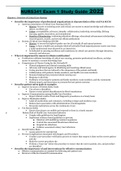
NURS341 Exam 1 Study Guide
Chapter 1: Overview of Critical Care Nursing ▪ Describe the importance of professional organizations & characteristics of the AACN & SCCM o American Association of Critical-Care Nursing (AACN) ▪ Mission: focuses on assisting acute and critical care nurses to attain knowledge and influence to deliver excellent care ▪ Values: accountability, advocacy, integrity, collaboration, leadership, stewardship, lifelong learning, quality, innovation, and commitment ▪ Benefits of Membership: continuing education offerings, educational advancement scholarships, research grants, awards, and several official publications o Society of Critical Care Medicine (SCCM) ▪ Mission: to secure the highest-quality care for all critically ill and injured patients ▪ Vision: to have a health care systemin which all critically ill and injured persons receive care from a multi-professional team directed by an intensivist. ▪ Is dedicated to ensuring excellence and consistency in critical care practice through education, research, and advocacy ▪ Why is it important for nurses to obtain certification? o Certification validates knowledge of critical care nursing, promotes professional excellence, an helps nurses to maintain a current knowledge base o Competencies of Nurses Caring for the Critically Ill ▪ Clinical judgement and clinical reasoning skills ▪ Advocacy and moral agency in identifying and resolving ethical issues ▪ Caring practices that are tailored to the uniqueness of the patient and family ▪ Collaboration with patients, family members, and health care team members ▪ Systems thinking that promotes holistic nursing care ▪ Response to diversity ▪ Facilitator of learning for patients and family members, team members, and the community ▪ Clinical inquiry and innovation to promote the best patient outcome ▪ Describe patient safety goals & examples o Improve Accuracy of Patient Safety Goals ▪ Use at least 2 identifiers ▪ Ensure correct patient identification for blood transfusions o Improve Communication among Health Care Providers ▪ Report clinical results of tests and diagnostic procedures on a timely basis o Improve Medication Safety ▪ Label all medications and containers, including syringes and medicine cups ▪ Reduce harm association with administration of anticoagulants ▪ Reconcile medications across the continuum of care o Use Alarms Safely ▪ Ensure that alarms are audible and respond to them in a timely manner o Reduce Risk of Health Care-Associated Infection ▪ Comply with guidelines for hand hygiene ▪ Implement evidence-based guidelines to prevent: ● Infection with multidrug-resistant organisms ● Central-line associated bloodstream infections ● Surgical site infections ● Catheter-associated urinary tract infections o Identify Safety Risks ▪ Assess patients for suicidal risk o Prevent Complications Associated with Surgery and Procedures ▪ Conduct a pre-procedure verification process to ensure that surgery is done on the correct patient and site ▪ Mark the correct procedure site ▪ Perform a “time-out” before the procedure to ensure that the correct patient, site, and procedure are identified ▪ Describe the importance of and interventions for effective communication o Effective communication is essential for delivering safe patient care o Barriers to Effective Handoff Communication ▪ Physical setting: background noise, lack of privacy, interruptions ▪ Social setting: organizational hierarchy and status issues ▪ Language: differences between people of varying racial and ethnic backgrounds or geographic areas ▪ Communication medium: limitations of communications via telephone, e-mail, paper, or computerized records versus face-to-face o Standardized approaches to improve communication ▪ Ask – Tell – Ask: encourages nurses to assess concerns before providing more information, especially, when discussing stressful issues with patients and families ▪ Tell Me More: encourages information sharing in challenging situations ▪ SBAR ● S – Situation: state what is happening in the present time that has warranted the SBAR communication ● B – Background: Explain circumstances leading up to this situation. Put the situation into context for the reader or listener ● A – Assessment: State what you think is the problem ● R – Recommendation: State your recommendation to correct the problem Chapter 2: Patient and Family Response to the Critical Care Experience ▪ Describe family centered care and nursing interventions to facilitate family-centered care o Family-centered care: the concept of treating the patient and family as an inseparable entity, recognizing that illness or injury of one family member invariable affects all other family members o Calgary Family Assessment Model ▪ Structural Assessment: done upon admission, and it identifies immediate family, extended family, and the decision makers ● Ethnicity, race, religion, and spirituality ● Designate a spokesperson for primary communication with the family members ▪ Developmental Assessment: information related to the family’s developmental stages, tasks, and attachments ▪ Functional Assessment: reveals how family members function and behave in relation to one another o Nursing Interventions ▪ Encourage family members to assist in patient assessment (identify changes) and participate in selected aspects of patient care ▪ Provide information to family members in a variety of formats ▪ Facilitate open visitation in the adult intensive care environment ▪ Allow family members to participate in rounds ▪ Describe specific concerns for geriatric patients in the ICU ▪ Describe the concepts as it applies to the critical care unit: o Family needs ▪ To have questions answered honestly ▪ To know the prognosis ▪ To talk with the nurse each day ▪ To know how the patient is being treated ▪ To know why things were done for the patient ▪ To be called at home about changes in the patient’s condition ▪ To receive information about the patient once per day ▪ To be assured that the best possible care is being given to the patient ▪ To have explanations given in term that are understandable ▪ To feel there is hope o Communication ▪ Frequent updates on patient’s condition, anticipated therapies or procedures, and goals of the critical care team are an easy and effective way to allay anxiety while building a relationship of mutual trust ▪ Facilitate communication by providing a simple, honest report of the patient’s condition, free of medical jargon ▪ Scheduled rounds between the health care team and the family assist in maintaining open communication ▪ Empathetic communication ● V – Value what the family tells you ● A – Acknowledge family emotions ● L – Listen to the family members ● U – Understand patient as a person ● E – Elicit (ask) questions of family members o Visitation ▪ Facilitate open visitation in adult intensive care environment if possible ▪ Determine visitation schedules in collaboration with the patient, family, and nurse; consider the best interest of the patient ▪ Provide open visitation in the pediatric ICU and neonatal ICU 24 hours a day ▪ Allow siblings to visit in the pediatric ICU and NICU (with parental approval) after participation in a pre-visit education program ▪ Do not restrict pets that are clean and properly immunized from visiting the ICU ● Develop guidelines for animal-assisted therapy o Presence during Resuscitation ▪ Benefits of Family Presence ● Helps family members to: o Remove doubt about the patient’s condition o Witness that everything possible is done o Decrease their anxiety and fear about what is happening to their loved one ● Facilitates Family Members’: o Need to be together with their loved one o Need to help and support their loved one o Sense of closure and grieving should death occur Chapter 3: Ethical and Legal Issues in Critical Care Nursing ▪ Describe the following ethical principles and examples of each: o Autonomy: respect for the individual and the ability of individuals to make decisions with regard to their own health and future o Beneficence: actions intended to benefit the patients or others o Nonmaleficence: actions intended not to harm or bring harm to others o Justice: being fair or just to the wider community in terms of the consequences of an action ▪ Fair allocation or distribution of health care resources o Veracity: the obligation to tell the truth o Fidelity: the moral duty to be faithful to the commitments that one makes to others o Confidentiality: respect for an individual autonomy and the right of individuals to control the information relating to their own health ▪ Describe the following ethical topics and examples of each: o Informed consent ▪ Three primary elements must be present for a person’s consent or decline of medical treatment or research participation to be considered valid: ● Competence – person’s ability to understand information regarding a proposed medical or nursing treatment o The ability of patients to understand relevant information is an essential prerequisite to their participation in the decision-making process and should be carefully evaluated as a part of the informed consent process ● Voluntariness ● Disclosure of information ▪ If the patient is not mentally capable of providing consent, informed consent is obtained from the designated health care surrogate or legal next of kin (proxy) ▪ Consent must be given voluntarily, without coercion or fraud, for the consent to be legally binding ● Includes freedom from pressure from family members, health care providers, and payers ▪ Basic information considered necessary for decision making includes the following: ● A diagnosis of the patient’s specific health problem and condition ● The nature, duration, and purpose of the proposed treatment or procedures ● The probable outcome of any medical or nursing intervention
Document information
- Uploaded on
- September 24, 2022
- Number of pages
- 37
- Written in
- 2022/2023
- Type
- Exam (elaborations)
- Contains
- Questions & answers


