
LEARNING UNIT 2: Urbanisation, Cities and Urban Life
1
LEARNING UNIT 2
Urbanisation, Cities and Urban Life
2.1 INTRODUCTION
Urban spaces are created by people, and they draw their character from the people that inhabit them. As
people live and work in urban spaces, they gradually impose themselves on their environment, modifying
and adjusting it as best they can, to suit their needs and express their values. Yet at the same time people
themselves gradually accommodate both to their physical environment and to the people around them
(Knox & McCarthy, 2014:359).
Preview …
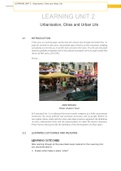
AMSTERDAM.
Photo: André C Horn
In Learning Unit 1 it is indicated that cities mainly comprise (a) a built environment
(structure), (b) social, political and economic structures, and (c) people. Before we
can explore where, when and why cities and urban societies originated, the definition
of cities, urbanisation levels and the characteristics of urban life deserve attention.
These factors always provide the backdrop of the development of urban space.
2.2 LEARNING OUTCOMES AND READING
LEARNING OUTCOMES
After working through all the prescribed study material for this Learning Unit,
you should be able to:
• Explain what makes a place “urban”’
, LEARNING UNIT 2: Urbanisation, Cities and Urban Life
2
• Describe levels of urbanisation and the reasons for urban growth
• Define “urbanism” as a way of life
READING
• For the purpose of achieving the above outcomes, it is recommended that you
read specific sections of Chapter 2, The Origins and Growth of Cities and Urban
Life (sections: Preview and The Definition of Cities) and Chapter 13,
Urbanization, Urban Life and Urban Spaces of the recommended textbook
(Knox, PL & McCarthy, LM. 2014. An Introduction to Urban Geography (Third
Edition). Essex: Pearson).
• NB: Please take note that you will have to consult the specified chapters in your
Recommended reading material to be able to complete this module successfully.
The information contained in the Study Guide alone will not be sufficient to pass
the examination for this module.
• For further enrichment you can also read: Pacione, M. 2009. Urban Geography.
London and New York: Routledge. (Chapters 1 and 4.)
• You can also do further searches on the internet to enrich your knowledge. A
specific search phrase that I found worth having a look at is: “Preconditions for
urbanization”.
2.3 LEARNING CONTENT
In Learning Unit 2, we are trying to obtain a definition of what a city is (2.3.1), compare
levels of urbanisation in relation to the reasons for urban growth (and decline) (2.3.2)
and compare urban living with living in rural or remote areas (2.3.3).
2.3.1 The definition of a city
Defining a city as something different from rural villages is not as easy as one might
think. To establish for ourselves “what a city is” we acknowledge a number of the
views on the topics:
• Louis Wirth (a member of the Chicago School of Human Ecology – refer
to Learning Unit 1) in the early 20th Century identified three fundamental
characteristics that make cities different from rural settlements:
◦ An increased number of people
◦ People’s increased physical density of living (agglomeration)
◦ An increased heterogeneity (social diversity) of the population
• V Gordon Childe characterises the distinctive characteristics of cities as:
◦ Size and density
◦ Specialisation of labour
◦ Concentration of surplus
◦ Diverse and class structured society
◦ State organisation based on a well-structured political system
◦ Monumental public buildings and structures
◦ Long distance trade
1
LEARNING UNIT 2
Urbanisation, Cities and Urban Life
2.1 INTRODUCTION
Urban spaces are created by people, and they draw their character from the people that inhabit them. As
people live and work in urban spaces, they gradually impose themselves on their environment, modifying
and adjusting it as best they can, to suit their needs and express their values. Yet at the same time people
themselves gradually accommodate both to their physical environment and to the people around them
(Knox & McCarthy, 2014:359).
Preview …
AMSTERDAM.
Photo: André C Horn
In Learning Unit 1 it is indicated that cities mainly comprise (a) a built environment
(structure), (b) social, political and economic structures, and (c) people. Before we
can explore where, when and why cities and urban societies originated, the definition
of cities, urbanisation levels and the characteristics of urban life deserve attention.
These factors always provide the backdrop of the development of urban space.
2.2 LEARNING OUTCOMES AND READING
LEARNING OUTCOMES
After working through all the prescribed study material for this Learning Unit,
you should be able to:
• Explain what makes a place “urban”’
, LEARNING UNIT 2: Urbanisation, Cities and Urban Life
2
• Describe levels of urbanisation and the reasons for urban growth
• Define “urbanism” as a way of life
READING
• For the purpose of achieving the above outcomes, it is recommended that you
read specific sections of Chapter 2, The Origins and Growth of Cities and Urban
Life (sections: Preview and The Definition of Cities) and Chapter 13,
Urbanization, Urban Life and Urban Spaces of the recommended textbook
(Knox, PL & McCarthy, LM. 2014. An Introduction to Urban Geography (Third
Edition). Essex: Pearson).
• NB: Please take note that you will have to consult the specified chapters in your
Recommended reading material to be able to complete this module successfully.
The information contained in the Study Guide alone will not be sufficient to pass
the examination for this module.
• For further enrichment you can also read: Pacione, M. 2009. Urban Geography.
London and New York: Routledge. (Chapters 1 and 4.)
• You can also do further searches on the internet to enrich your knowledge. A
specific search phrase that I found worth having a look at is: “Preconditions for
urbanization”.
2.3 LEARNING CONTENT
In Learning Unit 2, we are trying to obtain a definition of what a city is (2.3.1), compare
levels of urbanisation in relation to the reasons for urban growth (and decline) (2.3.2)
and compare urban living with living in rural or remote areas (2.3.3).
2.3.1 The definition of a city
Defining a city as something different from rural villages is not as easy as one might
think. To establish for ourselves “what a city is” we acknowledge a number of the
views on the topics:
• Louis Wirth (a member of the Chicago School of Human Ecology – refer
to Learning Unit 1) in the early 20th Century identified three fundamental
characteristics that make cities different from rural settlements:
◦ An increased number of people
◦ People’s increased physical density of living (agglomeration)
◦ An increased heterogeneity (social diversity) of the population
• V Gordon Childe characterises the distinctive characteristics of cities as:
◦ Size and density
◦ Specialisation of labour
◦ Concentration of surplus
◦ Diverse and class structured society
◦ State organisation based on a well-structured political system
◦ Monumental public buildings and structures
◦ Long distance trade


