
3.4.1 DNA, genes and chromosomes
09 March 2022 17:49
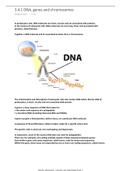
In prokaryotic cells, DNA molecules are short, circular and not associated with proteins.
In the nucleus of eukaryotic cells, DNA molecules are very long, linear and associated with
proteins, called histones.
Together a DNA molecule and its associated proteins form a chromosome.
The mitochondria and chloroplasts of eukaryotic cells also contain DNA which, like the DNA of
prokaryotes, is short, circular and not associated with protein.
A gene is a base sequence of DNA that codes for:
• the amino acid sequence of a polypeptide
• a functional RNA (including ribosomal RNA and tRNAs).
A gene occupies a fixed position, called a locus, on a particular DNA molecule.
A sequence of three DNA bases, called a triplet, codes for a specific amino acid.
The genetic code is universal, non-overlapping and degenerate.
In eukaryotes, much of the nuclear DNA does not code for polypeptides.
There are, for example, non-coding multiple repeats of base sequences between genes.
Even within a gene only some sequences, called exons, code for amino acid sequences.
Within the gene, these exons are separated by one or more non-coding sequences, called introns.
Genetic information, variation and relationships Page 1
,3.4.2 DNA and protein synthesis
15 January 2022 11:35
The concept of the genome as the complete set of genes in a cell and of the proteome as the full
range of proteins that a cell is able to produce.
The structure of molecules of messenger RNA (mRNA) and of transfer RNA (tRNA).
Messenger RNA - mRNA is a single-stranded molecule that carries genetic code from DNA in a cell’s
nucleus to ribosomes (to produce polypeptide chain)
mRNA is a single-stranded molecule
It is made up of a sugar-phosphate backbone and exposed unpaired bases
Uracil bases are present
Transfer RNA - transfer RNA that carries amino acids across the cytoplasm; carries amino acid to
mRNA
tRNA is a single-stranded molecule
It has a sugar-phosphate backbone
It has a folded shape
There are hydrogen bonds between some of the complementary bases
Amino acids bind to a specific region of the molecule
The specific anticodon found on the tRNA molecule is complementary to a specific codon on an
mRNA molecule
Genetic information, variation and relationships Page 2
, Transcription as the production of mRNA from DNA.
The role of RNA polymerase in joining mRNA nucleotides.
DNA is unwound by DNA helicase (by breaking hydrogen bonds) and only one strand is used as a
template, forming transcription bubble.
Free RNA nucleotides bind to complimentary bases on template strand (A,U/C,G) by hydrogen
bonds.
RNA polymerase joins free RNA nucleotides together by forming phosphodiester bonds.
Transcription bubble is closed.
This forms pre- mRNA, spliced (introns removed) to form mRNA.
• In prokaryotes, transcription results directly in the production of mRNA from DNA.
• In eukaryotes, transcription results in the production of pre-mRNA; this is then spliced to form
mRNA.
How does mutation in introns affect translation?
- Introns are non-coding
- So no effect on protein as they are not translated
Or
- Affect/ change splicing
- Gets different amino acid sequence
How does base deletion sometimes result in non-functional proteins?
1.(Mutation) changes triplets / codons after that point / causes frame shift;
2. Changes amino acid sequence (after this) / codes for different amino acids (after this);
Accept changes primary structure
3. Affects hydrogen / ionic / sulfur bond (not peptide bond);
4. Changes tertiary structure of protein (so non-functional) which means substrate-enzyme complex
cannot form(if asking about enzyme)
Translation as the production of polypeptides from the sequence of codons carried by mRNA. The
roles of ribosomes, tRNA and ATP.
- MRNA attaches to ribosome
- 2 TRNA molecules bind their anticodon to first two complementary codons
- Each TRNA molecule binds to specific amino acid
- The order of the codons determines the order of the amino acids, that join with peptide bonds to
form polypeptides
- Amino acids join using enzyme and energy from ATP
- First TRNA is released and ribosome moves along and the next TRNA attaches and cycle continues
- Once the last codon has been read, the polypeptide chain is folded up into proteins
Students should be able to:
• relate the base sequence of nucleic acids to the amino acid sequence of polypeptides, when
provided with suitable data about the genetic code
• interpret data from experimental work investigating the role of nucleic acids.
Students will not be required to recall in written papers specific codons and the amino acids for
which they code.
Genetic information, variation and relationships Page 3
09 March 2022 17:49
In prokaryotic cells, DNA molecules are short, circular and not associated with proteins.
In the nucleus of eukaryotic cells, DNA molecules are very long, linear and associated with
proteins, called histones.
Together a DNA molecule and its associated proteins form a chromosome.
The mitochondria and chloroplasts of eukaryotic cells also contain DNA which, like the DNA of
prokaryotes, is short, circular and not associated with protein.
A gene is a base sequence of DNA that codes for:
• the amino acid sequence of a polypeptide
• a functional RNA (including ribosomal RNA and tRNAs).
A gene occupies a fixed position, called a locus, on a particular DNA molecule.
A sequence of three DNA bases, called a triplet, codes for a specific amino acid.
The genetic code is universal, non-overlapping and degenerate.
In eukaryotes, much of the nuclear DNA does not code for polypeptides.
There are, for example, non-coding multiple repeats of base sequences between genes.
Even within a gene only some sequences, called exons, code for amino acid sequences.
Within the gene, these exons are separated by one or more non-coding sequences, called introns.
Genetic information, variation and relationships Page 1
,3.4.2 DNA and protein synthesis
15 January 2022 11:35
The concept of the genome as the complete set of genes in a cell and of the proteome as the full
range of proteins that a cell is able to produce.
The structure of molecules of messenger RNA (mRNA) and of transfer RNA (tRNA).
Messenger RNA - mRNA is a single-stranded molecule that carries genetic code from DNA in a cell’s
nucleus to ribosomes (to produce polypeptide chain)
mRNA is a single-stranded molecule
It is made up of a sugar-phosphate backbone and exposed unpaired bases
Uracil bases are present
Transfer RNA - transfer RNA that carries amino acids across the cytoplasm; carries amino acid to
mRNA
tRNA is a single-stranded molecule
It has a sugar-phosphate backbone
It has a folded shape
There are hydrogen bonds between some of the complementary bases
Amino acids bind to a specific region of the molecule
The specific anticodon found on the tRNA molecule is complementary to a specific codon on an
mRNA molecule
Genetic information, variation and relationships Page 2
, Transcription as the production of mRNA from DNA.
The role of RNA polymerase in joining mRNA nucleotides.
DNA is unwound by DNA helicase (by breaking hydrogen bonds) and only one strand is used as a
template, forming transcription bubble.
Free RNA nucleotides bind to complimentary bases on template strand (A,U/C,G) by hydrogen
bonds.
RNA polymerase joins free RNA nucleotides together by forming phosphodiester bonds.
Transcription bubble is closed.
This forms pre- mRNA, spliced (introns removed) to form mRNA.
• In prokaryotes, transcription results directly in the production of mRNA from DNA.
• In eukaryotes, transcription results in the production of pre-mRNA; this is then spliced to form
mRNA.
How does mutation in introns affect translation?
- Introns are non-coding
- So no effect on protein as they are not translated
Or
- Affect/ change splicing
- Gets different amino acid sequence
How does base deletion sometimes result in non-functional proteins?
1.(Mutation) changes triplets / codons after that point / causes frame shift;
2. Changes amino acid sequence (after this) / codes for different amino acids (after this);
Accept changes primary structure
3. Affects hydrogen / ionic / sulfur bond (not peptide bond);
4. Changes tertiary structure of protein (so non-functional) which means substrate-enzyme complex
cannot form(if asking about enzyme)
Translation as the production of polypeptides from the sequence of codons carried by mRNA. The
roles of ribosomes, tRNA and ATP.
- MRNA attaches to ribosome
- 2 TRNA molecules bind their anticodon to first two complementary codons
- Each TRNA molecule binds to specific amino acid
- The order of the codons determines the order of the amino acids, that join with peptide bonds to
form polypeptides
- Amino acids join using enzyme and energy from ATP
- First TRNA is released and ribosome moves along and the next TRNA attaches and cycle continues
- Once the last codon has been read, the polypeptide chain is folded up into proteins
Students should be able to:
• relate the base sequence of nucleic acids to the amino acid sequence of polypeptides, when
provided with suitable data about the genetic code
• interpret data from experimental work investigating the role of nucleic acids.
Students will not be required to recall in written papers specific codons and the amino acids for
which they code.
Genetic information, variation and relationships Page 3


