"
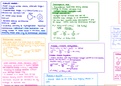
kepnulé model N
""" "
Electrophilic sub
""" """ """" "
"" ""
◦
double bonds
◦
Electrophiles must have
strong positive •
charge to attack benzene
ring
Expected bond length C- C (l54pm)
•
and G- C ◦
Halogen carrier
catalysts make
te
(134pm) but benzene has serine
stronger electrophiles
(140
all carbon carbon bonds
pm)
us µ •
Halogen
electrons
carrier accepts
from halogen on
lone
an
pair of
electrophile
↑ and
Benzene doesn't
•
As lone pair pulled away polarisation
deccrourise
•
benzene
G-7 cation forms making electrophile stronger
bromine water
•
Expected enthalpy of hydrogenation -360kJmoi' Clz -1 Alas → a+
+ Alai ( OR Fe Brg)
°ᵗ"°ⁿ
↑
halogen
experimental -208 kJmd ! Less carbocation
-
exothermic ,
more carrier
eeeea-ropn.eu,
" "" " "" "" " "" "
" "
"
'+ * a
stability comes from delocalised ya electrophilic
ring of electrons
→ I → + Ht lone
•
pair of
a
system inc ,
1-1+-1^-144 Alas
-
+ HCl ring making
"""""""""ˢ""""
→
Diedmd •
shake phen
overlap)
OH
•
each carbon forms 3 6 bonds (head on
,
1
Jtf É
" """ """
" "" """ " " " " "" "" """
"
" "
sideways ◦vena
's
M bond
CH } Cl -1 Alas → CH}-1 + Aldi ← REFLUX
C -
C
✓ ,
c. →
one
ring above "↳ "
↳
✗ one below tea Alas
0
→ + +
→
c- C ,
O Y _fia
p orbital
Sigma bond
FÉAyaM
Reflux benzene with acyl chloride-1 halogen carrier (in a non-aqueous Hojo
•
solvent like
dry ether) -0
phenylketones
cttz coat Alclz → Cttscot + All 4-
""" """" "" """ "he ?
1T¥ "→°Éo %
""
1+13 CO
'
•
Benzene's de localised Tl system spreads + tet
Out negative charge making it stable salicylic ac
very
Phenyl ethanol + few drop
Unwilling to
undergo addition reactions +
◦
AlCl4 Phosphoric
-
* + -0 Alclz + tech
that destroys stable ring
•
In alkenes C=c bonds area
of high Add cold
Phl (+ NaOH
•
cod ice
electrophiles
on
electron
density attracts ,
but
"" "
" ""
"
"" """ " """ "
" "
water
charge is spread out
•
to react via electrophilic
kepnulé model N
""" "
Electrophilic sub
""" """ """" "
"" ""
◦
double bonds
◦
Electrophiles must have
strong positive •
charge to attack benzene
ring
Expected bond length C- C (l54pm)
•
and G- C ◦
Halogen carrier
catalysts make
te
(134pm) but benzene has serine
stronger electrophiles
(140
all carbon carbon bonds
pm)
us µ •
Halogen
electrons
carrier accepts
from halogen on
lone
an
pair of
electrophile
↑ and
Benzene doesn't
•
As lone pair pulled away polarisation
deccrourise
•
benzene
G-7 cation forms making electrophile stronger
bromine water
•
Expected enthalpy of hydrogenation -360kJmoi' Clz -1 Alas → a+
+ Alai ( OR Fe Brg)
°ᵗ"°ⁿ
↑
halogen
experimental -208 kJmd ! Less carbocation
-
exothermic ,
more carrier
eeeea-ropn.eu,
" "" " "" "" " "" "
" "
"
'+ * a
stability comes from delocalised ya electrophilic
ring of electrons
→ I → + Ht lone
•
pair of
a
system inc ,
1-1+-1^-144 Alas
-
+ HCl ring making
"""""""""ˢ""""
→
Diedmd •
shake phen
overlap)
OH
•
each carbon forms 3 6 bonds (head on
,
1
Jtf É
" """ """
" "" """ " " " " "" "" """
"
" "
sideways ◦vena
's
M bond
CH } Cl -1 Alas → CH}-1 + Aldi ← REFLUX
C -
C
✓ ,
c. →
one
ring above "↳ "
↳
✗ one below tea Alas
0
→ + +
→
c- C ,
O Y _fia
p orbital
Sigma bond
FÉAyaM
Reflux benzene with acyl chloride-1 halogen carrier (in a non-aqueous Hojo
•
solvent like
dry ether) -0
phenylketones
cttz coat Alclz → Cttscot + All 4-
""" """" "" """ "he ?
1T¥ "→°Éo %
""
1+13 CO
'
•
Benzene's de localised Tl system spreads + tet
Out negative charge making it stable salicylic ac
very
Phenyl ethanol + few drop
Unwilling to
undergo addition reactions +
◦
AlCl4 Phosphoric
-
* + -0 Alclz + tech
that destroys stable ring
•
In alkenes C=c bonds area
of high Add cold
Phl (+ NaOH
•
cod ice
electrophiles
on
electron
density attracts ,
but
"" "
" ""
"
"" """ " """ "
" "
water
charge is spread out
•
to react via electrophilic