Introduction Dr. H. Mkrtchyan 24/01/20
Exams: Practical on 27 March, 45 min (there is a practice practical before). Also written exams,
40 min each: MCQs and seen essay questions; 28 February and 24 April.
Microbiology
Microbiology: the study of all forms of life that
are too small to be seen by the naked eye.
Microorganisms-many types: non-cellular
(viruses, prions), prokaryotic (archaea and
bacteria), and eukaryotic (fungi, algae, and
protozoa).
Bacteria were the first living
organism on the planet. No
bacteria, no oxygen in Earth’s
atmosphere. More bacteria living
on one person than people in the
world-7.5 billion.
Microorganisms can be found in
areas far too hostile for human
survival, and they also degrade
most of our waste.
Microbial ecosystems:
microorganisms are present
everywhere on Earth that supports
growth. Major ecosystems include:
aquatic, terrestrial, and higher
organisms (in or on them).
Microbial populations can interact
with each other in beneficial,
neutral or harmful ways. They first appeared 3.8 billion years ago; atmosphere was without
oxygen (anoxic), so most organisms are believed to be anaerobic.
Early metabolic types: cyanobacteria (oxygen evolving phototrophs)-evolved from the early
anaerobic organisms. O2 in atmosphere believed to have come from oxygenic photosynthesis
first done by cyanobacteria. Photosynthetic bacteria may have not been the first, but they
evolved early. Several bacterias carry out photosynthesis, but no archaea.
,Fossil evidence: microorganisms were not readily fossilised but some exceptions; fossilised
microbial formations (stromatolites) can be found in rocks that are 3.5 billions years old. 1 billion
year old microfossils resemble modern cyanobacteria.
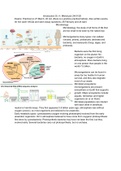
History (see pic above) started with Antoni van Leeuwenhoek, father of microbiology. First
recorded observation of bacteria (spheres, rods, packets of spheres, and motility). Classification
and immunology-Carolus Linnaeus, first classification scheme of living organism Binomial
System (father of modern taxonomy). Edward Jenner-immunization of humans against
smallpox. Father of epidemiology-John Snow; cholera outbreak in Soho, he plotted cases on a
,map and ID a water pump as the source of the disease (had handle removed, case diminished).
Louis Pasteur-showed germs were present in the air and the cause of fermentation (widely
distributed in nature). Robert Koch-experimental evidence about infectious disease concept.
Impact of microorganisms: modern agriculture and human nutrition; food, energy, and the
environment; biotechnology; agents of disease. Lots of infectious diseases-common cold, TB,
malaria, and thrush included. Alexander Fleming in 1928 discovered (not made?) first medically
useful antibiotic, penicillin. There are now resistant bacteria: E. coli, K.Pneumoniae,
enterococcus faecium, pseudomonas aeruginosa, and MRSA. They are believed to be a big
threat from climate change (ME: more extreme temps, better for microorganisms and not so for
us). UK: Since 2014, the UK has cut antibiotic usage by >7%, but the number of drug-resistant
bloodstream infections increased by 35% from 2013-2017. By 2025, UK gov aims to cut the
number of infections by 10% and prevent 15000 patients each year from contracting infections
as a result of their healthcare. Antibiotic resistance: bacteria cells in human, some drug
resistant. Antibiotics kill bacteria but resistant strains remain. Those multiply, then resistance
spreads. Resistance occurs quick (12 years from first discovery)!
Enough about us, microbial nutrition now. Energy sources: phototrophs-light,
chemotrophs-oxidation of chemical compounds (organic or inorganic). Carbon sources:
autotrophs-CO2 as main C source. Heterotrophs-use organic matter made by other organisms
as C source. Photoautotrophic-sunlight and C from CO2. Photoheterotrophic-sunlight but use
organic compounds as C sources. Chemolithotrophic -oxidation of inorganic compounds
(ammonia/hydrogen sulfide) and use CO2 as principal C source. Chemoorganotrophic-organic
, compounds as E sources as well as C sources. Symbiotic: microbe-microbe, plant-microbe, or
even animal-microbe.
Temperature and growth; the factors affecting microbial growth are temperature and oxygen.
Temperature-cardinal temps (min, optimal, and max). Growth: -20-120. Optimum: 0-75, upper
limit for protozoa is 56, whilst for algae and fungi is 55-62. Oxygen: obligate aerobes-completely
dependent on atmospheric O2 for growth. Facultative aerobes-do not require O2 for growth, but
grow better in its presence. Microaerophiles-damaged by the normal atmospheric level of O2
(20%). Aerotolerant aerobes-grow equally well whether O2 present or no. Obligate
anaerobes-do not tolerate O2 at all and die in its presence.
Culture media: a liquid or solid preparation used to grow microorganisms. The precise
composition of a medium will depend on the species we are trying to cultivate. Agar-polymer
extracted from red algae, well suited as a solidifying agent; melts at about boiling point, once
melted it does not harden until reaching 45; can be incubated at a wide range of temp; most
microorganisms cannot degrade it. Methods of assessing growth: total cell count-measures all
cells (living or not-haemocytometer); viable cell count (spread plate method-pour plate method);
turbidimetric (estimate number of cells in a sample using spectrophotometer). Aseptic
technique-must minimise risk of contaminating ourselves/environment with the microorganism,
or introducing an unknown contaminant into our culture. Viable Cell Count-only living counted,
only colonies ranging from 30-300 are considered. Lower numbers-may not be representative of
the population as a whole; higher-difficult to count with accuracy. Calculate the number of colony
forming units per mL (CFU/mL). Dilute cell suspensions before plating, and assume each viable
cell will grow and divide to yield one colony.
Bacteria Cell Dr. Sally Cutler
file:///C:/Users/King_Narcissus73/Downloads/TAKE%20NOTES%20THEN%20DELETE.pdf
Workshop One 31/01/20 Dr. M. Saia
Fermented food is a metabolic way of the microbes (like beer, cider, wine, cheese, etc). In cycle
of nutrition and death and life, microbes help degrade the macromolecules (pieces of
animals/plants). We can produce a lot of special complex molecules, but the microbes can
break it down and degrade them to simple sugars and things. Intestine is packed with microbes;
more microbes than the number of cells in our body (but they do not weigh much). Main reason
to study them: they bring diseases! We must create vaccines for them (like coronavirus), since
we do not have the resistance of it. Microbes do interact with each other.
Exams: Practical on 27 March, 45 min (there is a practice practical before). Also written exams,
40 min each: MCQs and seen essay questions; 28 February and 24 April.
Microbiology
Microbiology: the study of all forms of life that
are too small to be seen by the naked eye.
Microorganisms-many types: non-cellular
(viruses, prions), prokaryotic (archaea and
bacteria), and eukaryotic (fungi, algae, and
protozoa).
Bacteria were the first living
organism on the planet. No
bacteria, no oxygen in Earth’s
atmosphere. More bacteria living
on one person than people in the
world-7.5 billion.
Microorganisms can be found in
areas far too hostile for human
survival, and they also degrade
most of our waste.
Microbial ecosystems:
microorganisms are present
everywhere on Earth that supports
growth. Major ecosystems include:
aquatic, terrestrial, and higher
organisms (in or on them).
Microbial populations can interact
with each other in beneficial,
neutral or harmful ways. They first appeared 3.8 billion years ago; atmosphere was without
oxygen (anoxic), so most organisms are believed to be anaerobic.
Early metabolic types: cyanobacteria (oxygen evolving phototrophs)-evolved from the early
anaerobic organisms. O2 in atmosphere believed to have come from oxygenic photosynthesis
first done by cyanobacteria. Photosynthetic bacteria may have not been the first, but they
evolved early. Several bacterias carry out photosynthesis, but no archaea.
,Fossil evidence: microorganisms were not readily fossilised but some exceptions; fossilised
microbial formations (stromatolites) can be found in rocks that are 3.5 billions years old. 1 billion
year old microfossils resemble modern cyanobacteria.
History (see pic above) started with Antoni van Leeuwenhoek, father of microbiology. First
recorded observation of bacteria (spheres, rods, packets of spheres, and motility). Classification
and immunology-Carolus Linnaeus, first classification scheme of living organism Binomial
System (father of modern taxonomy). Edward Jenner-immunization of humans against
smallpox. Father of epidemiology-John Snow; cholera outbreak in Soho, he plotted cases on a
,map and ID a water pump as the source of the disease (had handle removed, case diminished).
Louis Pasteur-showed germs were present in the air and the cause of fermentation (widely
distributed in nature). Robert Koch-experimental evidence about infectious disease concept.
Impact of microorganisms: modern agriculture and human nutrition; food, energy, and the
environment; biotechnology; agents of disease. Lots of infectious diseases-common cold, TB,
malaria, and thrush included. Alexander Fleming in 1928 discovered (not made?) first medically
useful antibiotic, penicillin. There are now resistant bacteria: E. coli, K.Pneumoniae,
enterococcus faecium, pseudomonas aeruginosa, and MRSA. They are believed to be a big
threat from climate change (ME: more extreme temps, better for microorganisms and not so for
us). UK: Since 2014, the UK has cut antibiotic usage by >7%, but the number of drug-resistant
bloodstream infections increased by 35% from 2013-2017. By 2025, UK gov aims to cut the
number of infections by 10% and prevent 15000 patients each year from contracting infections
as a result of their healthcare. Antibiotic resistance: bacteria cells in human, some drug
resistant. Antibiotics kill bacteria but resistant strains remain. Those multiply, then resistance
spreads. Resistance occurs quick (12 years from first discovery)!
Enough about us, microbial nutrition now. Energy sources: phototrophs-light,
chemotrophs-oxidation of chemical compounds (organic or inorganic). Carbon sources:
autotrophs-CO2 as main C source. Heterotrophs-use organic matter made by other organisms
as C source. Photoautotrophic-sunlight and C from CO2. Photoheterotrophic-sunlight but use
organic compounds as C sources. Chemolithotrophic -oxidation of inorganic compounds
(ammonia/hydrogen sulfide) and use CO2 as principal C source. Chemoorganotrophic-organic
, compounds as E sources as well as C sources. Symbiotic: microbe-microbe, plant-microbe, or
even animal-microbe.
Temperature and growth; the factors affecting microbial growth are temperature and oxygen.
Temperature-cardinal temps (min, optimal, and max). Growth: -20-120. Optimum: 0-75, upper
limit for protozoa is 56, whilst for algae and fungi is 55-62. Oxygen: obligate aerobes-completely
dependent on atmospheric O2 for growth. Facultative aerobes-do not require O2 for growth, but
grow better in its presence. Microaerophiles-damaged by the normal atmospheric level of O2
(20%). Aerotolerant aerobes-grow equally well whether O2 present or no. Obligate
anaerobes-do not tolerate O2 at all and die in its presence.
Culture media: a liquid or solid preparation used to grow microorganisms. The precise
composition of a medium will depend on the species we are trying to cultivate. Agar-polymer
extracted from red algae, well suited as a solidifying agent; melts at about boiling point, once
melted it does not harden until reaching 45; can be incubated at a wide range of temp; most
microorganisms cannot degrade it. Methods of assessing growth: total cell count-measures all
cells (living or not-haemocytometer); viable cell count (spread plate method-pour plate method);
turbidimetric (estimate number of cells in a sample using spectrophotometer). Aseptic
technique-must minimise risk of contaminating ourselves/environment with the microorganism,
or introducing an unknown contaminant into our culture. Viable Cell Count-only living counted,
only colonies ranging from 30-300 are considered. Lower numbers-may not be representative of
the population as a whole; higher-difficult to count with accuracy. Calculate the number of colony
forming units per mL (CFU/mL). Dilute cell suspensions before plating, and assume each viable
cell will grow and divide to yield one colony.
Bacteria Cell Dr. Sally Cutler
file:///C:/Users/King_Narcissus73/Downloads/TAKE%20NOTES%20THEN%20DELETE.pdf
Workshop One 31/01/20 Dr. M. Saia
Fermented food is a metabolic way of the microbes (like beer, cider, wine, cheese, etc). In cycle
of nutrition and death and life, microbes help degrade the macromolecules (pieces of
animals/plants). We can produce a lot of special complex molecules, but the microbes can
break it down and degrade them to simple sugars and things. Intestine is packed with microbes;
more microbes than the number of cells in our body (but they do not weigh much). Main reason
to study them: they bring diseases! We must create vaccines for them (like coronavirus), since
we do not have the resistance of it. Microbes do interact with each other.