BIOLOGICAL MEMBRANES 2
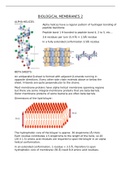
ALPHA-HELICES:
Alpha helices have a regular pattern of hydrogen bonding of
peptide backbone.
Peptide bond 1 H-bonded to peptide bond 4, 2 to 5, etc…
3.6 residues per turn (5.4 Å) = 1.5Å/ residue
In a fully extended conformation 3.5Å/ residue
BETA-SHEETS:
An antiparallel β-sheet is formed with adjacent β-strands running in
opposite directions. Every other side chain extends above or below the
sheet. H-bonds are quite perpendicular to the chains.
Most membrane proteins have alpha helical membrane spanning regions
but there are some integral membrane proteins that are beta-barrels.
Outer membrane proteins of some bacteria are often beta barrels.
Dimensions of the lipid bilayer:
The hydrophobic core of the bilayer is approx. 30 Angstroms (Å) thick.
Each residue contributes 1.5 Angstroms to the length of the helix, so 20
(20 X 1.5) amino acid residues are required to span the bilayer in an alpha
helical conformation.
In an extended conformation, 1 residue = 3.5 Å, therefore to span
hydrophobic core of membrane (30 Å) need 8-9 amino acid residues.
, Transmembrane spanning segments are made up of around 20
hydrophobic amino acids in an alpha-helical conformation.
Integral membrane proteins may span the membrane many times:
Some examples of alpha helical membrane proteins:
Bacteriorhodopsin
Bovine cytochrome c oxidase complex
Porins are beta barrel membrane proteins.
Predicting membrane protein structure from sequence:
Features of membrane proteins can help predict whether a protein is
likely to be a (alpha-helical) membrane protein or not.
Hydrophobicity analysis: there are a number of different hydrophobicity
scales i.e. Kyte and Doolittle, Engelmann and Steitz. Each individual amino
acid has a hydrophobicity value. Use an average over a number of amino
acids (usually 15-20).
e.g. Hydrophobicity analysis of GpA: average hydrophobicity of a stretch
of amino acids is calculated, plotted on a graph and then window is slid
along. When window is over a hydrophobic stretch of amino acids there is
a trough. These are possible transmembrane regions.
Hydrophobic amino acids contact the hydrophobic lipid interior.
Polar peptide bonds are masked by H-bonding lipid bilayer. Alpha-helices
are the most common membrane spanning segments.
Almost all proteins synthesised on ribosomes in the cytoplasm. Membrane
proteins have parts that are cytoplasmic, parts that are buried in the lipid
bilayer and parts that are extracytoplasmic. It is energetically
unfavourable to move large hydrophilic portions of polypeptide chain
through the lipid bilayer.
Membrane proteins assemble in protein conducting channels
ALPHA-HELICES:
Alpha helices have a regular pattern of hydrogen bonding of
peptide backbone.
Peptide bond 1 H-bonded to peptide bond 4, 2 to 5, etc…
3.6 residues per turn (5.4 Å) = 1.5Å/ residue
In a fully extended conformation 3.5Å/ residue
BETA-SHEETS:
An antiparallel β-sheet is formed with adjacent β-strands running in
opposite directions. Every other side chain extends above or below the
sheet. H-bonds are quite perpendicular to the chains.
Most membrane proteins have alpha helical membrane spanning regions
but there are some integral membrane proteins that are beta-barrels.
Outer membrane proteins of some bacteria are often beta barrels.
Dimensions of the lipid bilayer:
The hydrophobic core of the bilayer is approx. 30 Angstroms (Å) thick.
Each residue contributes 1.5 Angstroms to the length of the helix, so 20
(20 X 1.5) amino acid residues are required to span the bilayer in an alpha
helical conformation.
In an extended conformation, 1 residue = 3.5 Å, therefore to span
hydrophobic core of membrane (30 Å) need 8-9 amino acid residues.
, Transmembrane spanning segments are made up of around 20
hydrophobic amino acids in an alpha-helical conformation.
Integral membrane proteins may span the membrane many times:
Some examples of alpha helical membrane proteins:
Bacteriorhodopsin
Bovine cytochrome c oxidase complex
Porins are beta barrel membrane proteins.
Predicting membrane protein structure from sequence:
Features of membrane proteins can help predict whether a protein is
likely to be a (alpha-helical) membrane protein or not.
Hydrophobicity analysis: there are a number of different hydrophobicity
scales i.e. Kyte and Doolittle, Engelmann and Steitz. Each individual amino
acid has a hydrophobicity value. Use an average over a number of amino
acids (usually 15-20).
e.g. Hydrophobicity analysis of GpA: average hydrophobicity of a stretch
of amino acids is calculated, plotted on a graph and then window is slid
along. When window is over a hydrophobic stretch of amino acids there is
a trough. These are possible transmembrane regions.
Hydrophobic amino acids contact the hydrophobic lipid interior.
Polar peptide bonds are masked by H-bonding lipid bilayer. Alpha-helices
are the most common membrane spanning segments.
Almost all proteins synthesised on ribosomes in the cytoplasm. Membrane
proteins have parts that are cytoplasmic, parts that are buried in the lipid
bilayer and parts that are extracytoplasmic. It is energetically
unfavourable to move large hydrophilic portions of polypeptide chain
through the lipid bilayer.
Membrane proteins assemble in protein conducting channels