Cancer, Tissue Renewal, Stem Cells and Stem Cell Therapies
CANCER:
Cancer cells escape the normal controls over cell
survival, proliferation and organisation.
Cells that break through boundaries, such as basal
lamina, enter the bloodstream and colonise distant sites
in the body are said to form metastases. These secondary
tumours are often highly dangerous.
A multicellular organism may tolerate some mistakes in
cell proliferation, however, genetic alterations that lead
to persistent mis-regulation of cell proliferation and
survival can lead to uncontrolled or cancerous growth.
Excess growth of cells within their original tissue (benign
tumour) is typically less dangerous but may proceed such
that cells invade surrounding tissues (malignant tumour),
leading to damage that may be life-threatening. These
events occur due to a series of mutations in genes that
normally regulate cell proliferation, survival and
organisation within tissues.
Cancer cells have defects in 2 key types of gene:
Tumour suppressors and Oncogenes.
Loss of control over cell proliferation is an
important defect in cancer cells, though not
the only defect. Typically, both the activation
of proto-oncogenes and the loss or
inactivation of tumour suppressor genes is
required to release the cell from normal
proliferative controls.
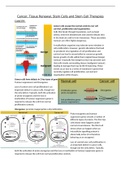
Oncogenes: promote inappropriate cell proliferation.
Proto-oncogenes and tumour
suppressor genes encode a number of
different types of protein. The first two
cells shows what happens under
normal circumstances. The third cell
shows what can happen when an
intracellular signalling protein is
abnormally active (it is therefore
behaving as an oncogene)
Loss of control over cell proliferation is
an important defect in cancer cells,
though not the only defect. Typically,
both the activation of proto-oncogenes and the loss or inactivation of tumour suppressor genes is
required to release the cell from normal proliferative controls.
, This includes abnormally active proteins in the growth factor (RTK) signalling pathway
e.g. Normal protein in a cell not normally
expressing that protein
e.g. Normal protein made in excess
e.g. Mutant protein that is always in the
active state (constitutively active), such as
receptors that do not need a signal for
dimerisation or Ras permanently associated
with GTP
Tumour suppressors: often provide a
“braking” mechanism for the cell cycle.
Therefore, if the tumour suppressor is
inactivated or lost, the braking system is
released and the cell cycle is misregulated.
Example of a proto-oncogene: Ras:-
If Ras becomes constitutively activated the cell
signalling pathway will be stimulated without the
presence of a signalling molecule; onward transmission
of the signal will therefore occur causing a change in
cell proliferation.
Example of a tumour suppressor: p53:-
The main route of cell-cycle arrest is
indirectly through p53 activation. p53 is a
transcription factor that can activate the
gene expression of other genes; it is the
proteins of these other genes which cause
the cell cycle to arrest. Loss or inactivation
of p53 can result in inappropriate progress
into Mitosis of the cell cycle. p53 is
therefore a tumour suppressor.
A polyp in the gut
epithelium can accumulate mutations and form a malignant cancer.
In cases such as colon cancer, tumour progression is well understood, as a series of
mutations that often occur in the same key genes (or signalling pathways). This
knowledge is leading to increasingly better prevention and treatment strategies.
STEM CELLS AND TISSUE RENEWAL:
CANCER:
Cancer cells escape the normal controls over cell
survival, proliferation and organisation.
Cells that break through boundaries, such as basal
lamina, enter the bloodstream and colonise distant sites
in the body are said to form metastases. These secondary
tumours are often highly dangerous.
A multicellular organism may tolerate some mistakes in
cell proliferation, however, genetic alterations that lead
to persistent mis-regulation of cell proliferation and
survival can lead to uncontrolled or cancerous growth.
Excess growth of cells within their original tissue (benign
tumour) is typically less dangerous but may proceed such
that cells invade surrounding tissues (malignant tumour),
leading to damage that may be life-threatening. These
events occur due to a series of mutations in genes that
normally regulate cell proliferation, survival and
organisation within tissues.
Cancer cells have defects in 2 key types of gene:
Tumour suppressors and Oncogenes.
Loss of control over cell proliferation is an
important defect in cancer cells, though not
the only defect. Typically, both the activation
of proto-oncogenes and the loss or
inactivation of tumour suppressor genes is
required to release the cell from normal
proliferative controls.
Oncogenes: promote inappropriate cell proliferation.
Proto-oncogenes and tumour
suppressor genes encode a number of
different types of protein. The first two
cells shows what happens under
normal circumstances. The third cell
shows what can happen when an
intracellular signalling protein is
abnormally active (it is therefore
behaving as an oncogene)
Loss of control over cell proliferation is
an important defect in cancer cells,
though not the only defect. Typically,
both the activation of proto-oncogenes and the loss or inactivation of tumour suppressor genes is
required to release the cell from normal proliferative controls.
, This includes abnormally active proteins in the growth factor (RTK) signalling pathway
e.g. Normal protein in a cell not normally
expressing that protein
e.g. Normal protein made in excess
e.g. Mutant protein that is always in the
active state (constitutively active), such as
receptors that do not need a signal for
dimerisation or Ras permanently associated
with GTP
Tumour suppressors: often provide a
“braking” mechanism for the cell cycle.
Therefore, if the tumour suppressor is
inactivated or lost, the braking system is
released and the cell cycle is misregulated.
Example of a proto-oncogene: Ras:-
If Ras becomes constitutively activated the cell
signalling pathway will be stimulated without the
presence of a signalling molecule; onward transmission
of the signal will therefore occur causing a change in
cell proliferation.
Example of a tumour suppressor: p53:-
The main route of cell-cycle arrest is
indirectly through p53 activation. p53 is a
transcription factor that can activate the
gene expression of other genes; it is the
proteins of these other genes which cause
the cell cycle to arrest. Loss or inactivation
of p53 can result in inappropriate progress
into Mitosis of the cell cycle. p53 is
therefore a tumour suppressor.
A polyp in the gut
epithelium can accumulate mutations and form a malignant cancer.
In cases such as colon cancer, tumour progression is well understood, as a series of
mutations that often occur in the same key genes (or signalling pathways). This
knowledge is leading to increasingly better prevention and treatment strategies.
STEM CELLS AND TISSUE RENEWAL: