Concepts of cell signalling
Cell signalling: chemical signal released by one cell & recognised by another cell. Usually involves a
receptor molecule that recognises the signal in a highly specific manner. Allows the receiving cell to
make a characteristic response.
Types of signal: proteins, peptides, steroids, dissolved gases, amino acids, fatty acid derivatives &
nucleotides.
Why is cell signalling important? Communication – essential for co-ordination of cell behaviour.
Single cell organisms, such as yeast, use signalling to identify and interact with cells of the correct
mating type in sexual reproduction. Multicellular organisms depend on cell signalling for correct
development, tissue maintenance and homeostasis
3 concepts of cell signalling
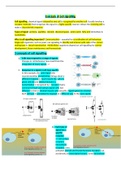
1. Cells may respond to a range of signals:
Changes in cell behaviour may result from the
integration of many signals. =>
2. Response to a signal is cell-type specific:
In this example, the same signal (the
neurotransmitter acetylcholine) brings about a
different response in heart muscle (A), salivary
gland cells (B) and skeletal muscle (C).
Acetylcholine is recognised by a receptor that is
common to heart and salivary gland cells, but
different to that on skeletal muscle cells (actually a ligand-gated ion channel).
Each cell type is specialized to respond in a different way to the same signal.
3. Each type of
signal has a
specific
receptor:
<= Cell surface
receptors
Intracellular
receptors: once
activated, steroid and thyroid hormone receptors can
act directly as transcription factors. Some intracellular
Cell signalling: chemical signal released by one cell & recognised by another cell. Usually involves a
receptor molecule that recognises the signal in a highly specific manner. Allows the receiving cell to
make a characteristic response.
Types of signal: proteins, peptides, steroids, dissolved gases, amino acids, fatty acid derivatives &
nucleotides.
Why is cell signalling important? Communication – essential for co-ordination of cell behaviour.
Single cell organisms, such as yeast, use signalling to identify and interact with cells of the correct
mating type in sexual reproduction. Multicellular organisms depend on cell signalling for correct
development, tissue maintenance and homeostasis
3 concepts of cell signalling
1. Cells may respond to a range of signals:
Changes in cell behaviour may result from the
integration of many signals. =>
2. Response to a signal is cell-type specific:
In this example, the same signal (the
neurotransmitter acetylcholine) brings about a
different response in heart muscle (A), salivary
gland cells (B) and skeletal muscle (C).
Acetylcholine is recognised by a receptor that is
common to heart and salivary gland cells, but
different to that on skeletal muscle cells (actually a ligand-gated ion channel).
Each cell type is specialized to respond in a different way to the same signal.
3. Each type of
signal has a
specific
receptor:
<= Cell surface
receptors
Intracellular
receptors: once
activated, steroid and thyroid hormone receptors can
act directly as transcription factors. Some intracellular