Birth of Neurones: Neuronal Growth Factors
Key concept: stages of neurogenesis and neurotrophic growth factors.
Neurogenesis = formation of the nervous system during embryogenesis.
(The brain is a complex organ, has neurones as well as non-neuronal cell
types such as glia, astrocytes, blood vessels, etc. Not just neurogenesis –
the formation of neurones).
Neurotrophic growth factors = protein growth factors that act specifically
on nerve cells.
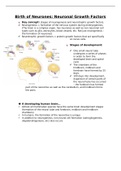
Stages of development:
One small neural tube
undergoes a series of phases
in order to form the
developed brain and spinal
cord.
The chambers of the
hindbrain, midbrain and
forebrain have formed by 25
days.
100 days into development,
expansion of certain parts of
the neural tube has occurred
– the forebrain has formed
part of the neocortex as well as the cerebellum, and hindbrain forms
the pons.
A developing human brain…
Almost all mammalian species have the same brain development stages
(formation of the neural tube and forebrain, midbrain and hindbrain
chambers)
In humans, the formation of the neocortex is unique
In addition to neurogenesis, non-neural cell formation (astrogliogenesis,
oligodendrogenesis, etc) also occurs
, Humans have
a long
gestation
period of 9
months – this
means that
synaptogenesis forms strong synapses as axon terminals and dendrites
grow toward each other
Humans generate billions of excess neurones during development which
must be killed off via apoptosis = apoptotic pruning
During early development, this apoptotic pathway is switched on, so that
neurones with non-strengthened synapses are killed off and only those
with strengthened synapses continue into adulthood. After birth, this
apoptotic pathway is switched off.
Neurones are terminally differentiated, meaning that neurones killed
during adult life cannot be replaced
Growth factors and development:
Various growth factors
trigger the growth and
development of cells into
neurones and glia.
Early formation of the
neural tube:
differentiation of various
regions of the brain is
mediated through a combination of signals (growth factors, Hox genes,
other proteins, etc,) that signal to the developing neural tube cells to
remain in the same location, migrate, grow, etc.
Dorsalising/ ventralising signals will cause specific proteins to be
expressed in dorsal/ ventral cells of the neural tube, leading to the
development of the hindbrain, midbrain and forebrain regions.
Key concept: stages of neurogenesis and neurotrophic growth factors.
Neurogenesis = formation of the nervous system during embryogenesis.
(The brain is a complex organ, has neurones as well as non-neuronal cell
types such as glia, astrocytes, blood vessels, etc. Not just neurogenesis –
the formation of neurones).
Neurotrophic growth factors = protein growth factors that act specifically
on nerve cells.
Stages of development:
One small neural tube
undergoes a series of phases
in order to form the
developed brain and spinal
cord.
The chambers of the
hindbrain, midbrain and
forebrain have formed by 25
days.
100 days into development,
expansion of certain parts of
the neural tube has occurred
– the forebrain has formed
part of the neocortex as well as the cerebellum, and hindbrain forms
the pons.
A developing human brain…
Almost all mammalian species have the same brain development stages
(formation of the neural tube and forebrain, midbrain and hindbrain
chambers)
In humans, the formation of the neocortex is unique
In addition to neurogenesis, non-neural cell formation (astrogliogenesis,
oligodendrogenesis, etc) also occurs
, Humans have
a long
gestation
period of 9
months – this
means that
synaptogenesis forms strong synapses as axon terminals and dendrites
grow toward each other
Humans generate billions of excess neurones during development which
must be killed off via apoptosis = apoptotic pruning
During early development, this apoptotic pathway is switched on, so that
neurones with non-strengthened synapses are killed off and only those
with strengthened synapses continue into adulthood. After birth, this
apoptotic pathway is switched off.
Neurones are terminally differentiated, meaning that neurones killed
during adult life cannot be replaced
Growth factors and development:
Various growth factors
trigger the growth and
development of cells into
neurones and glia.
Early formation of the
neural tube:
differentiation of various
regions of the brain is
mediated through a combination of signals (growth factors, Hox genes,
other proteins, etc,) that signal to the developing neural tube cells to
remain in the same location, migrate, grow, etc.
Dorsalising/ ventralising signals will cause specific proteins to be
expressed in dorsal/ ventral cells of the neural tube, leading to the
development of the hindbrain, midbrain and forebrain regions.