Optimal foraging!
Why do animals forage?
Basic requirement for life (cell metabolism)
Improve body ‘quality’ (status ornaments – attract mate)
Feed breeding partner
Feed offspring
Economics of foraging: load size & prey choice
Economics = the branch of social science that deals with the production,
distributon and consumption of goods and services, and their management.
Main principle = profit and loss -> Animal foraging
Modelling time budgets:
Time is a limiting resource, both in terms of time spent foraging for (finding)
food and time spent handling/ consuming food.
Assumptions:
All animals are identical – may not necessarily be true, some animals may be
more successful in foraging activities due to larger size, etc.
There is no variation in any of these parameters in space or time – may not be
true, different territories and different times may have different prey densities,
etc.
There are no interactions between animals – interactions do often occur, at
territory boundaries in particular, animals may engage in fights over resources
‘Patchy’ environments
For example, marine environments may have ‘patches’ of coral and sand, terrestrial
environments may be composed of regions with heather and stonier areas. Predators
may forage on animals found exclusively in a particular patch, so would only be
interested in this type of ‘patch’.
How is the foraging environment patchy?
Patches may differ with respect to:
-- Food density
-- Prey size
-- Prey type
-- Prey refuges
-- Number of predators
, There are profitable and less profitable patches
Load size: how many items should a parent collect?
Too few -> wasted time on flying to the food patch
Too many -> losing prey items whilst foraging
-> increased risk of predation whilst foraging (load may make the
animal less agile and less able to escape predators)
OPTIMAL FORAGING takes this trade-off into account (not maximal foraging)
Marginal value theorem (MVT)
Marginal value is another concept from economics. It considers the economic costs
(changes) of altering the value of another factor (e.g. production, consumption,
energy costs, etc.)
MVT and animal behaviour
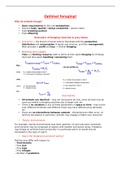
Marginal Value Theorem proposed by E. Charnov (1976):
Loading (or gain) curve – number of items taken
to offspring
Searching time – time spent in food patch
Travel time – time spent between nest and food
patch
Optimal searching time depends on travel time.
Marginal value = food intake/ (travel time + searching
time)
MVT – deriving quantitative predictions
Predictions can be made of the optimal foraging time by
changing the travel time and changing the shape of the gain
curve.
MVT – when to leave a food ‘patch’?
MVT predicts that optimal foragers in a ‘patch’ of resources
will forage for longer time:
1. In more ‘profitable’ patches – more to gain from that
patch
2. As the distance between patches increases – would cost less energy to stay put in
a patch and forage than travel between patches
3. When the environment as a whole is less profitable
MVT – empirical data:
Experimental tests of load size selection in starlings (Kacelnik
1980s) – time as a limiting factor.
Observed: load size increased with travel time (longer round
trip time means more time spent foraging and a larger load size)
and actual load sizes closely matched those predicted.
Why do animals forage?
Basic requirement for life (cell metabolism)
Improve body ‘quality’ (status ornaments – attract mate)
Feed breeding partner
Feed offspring
Economics of foraging: load size & prey choice
Economics = the branch of social science that deals with the production,
distributon and consumption of goods and services, and their management.
Main principle = profit and loss -> Animal foraging
Modelling time budgets:
Time is a limiting resource, both in terms of time spent foraging for (finding)
food and time spent handling/ consuming food.
Assumptions:
All animals are identical – may not necessarily be true, some animals may be
more successful in foraging activities due to larger size, etc.
There is no variation in any of these parameters in space or time – may not be
true, different territories and different times may have different prey densities,
etc.
There are no interactions between animals – interactions do often occur, at
territory boundaries in particular, animals may engage in fights over resources
‘Patchy’ environments
For example, marine environments may have ‘patches’ of coral and sand, terrestrial
environments may be composed of regions with heather and stonier areas. Predators
may forage on animals found exclusively in a particular patch, so would only be
interested in this type of ‘patch’.
How is the foraging environment patchy?
Patches may differ with respect to:
-- Food density
-- Prey size
-- Prey type
-- Prey refuges
-- Number of predators
, There are profitable and less profitable patches
Load size: how many items should a parent collect?
Too few -> wasted time on flying to the food patch
Too many -> losing prey items whilst foraging
-> increased risk of predation whilst foraging (load may make the
animal less agile and less able to escape predators)
OPTIMAL FORAGING takes this trade-off into account (not maximal foraging)
Marginal value theorem (MVT)
Marginal value is another concept from economics. It considers the economic costs
(changes) of altering the value of another factor (e.g. production, consumption,
energy costs, etc.)
MVT and animal behaviour
Marginal Value Theorem proposed by E. Charnov (1976):
Loading (or gain) curve – number of items taken
to offspring
Searching time – time spent in food patch
Travel time – time spent between nest and food
patch
Optimal searching time depends on travel time.
Marginal value = food intake/ (travel time + searching
time)
MVT – deriving quantitative predictions
Predictions can be made of the optimal foraging time by
changing the travel time and changing the shape of the gain
curve.
MVT – when to leave a food ‘patch’?
MVT predicts that optimal foragers in a ‘patch’ of resources
will forage for longer time:
1. In more ‘profitable’ patches – more to gain from that
patch
2. As the distance between patches increases – would cost less energy to stay put in
a patch and forage than travel between patches
3. When the environment as a whole is less profitable
MVT – empirical data:
Experimental tests of load size selection in starlings (Kacelnik
1980s) – time as a limiting factor.
Observed: load size increased with travel time (longer round
trip time means more time spent foraging and a larger load size)
and actual load sizes closely matched those predicted.