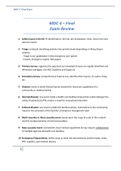
MDC 4 - Final exam review NUR2502 (Latest 2022 / 2023) Rasmussen
MDC 4 – Final Exam Review 1- Safety issues in the ED: Pt identification, fall risk, skin breakdown, HAIs, med errors and adverse events. 2- Triage: sorting & classifying patients into priority levels depending on illness/injury severity - Triage nurse: gatekeeper in the emergency care system - 3 levels: Emergent, Urgent, Nonurgent 3- Primary Survey: organizes the approach so immediate threats are rapidly identified and effectively managed. Use ABC Disability and Exposure 4- Secondary Survey: comprehensive head-to-toe, identify other injuries. Ex: splint, Foley, etc. 5- Disaster: event in which illness/injuries exceed the resources capabilities of a community or medical facility 6- Internal disaster: any event inside a health care facility/campus that could endanger the safety of patients/staff & creates a need for evacuation/relocation 7- External disaster: any event outside the facility/campus. Somewhere in the community, requires the activation of the facility’s emergency management plan 8- Multi-casualty vs. Mass casualty event: based upon the scope & scale of the incident and the number/severity of victims/casualties 9- Mass casualty event: overwhelms local medical capabilities & may require collaboration of multiple agencies & health care facilities 10- Emergency Preparedness: define ways to meet the extraordinary need for beds, meds, PPE, supplies, and medical devices 11- Disaster Triage Tag System: • Red: Emergent: class I – immediate threat to life • Yellow: Urgent: class II – tx within 30min to 2h time frame • Green: Nonurgent: class III – waking wounded, tx 2h • Black: Expected: class IV – expected to die or dead 12- DMAT: part of the National Disaster Medical System (NDMS), federal employees; their licenses are valid in all states 13- Critical Incident Stress Debriefing (CISD): provide small group sessions for staff to promote effective coping strategies 14- Heat exhaustion: results from dehydration. Caused by heavy perspiration & inadequate fluid & electrolyte intake during heat exposure • S/Sx: flu-like symptoms, heavy sweating • Inter: rest in a cool place, cold pack on neck/ab/groin - Rehydrate w/ electrolytes, NPO 15- Heat stroke: emergency, body temp 104oF • S/Sx: hot, dry skin, ALOC, hypotn, tachycardia/pnea, oliguria, electrolyte imbalance, crackles (pulmonary edema), coagulopathy - Risk for hypovolemic shock,
Document information
- Uploaded on
- August 16, 2022
- Number of pages
- 15
- Written in
- 2022/2023
- Type
- Exam (elaborations)
- Contains
- Questions & answers