Written by students who passed Immediately available after payment Read online or as PDF Wrong document? Swap it for free 4.6 TrustPilot
logo-home
Document preview thumbnail
Preview 4 out of 73 pages
Summary

Summary of Comparative Analysis Of Political Systems

Document preview thumbnail
Preview 4 out of 73 pages

Summary of Comparative Analysis Of Political Systems

Content preview

1. Comment
18 October 2020 at 18:10:30
Looking though the lens of ones
own context

2. Comment
18 October 2020 at 18:12:53
According to Peace of Westphalia
and Montevideo Convention

3. Comment
18 October 2020 at 18:12:47
Internal and external

4. Comment
18 October 2020 at 18:14:21
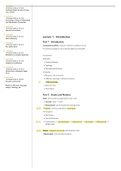
Lecture 1 - Introduction
More uniformity

5. Comment Part 1 - Introduction
18 October 2020 at 18:14:37
Comparative politics: research method in political science
E.g. police force
• Combines substance and methods (depth and breadth)
6. Comment
18 October 2020 at 18:14:51
Extraction of societal resources Comparison:

7. Comment • Benefits:
18 October 2020 at 18:15:03
Creation of institutions • Contextualization

• Typology
8. Comment
18 October 2020 at 18:19:01 • Generate/test theories
Distinct from citizenship (legal
• Hazards:
term)
• Requires a lot of context
9. Comment
18 October 2020 at 18:22:01 • Different meanings in different contexts
Socially constructed 1 • Ethnocentrism
Based on ethnicity, language, • Selection bias
religion, ideology, etc
• Stereotypes


Part 2 - States and Nations
State: formal political organization (main unit)

• Country: state + nation

• Government: set of people that manage state
2 3 • Features: territory, population, sovereignty

• Emergence:

• War theory
• French Revolution
4 7 • Centralization → standardization → national force → mobilization → differentiation →
welfare state


8 9 Nation: imagined community with territorial claim

• Nationalism: seek self-determination

,10. Comment
18 October 2020 at 18:17:20
Often rooted in ethnicity

11. Comment
18 October 2020 at 18:18:09
E.g. in multiethnic Yugoslavia,
politicians pushed for ethnic
homogenization

12. Comment
18 October 2020 at 18:20:24
Revolutionists inherited the state
and tried to create a nation out of
different groups
10 • Push to homogenize
13. Comment
• Ethnicity: common descent (socially constructed)
18 October 2020 at 18:21:22
E.g. many former colonies in 11 • Often used for mobilization/legitimation
global south

14. Comment Which came first: nation or state?
18 October 2020 at 18:28:16
Positive connotations • Nazi Germany: Arian nation

Only countries that do not self- 12 • France: state
identity are Vatican City and 13 • Nation-building: state → nation-state
Saudi Arabia

15. Comment Part 3 - Regimes
18 October 2020 at 18:27:54
E.g. Switzerland Aristotle’s Typology of Regimes

Not feasible on large scale Public Interest Private Interests

Rule by one Monarchy Tyranny
16. Comment
18 October 2020 at 18:27:35 Rule by few Aristocracy Oligarchy
Schumpeter: democratic elitism
Rule by many/all Polity Democracy

17. Comment
18 October 2020 at 18:27:07
Protects majority Contemporary typology:

18. Comment 14 • Democratic regimes: rule by people, political equality
18 October 2020 at 18:26:48
15 16 • Direct vs representative
Protects minority (from tyranny of
the majority) 17 18 • Majoritarian vs liberal

19. Comment 19 • Authoritarian regimes: no competition for power
18 October 2020 at 18:30:38
20 • Military junta
Negative connotations
21 • Dictatorship
Proliferating
22 • Absolute monarchy
20. Comment 23 • One-party state
18 October 2020 at 18:29:20
E.g. Egypt, Thailand 24 • Theocracy
25 26 • Hybrid/illiberal regimes: unstable gray zone
21. Comment
18 October 2020 at 18:29:26 27 28 • Totalitarian regimes: mass mobilization (ideological socialization), omnipresence
E.g. Cameroon, Russia,
Venezuela
Democracy index: Freedom House
22. Comment
18 October 2020 at 18:29:37
E.g. Oman, Saudi Arabia,
Swaziland

23. Comment
18 October 2020 at 18:29:46
E.g. China, Cuba, Vietnam

24. Comment
18 October 2020 at 18:29:58
E.g. Iran, Vietnam

25. Comment
18 October 2020 at 18:31:26
Most emerged in 3rd wave of

, democratization

Some progressing, some
regressing

26. Comment
18 October 2020 at 18:31:47
Political turmoil

27. Comment
18 October 2020 at 18:32:25
Now very rare (only North Korea)

E.g. Italy (Mussolini), Nazi
Germany (Hitler), Soviet Union
(Stalin), China (Mao)

28. Comment
18 October 2020 at 18:33:17
Very little privacy, system of terror
(secret police)

Powerful leader image

, Readings:
• Cases in Comparative Politics (O’Neil, 2018), chapter 1

• Calhoun, C. (1993). Nationalism and Ethnicity. Annual Review of Sociology, 19, pp.
211-239

Document information

Study
Uploaded on
August 10, 2022
Number of pages
73
Written in
2020/2021
Type
Summary
$8.36

Wrong document? Swap it for free Within 14 days of purchase and before downloading, you can choose a different document. You can simply spend the amount again.
Written by students who passed
Immediately available after payment
Read online or as PDF

Sold
5
Followers
4
Items
29
Last sold
1 year ago


Why students choose Stuvia

Created by fellow students, verified by reviews

Quality you can trust: written by students who passed their tests and reviewed by others who've used these notes.

Didn't get what you expected? Choose another document

No worries! You can instantly pick a different document that better fits what you're looking for.

Pay as you like, start learning right away

No subscription, no commitments. Pay the way you're used to via credit card and download your PDF document instantly.

Student with book image

“Bought, downloaded, and aced it. It really can be that simple.”

Alisha Student

Working on your references?

Create accurate citations in APA, MLA and Harvard with our free citation generator.

Working on your references?

Frequently asked questions