

Perceptual Organization
Gestalt Approach to Perceptual Grouping
• Sensations versus perception
• Laws of perceptual organisation (Wertheimer, 1923)
• Gestalt psychologists offered compelling illustrations to explore how we perceive the world, and their
viewpoint has deep theoretical implications.
SENSATION: the stimulation of the senses
PERCEPTION: the selection, organisation, and interpretation of sensorial information
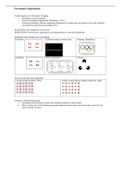
Examples of the Gestalt Laws of Grouping
Proximity Common motion (common fate) Pragnanz (Simplicity)
Similarity Good continuation Closure
New laws that have been identified
Common region (Palmer 1992) Uniform connectedness (Palmer and Rock, 1994)
Summary: Perceptual grouping
Perceptions reflect groups of parts that configure together to form wholes.
Many of these laws of describing perceptual organisation have been known for many years but new
ones are being revealed.
Gestalt Approach to Perceptual Grouping
• Sensations versus perception
• Laws of perceptual organisation (Wertheimer, 1923)
• Gestalt psychologists offered compelling illustrations to explore how we perceive the world, and their
viewpoint has deep theoretical implications.
SENSATION: the stimulation of the senses
PERCEPTION: the selection, organisation, and interpretation of sensorial information
Examples of the Gestalt Laws of Grouping
Proximity Common motion (common fate) Pragnanz (Simplicity)
Similarity Good continuation Closure
New laws that have been identified
Common region (Palmer 1992) Uniform connectedness (Palmer and Rock, 1994)
Summary: Perceptual grouping
Perceptions reflect groups of parts that configure together to form wholes.
Many of these laws of describing perceptual organisation have been known for many years but new
ones are being revealed.


