12.1 GLYCOLYSIS
07 October 2021
16:36
Aerobic respiration - Requires oxygen, producing CO2, H2O and a lot of ATP.
Anaerobic respiration - Takes place in the absence of O2, producing lactate in
animals and ethanol in plants and fungi.
● Forms small amounts of ATP.
Aerobic respiration is divided into 4 stages:
● Glycolysis
● Link reaction
● Krebs cycle
● Oxidative phosphorylation.
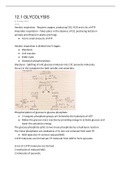
Glycolysis - Splitting of a 6C glucose molecule into 2 3C pyruvate molecules.
Occurs in the cytoplasm for both aerobic and anaerobic.
Phosphorylation of glucose to glucose phosphate.
● 2 inorganic phosphate groups are formed by the hydrolysis of ATP.
● Makes the glucose more reactive by providing energy to activate glucose and
lower the activation energy.
The glucose phosphate splits to two triose phosphates by a hydrolysis reaction.
The triose phosphates are oxidised as 2 H+ ions are removed from each TP.
● NAD takes the H+ to form reduced NAD.
2 ATP molecules are formed per TP molecule from ADP to form pyruvate.
A net of 2 ATP molecules are formed.
2 molecules of reduced NAD.
2 molecules of pyruvate.
, 12.2 LINK REACTION & KREBS CYCLE
08 November 2021
21:03
The pyruvate molecules are actively transported into the matrix.
The link reaction converts each pyruvate molecule into acetyl coenzyme A.
Pyruvate is oxidised to 2C acetate.
● Loses a CO2 molecule and 2 H are accepted by NAD to form reduced NAD.
The acetate combines with coenzyme A to form acetyl coenzyme A.
● This occurs 2 times for each glucose molecule.
The Krebs cycle takes place in the matrix.
Acetyl CoA combines with a 4 C molecule to form a 6C molecule.
07 October 2021
16:36
Aerobic respiration - Requires oxygen, producing CO2, H2O and a lot of ATP.
Anaerobic respiration - Takes place in the absence of O2, producing lactate in
animals and ethanol in plants and fungi.
● Forms small amounts of ATP.
Aerobic respiration is divided into 4 stages:
● Glycolysis
● Link reaction
● Krebs cycle
● Oxidative phosphorylation.
Glycolysis - Splitting of a 6C glucose molecule into 2 3C pyruvate molecules.
Occurs in the cytoplasm for both aerobic and anaerobic.
Phosphorylation of glucose to glucose phosphate.
● 2 inorganic phosphate groups are formed by the hydrolysis of ATP.
● Makes the glucose more reactive by providing energy to activate glucose and
lower the activation energy.
The glucose phosphate splits to two triose phosphates by a hydrolysis reaction.
The triose phosphates are oxidised as 2 H+ ions are removed from each TP.
● NAD takes the H+ to form reduced NAD.
2 ATP molecules are formed per TP molecule from ADP to form pyruvate.
A net of 2 ATP molecules are formed.
2 molecules of reduced NAD.
2 molecules of pyruvate.
, 12.2 LINK REACTION & KREBS CYCLE
08 November 2021
21:03
The pyruvate molecules are actively transported into the matrix.
The link reaction converts each pyruvate molecule into acetyl coenzyme A.
Pyruvate is oxidised to 2C acetate.
● Loses a CO2 molecule and 2 H are accepted by NAD to form reduced NAD.
The acetate combines with coenzyme A to form acetyl coenzyme A.
● This occurs 2 times for each glucose molecule.
The Krebs cycle takes place in the matrix.
Acetyl CoA combines with a 4 C molecule to form a 6C molecule.