

Within sports, injuries are extremely common. Injuries can be obtained in many ways,
though there are three types of forces applied to the situation, depending on the injury type.
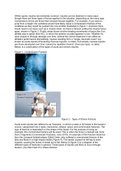
Compressive forces are those that compact tissues together. For example, if you were to
jump from a height, the vertebrae would most likely cause a compression fracture of the
vertebrae as they would be pushed into one another illustrated in Figure 1. A tension force
would result in an injury such as a muscle strain, as there is tension pulling the muscle tissue
apart, shown in Figure 2. Finally, shear forces involve twisting movements of tissue like if an
athlete was to sprain their ACL, in which the anterior cruciate ligament is torn. Whether it’s
upon impact or through damage over time, without the correct treatment it can affect an
athlete’s performance dramatically. Injuries resulting from a “single, traumatic event” are
known as acute injuries (Preventing Overuse Injuries, no date). Conversely, overuse injuries
are those developed over time “caused by repetitive trauma” (Overuse Injury, no date).
Below, is a continuation of the types of acute and chronic injuries.
Figure 1 - Compression Fracture
Figure 2 - Types of Stress Fracture
Acute bone injuries are referred to as ‘fractures’, in which a crack or full break in the bone(s)
occurs, categorised into 4 types; transverse, oblique, spiral, and comminuted fractures. The
type of fracture is dependent on the shape of the break. For the purpose of using an
example, the comminuted fracture will be used. This is when the bone is cracked into more
than 2 fragments (Comminuted Fractures, June 2018). An example of this fracture would be
from the Liverpool football player, Djibril Cissé, who suffered a comminuted fracture of the
tibia and fibula in a high-impact tackle (Figure 4). This tackle caused his left leg to bend
inwards, causing the bones to break as he fell. Below (in figure 3) is a diagram of the
different types of fractures in general. These types of injuries are likely to occur through
tension, you often hear of a ‘stress fracture’.
, Figure 3 - Types of Fractures Figure 4 - Cissé Fracture
Example
There are two types of injuries that can occur in the joint; dislocation and subluxation. A
dislocation is the complete separation of the joint surfaces, while subluxation is only partial.
Dislocations are extremely painful and it can be difficult to correct the injury, attempting to
place the joint back in the socket. Below is a diagram illustrating the types of dislocations
(Figure 6).The rehabilitation process is long and the risk of re-dislocating is up by around
70% for the first 2 years after the injury. An example could be in olympic weightlifting, in
which a snatch that is unbalanced could cause the shoulder or elbow joints to be misplaced
because of the weight (Figure 5).
Figure 5 - Dislocated Shoulder
Figure 6 - Types of Shoulder Dislocations
though there are three types of forces applied to the situation, depending on the injury type.
Compressive forces are those that compact tissues together. For example, if you were to
jump from a height, the vertebrae would most likely cause a compression fracture of the
vertebrae as they would be pushed into one another illustrated in Figure 1. A tension force
would result in an injury such as a muscle strain, as there is tension pulling the muscle tissue
apart, shown in Figure 2. Finally, shear forces involve twisting movements of tissue like if an
athlete was to sprain their ACL, in which the anterior cruciate ligament is torn. Whether it’s
upon impact or through damage over time, without the correct treatment it can affect an
athlete’s performance dramatically. Injuries resulting from a “single, traumatic event” are
known as acute injuries (Preventing Overuse Injuries, no date). Conversely, overuse injuries
are those developed over time “caused by repetitive trauma” (Overuse Injury, no date).
Below, is a continuation of the types of acute and chronic injuries.
Figure 1 - Compression Fracture
Figure 2 - Types of Stress Fracture
Acute bone injuries are referred to as ‘fractures’, in which a crack or full break in the bone(s)
occurs, categorised into 4 types; transverse, oblique, spiral, and comminuted fractures. The
type of fracture is dependent on the shape of the break. For the purpose of using an
example, the comminuted fracture will be used. This is when the bone is cracked into more
than 2 fragments (Comminuted Fractures, June 2018). An example of this fracture would be
from the Liverpool football player, Djibril Cissé, who suffered a comminuted fracture of the
tibia and fibula in a high-impact tackle (Figure 4). This tackle caused his left leg to bend
inwards, causing the bones to break as he fell. Below (in figure 3) is a diagram of the
different types of fractures in general. These types of injuries are likely to occur through
tension, you often hear of a ‘stress fracture’.
, Figure 3 - Types of Fractures Figure 4 - Cissé Fracture
Example
There are two types of injuries that can occur in the joint; dislocation and subluxation. A
dislocation is the complete separation of the joint surfaces, while subluxation is only partial.
Dislocations are extremely painful and it can be difficult to correct the injury, attempting to
place the joint back in the socket. Below is a diagram illustrating the types of dislocations
(Figure 6).The rehabilitation process is long and the risk of re-dislocating is up by around
70% for the first 2 years after the injury. An example could be in olympic weightlifting, in
which a snatch that is unbalanced could cause the shoulder or elbow joints to be misplaced
because of the weight (Figure 5).
Figure 5 - Dislocated Shoulder
Figure 6 - Types of Shoulder Dislocations


