Summary LPC Notes Advocacy Revision Notes and Script with Chronology 2022 (BPP and ULaw Competent)
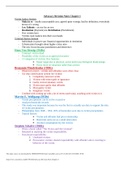
Advocacy Revision Notes Chapter 1 Victim Justice System - Mala in se – totally unacceptable acts; agreed upon wrongs; bad by definition; everybody knows it’s wrong - Lex Talionis – an eye for an eye - Restitution (Payment) vs. Retribution (Punishment) - Few written laws - Victims took matters into their own hands Criminal Justice System - Individuals in power saw financial opportunities in restitution - Urbanization brought about higher crime rates - The new focus because punishment and deterrence. Hans Von Hentig (1940s) - Criminal –victim dyad - Possibility of the victim as an agent provocateur - 13 categories of victims. Key features; • Easier target due to physical, social and/or psychological disadvantage • Focus more on situations rather than actions Benjamin Mendelssohn (1950s) - Observed a trend – victims and offenders were often close - Six step classification system for victims: 1. Completely innocent victim 2. Victims with minor guilt or ignorance 3. Guilty victim/voluntary victim 4. Victim more guilty than offender 5. Most guilty victim 6. Imaginary victim - Credited with coming up with a lot of terms used today; anything with victim in it. Marvin E. Wolfgang (1950s) - Victim precipitation can be active or passive - Analyzed homicide records - This study was important because he was the first to actually use data to support the idea of victim precipitation. - Philadelphia from 1948 – 1952, 26% of homicides were due to victim precipitation. - Typical factors: • Victim and offender had prior relationship • Homicide starts out as a small altercation • Alcohol consumption (by the victim) Stephen Schafer (1960s) - Wrote a book called “The Victim and His Criminal” - Returned to studying the victim responsibility - Functional responsibility 1. Unrelated victims 2. Provocative victims: shared responsibility with offender who is reacting to behavior of the victim. This study source was downloaded by from CourseH
Document information
- Uploaded on
- July 24, 2022
- Number of pages
- 3
- Written in
- 2021/2022
- Type
- Summary