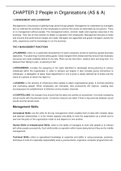
CHAPTER 2 People in Organisations (AS & A)
1.6 MANGEMENT AND LEADERSHIP
Management is the process of getting things done through people. Management is undertaken by managers
who co-ordinate the activities of other employees to achieve the results not obtainable by one person. There
is no management without people. The management plans, controls, leads and organise resources in the
business. They rely on their position to obtain co-operation from employees. Management focuses on tasks
and ensures that performance targets are made. Managers are appointed and goods managers usually the
skills, experience and the knowledge to run the business
THE 4 MANAGEMENT FUNCTIONS
a)PLANNING: refers to a systematic development of action programs aimed at reaching agreed business
objectives. Thus planning involves setting goals. Good mangers think ahead and they ensure that necessary
resources are made available before it’s too late. Plans can be short term, medium term and long term. It is
believed that ‘failing to plan, is planning to fail’
b)ORGANISING: includes the assigning of the tasks identified or developed during planning to various
individuals within the organisation in order to achieve set targets. It also includes giving instructions to
individuals. i.e delegation of tasks. Each department or unit is given a clearly defined list of duties and the
name of a person to whom the report to.
c)LEADING: is the process of influencing other people to attain organisational goals. It involves directing
and motivating people. When employees are motivated, their productivity will improve. Leading also
encompasses the establishment of effective communication channels
d)CONTROLLING: the manger must ensure that the tasks are carried out as planned. It involves comparing
actual results with the planned results. Corrective measure are taken if there is big anomaly between actual
results and the aimed result.
Management Skills
Conceptual Skills: are the skills for the top management which enables them to deal with complex ideas
and abstract relationships. It is the mental capacity and ability to view the organisation as a whole and to
see how the parts of the organisation relate to and depend on one another.
Human Skills or Interpersonal Skills: refers to the ability of managers to work with people or to interact
with other people successfully. Such skills builds co-operation within teams being led and they are for middle
management.
Technical Skills: refers to specialised knowledge or expertise and ability in using processes, practices,
technique or tools of a speciality responsibility area e.g accountants, engineers, computer programmers etc.
,Mintzberg’s roles of management
Henry Mintzberg identified ten management roles which are then grouped into three main categories
namely interpersonal roles, information roles and decision roles
Interpersonal Roles Information roles Decision Roles
Figurehead Monitor Entrepreneur
Leader Disseminator Disturbance handler
liaison Spokesperson Resource allocator
Negotiator
Interpersonal Roles : involves dealing with and motivating staff at all levels of an organisation
i) Figurehead: these are duties that are symbolic or ceremonial in nature e.g guest of honour at
a function like a Prize Giving Day
ii) Leader: involves directing and co-ordinating the activities of all employees in the business. Thus
the manager will provide direction for the team or business by making clear what is required of
everyone in the business. It also involves staffing and monitoring staff.
iii) Liaison: It involves the mangers’ interpersonal relationships outside of their area of command.
Thus the manager should be able to make contacts both inside and outside the organisation.
The main aim is to establish good relationships e.g participating in meetings with other
businesses.
Information Roles
i) Monitor: involves examining the environment to gather information, changes, opportunities and
problems that may affect the business. It also involves the processing of information related to
those internal or external changes which might the business.
ii) Disseminator: involves providing important or privileged information to the subordinates.
Information needs to be passed to the appropriate people as and when required. This must be
at a suitable time and must use an appropriate medium
iii) Spokesperson: the mangers represents the business to other people outside the business. As
a spokesperson, the manager will have to pass information to interested parties e.g informing
the Local authorities about planned changes and also communicating with trade unions for any
proposed changes to the conditions of work.
Decision Roles
i) Entrepreneur: it involves the process of continually looking for new ideas or new methods to
improve the organisation’s performance. For example, an effective marketing manager
continually seeks to develop new products.
ii) Disturbance handler: it involves the manager making decisions to take corrective in response
to situations out of control. The main aim will be to bring about peace and harmony. E.g the
responding to emergences like strikes, disasters etc.
iii) Resource allocator: effectively allocating resources whether they are funds, equipment or
people in the business organisation. The manger must bear in mind that the resources are
always scarce. The manager will make decisions on who will get what resources.
, iv) Negotiator: involves negotiating agreements between employees or between departments.
Negotiating agreements with other businesses e.g suppliers or customers. Negotiating with
trade unions to obtain advantages for his business etc.
Managerial Effectiveness and Efficiency
The manger is judged by his performance. The criteria used is effectiveness and efficiency as shown
in the table below
Ineffective Effective
Efficient not reaching goals and not reaching goals and not wasting
wasting resources resources
inefficient not reaching goals and wasting reaching goals and wasting
resources resources
Managerial Effectiveness: it defines as ‘’doing the right thing’. It is defined in terms of resource utilisation
in relation to organisational goal attainment. A manger has the responsibility of selecting the right goal
and appropriate means of achieving that goal. If organisations are using their resources to attain their
goals, the managers are effective
Managerial Efficiency: it is defined as ‘doing the thing right’. It measures the cost of attaining a given
goal. The higher the proportion of organisational resources that contribute to productivity, the more
efficient is the manager. If minimum cost is spend to obtain the desired goal, the manager is being
efficient.
Leadership
Refers to the process of influencing other people to work harder for the business to achieve its
objectives. The leader must inspire other employees to put more effort in whatever task they have to
perform. Thus a leader is someone who can inspire and drive a group of people towards a target or
goal.
Differences between leaders and mangers
Managers leaders
Someone who controls and directs within Someone who can inspire or drive a
a business group of people towards a business goal
Rely on their position to obtain co- They motivate or encourage a team to
operation of employees achieve goals using their personality
(qualities)
Focused on tasks Focused on people
Responsible for ensuring that Responsible for setting new targets
performance targets are met Concentrate on long term goals
Concentrate on short term goals Leaders are elected
Managers are appointed
, Leadership Qualities
i) Self-confidence: leaders have self-trust and they believe that they have the ability to make
sound decisions and to identify achievable long term objectives of the business
ii) Creative: are able to come up with new or original ideas. Leaders need to be able to come up
with ideas that others might not think of.
iii) Dependable: able to be trusted to do or to provide what is needed.
iv) Energetic: they work extra hard to achieve the goals of the business
v) Multitalented: possess several skills so that they can understand a wide range of issues
affecting their business.
vi) Charisma: a leader must have a personality that makes other people believe in him and be
prepared to follow you and your ideas.
vii) Persistent: continuing to do something even though it is difficult
Leadership roles in business
a) Directors : are elected into office by shareholders of a private or public limited company. They
are senior managers elected to represent shareholders. They set corporate or departmental
objectives. They also ensure that departmental goals are met.
b) Managers: refers to any individual responsible for people, resources or decision making. They
have some control over the staff below them in the hierarchy. They ensures that the rules are
being followed by employees
c) Supervisors: refers to an employee overseeing the work of others. They are appointed by
management to watch over the work of others. They are just team leaders and are not involved
in decision making. Their mandate is to help staff achieve corporate objectives
d) Workers’ Representatives: are employees who represent other employees on negotiations
with the management. They are elected by workers to present the views of the workforce to
senior management. These employee representatives must have excellent communication
skills
leadership styles:
It is accepted that different leadership styles are appropriate for different circumstances and that a manger or
leader might actually choose to use more than one leadership style depending on the situation at that time. For
example, a democratic leader might adopt characteristics of an autocratic leader if a situation required immediate
action such as an emergency. There are three main leadership style and these include autocratic, democratic
and laissez-faire
i) Autocratic /Boss Centred: the leader is an authoritarian and assumes responsibility for all aspects
of the business. Communication is one way with little or no feedback i.e top-down communication. It is a
form of leadership used in hierarchical business in which all decisions are taken by those at the top of the
organisation. Such leaders do not trust their employees to make decisions about their own work. The
leader makes the decisions by telling employees what he/she wants done and how he/she wants it done.
1.6 MANGEMENT AND LEADERSHIP
Management is the process of getting things done through people. Management is undertaken by managers
who co-ordinate the activities of other employees to achieve the results not obtainable by one person. There
is no management without people. The management plans, controls, leads and organise resources in the
business. They rely on their position to obtain co-operation from employees. Management focuses on tasks
and ensures that performance targets are made. Managers are appointed and goods managers usually the
skills, experience and the knowledge to run the business
THE 4 MANAGEMENT FUNCTIONS
a)PLANNING: refers to a systematic development of action programs aimed at reaching agreed business
objectives. Thus planning involves setting goals. Good mangers think ahead and they ensure that necessary
resources are made available before it’s too late. Plans can be short term, medium term and long term. It is
believed that ‘failing to plan, is planning to fail’
b)ORGANISING: includes the assigning of the tasks identified or developed during planning to various
individuals within the organisation in order to achieve set targets. It also includes giving instructions to
individuals. i.e delegation of tasks. Each department or unit is given a clearly defined list of duties and the
name of a person to whom the report to.
c)LEADING: is the process of influencing other people to attain organisational goals. It involves directing
and motivating people. When employees are motivated, their productivity will improve. Leading also
encompasses the establishment of effective communication channels
d)CONTROLLING: the manger must ensure that the tasks are carried out as planned. It involves comparing
actual results with the planned results. Corrective measure are taken if there is big anomaly between actual
results and the aimed result.
Management Skills
Conceptual Skills: are the skills for the top management which enables them to deal with complex ideas
and abstract relationships. It is the mental capacity and ability to view the organisation as a whole and to
see how the parts of the organisation relate to and depend on one another.
Human Skills or Interpersonal Skills: refers to the ability of managers to work with people or to interact
with other people successfully. Such skills builds co-operation within teams being led and they are for middle
management.
Technical Skills: refers to specialised knowledge or expertise and ability in using processes, practices,
technique or tools of a speciality responsibility area e.g accountants, engineers, computer programmers etc.
,Mintzberg’s roles of management
Henry Mintzberg identified ten management roles which are then grouped into three main categories
namely interpersonal roles, information roles and decision roles
Interpersonal Roles Information roles Decision Roles
Figurehead Monitor Entrepreneur
Leader Disseminator Disturbance handler
liaison Spokesperson Resource allocator
Negotiator
Interpersonal Roles : involves dealing with and motivating staff at all levels of an organisation
i) Figurehead: these are duties that are symbolic or ceremonial in nature e.g guest of honour at
a function like a Prize Giving Day
ii) Leader: involves directing and co-ordinating the activities of all employees in the business. Thus
the manager will provide direction for the team or business by making clear what is required of
everyone in the business. It also involves staffing and monitoring staff.
iii) Liaison: It involves the mangers’ interpersonal relationships outside of their area of command.
Thus the manager should be able to make contacts both inside and outside the organisation.
The main aim is to establish good relationships e.g participating in meetings with other
businesses.
Information Roles
i) Monitor: involves examining the environment to gather information, changes, opportunities and
problems that may affect the business. It also involves the processing of information related to
those internal or external changes which might the business.
ii) Disseminator: involves providing important or privileged information to the subordinates.
Information needs to be passed to the appropriate people as and when required. This must be
at a suitable time and must use an appropriate medium
iii) Spokesperson: the mangers represents the business to other people outside the business. As
a spokesperson, the manager will have to pass information to interested parties e.g informing
the Local authorities about planned changes and also communicating with trade unions for any
proposed changes to the conditions of work.
Decision Roles
i) Entrepreneur: it involves the process of continually looking for new ideas or new methods to
improve the organisation’s performance. For example, an effective marketing manager
continually seeks to develop new products.
ii) Disturbance handler: it involves the manager making decisions to take corrective in response
to situations out of control. The main aim will be to bring about peace and harmony. E.g the
responding to emergences like strikes, disasters etc.
iii) Resource allocator: effectively allocating resources whether they are funds, equipment or
people in the business organisation. The manger must bear in mind that the resources are
always scarce. The manager will make decisions on who will get what resources.
, iv) Negotiator: involves negotiating agreements between employees or between departments.
Negotiating agreements with other businesses e.g suppliers or customers. Negotiating with
trade unions to obtain advantages for his business etc.
Managerial Effectiveness and Efficiency
The manger is judged by his performance. The criteria used is effectiveness and efficiency as shown
in the table below
Ineffective Effective
Efficient not reaching goals and not reaching goals and not wasting
wasting resources resources
inefficient not reaching goals and wasting reaching goals and wasting
resources resources
Managerial Effectiveness: it defines as ‘’doing the right thing’. It is defined in terms of resource utilisation
in relation to organisational goal attainment. A manger has the responsibility of selecting the right goal
and appropriate means of achieving that goal. If organisations are using their resources to attain their
goals, the managers are effective
Managerial Efficiency: it is defined as ‘doing the thing right’. It measures the cost of attaining a given
goal. The higher the proportion of organisational resources that contribute to productivity, the more
efficient is the manager. If minimum cost is spend to obtain the desired goal, the manager is being
efficient.
Leadership
Refers to the process of influencing other people to work harder for the business to achieve its
objectives. The leader must inspire other employees to put more effort in whatever task they have to
perform. Thus a leader is someone who can inspire and drive a group of people towards a target or
goal.
Differences between leaders and mangers
Managers leaders
Someone who controls and directs within Someone who can inspire or drive a
a business group of people towards a business goal
Rely on their position to obtain co- They motivate or encourage a team to
operation of employees achieve goals using their personality
(qualities)
Focused on tasks Focused on people
Responsible for ensuring that Responsible for setting new targets
performance targets are met Concentrate on long term goals
Concentrate on short term goals Leaders are elected
Managers are appointed
, Leadership Qualities
i) Self-confidence: leaders have self-trust and they believe that they have the ability to make
sound decisions and to identify achievable long term objectives of the business
ii) Creative: are able to come up with new or original ideas. Leaders need to be able to come up
with ideas that others might not think of.
iii) Dependable: able to be trusted to do or to provide what is needed.
iv) Energetic: they work extra hard to achieve the goals of the business
v) Multitalented: possess several skills so that they can understand a wide range of issues
affecting their business.
vi) Charisma: a leader must have a personality that makes other people believe in him and be
prepared to follow you and your ideas.
vii) Persistent: continuing to do something even though it is difficult
Leadership roles in business
a) Directors : are elected into office by shareholders of a private or public limited company. They
are senior managers elected to represent shareholders. They set corporate or departmental
objectives. They also ensure that departmental goals are met.
b) Managers: refers to any individual responsible for people, resources or decision making. They
have some control over the staff below them in the hierarchy. They ensures that the rules are
being followed by employees
c) Supervisors: refers to an employee overseeing the work of others. They are appointed by
management to watch over the work of others. They are just team leaders and are not involved
in decision making. Their mandate is to help staff achieve corporate objectives
d) Workers’ Representatives: are employees who represent other employees on negotiations
with the management. They are elected by workers to present the views of the workforce to
senior management. These employee representatives must have excellent communication
skills
leadership styles:
It is accepted that different leadership styles are appropriate for different circumstances and that a manger or
leader might actually choose to use more than one leadership style depending on the situation at that time. For
example, a democratic leader might adopt characteristics of an autocratic leader if a situation required immediate
action such as an emergency. There are three main leadership style and these include autocratic, democratic
and laissez-faire
i) Autocratic /Boss Centred: the leader is an authoritarian and assumes responsibility for all aspects
of the business. Communication is one way with little or no feedback i.e top-down communication. It is a
form of leadership used in hierarchical business in which all decisions are taken by those at the top of the
organisation. Such leaders do not trust their employees to make decisions about their own work. The
leader makes the decisions by telling employees what he/she wants done and how he/she wants it done.