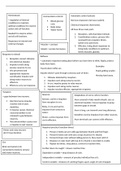
Homeostasis Homeostasis controls Automatic control systems
= regulation of internal Blood glucose Nervous responses (nervous system).
conditions to maintain conc
optimal conditions for enzyme Chemical responses (hormones).
Body temp
action and cell function. Water levels All have three main parts
Needed for enzyme action 1. Receptors, cells that detect stimuli.
and all cell functions. 2. Coordination centres, process info
Responses to internal and received from receptors (brain,
external changes. spinal cord, pancreas).
Muscles = contract
3. Effectors, bring about responses to
Glands = secrete hormones bring body conditions to optimum
levels (muscles, glands).
Response to stimuli
Reflexes
1. Receptors convert stimulus
into electrical impulse. = automatic responses taking place before you have time to think. Rapid, protect
2. Impulse travels along body from harm.
Examples
sensory neurons to cns. Travels down reflex arc.
3. Info processed and Pupils getting smaller.
appropriate response Impulse doesn’t pass through conscious part of brain.
coordinated, impulse sent Moving hand away.
1. Stimulus detected by receptors.
along motor neurons to 2. Impulses sent along sensory neuron.
effectors. 3. In cns, impulse passes to relay neuron.
4. Effectors carry out response. 4. Impulses sent along motor neuron.
5. Impulse reaches effector, appropriate response.
Synapses
Neurons Adaptations of nerve cells to function
= gaps between two neurons.
Sensory, carries e impulses Axon covered in fatty myelin sheath, acts as
Electrical nerve impulse from receptors to cns. electrical insulator. Forces impulses to jump
reaches end of axon,
Relay, in cns and carries between gaps in sheath.
dendrites.
E impulse causes chemical impulses from sensory to Axon is long, can transmit over long distances.
neurotransmitter to be motor.
released in gap between Dendrites receive impulses from other neurons.
Motor, carries impulses from
neurons. Axon terminals can connect with effectors.
cns to effectors.
Neurotransmitter causes new
e impulse in next neuron.
Required practical (reaction times)
Motor and relay neurons
don’t have dendron. 1. Person A holds out arm with gap between thumb and first finger.
2. Person B holds ruler with zero at top of person A’s thumb.
3. Person B drops ruler without telling person A, they must catch it.
4. Distance on ruler level with top of A’s thumb is recorded in a table.
Cns
5. Repeat ten times, swap places, convert to reaction time.
Brain and spinal cord,
Further down its caught = slower reaction time.
connected to body by sensory
and motor neurons. Dependent variable = drop distance of ruler.
Independent variable = amount of practice individual has at it.
Control variable = distance of catching fingers apart, angle of ruler dropped.
= regulation of internal Blood glucose Nervous responses (nervous system).
conditions to maintain conc
optimal conditions for enzyme Chemical responses (hormones).
Body temp
action and cell function. Water levels All have three main parts
Needed for enzyme action 1. Receptors, cells that detect stimuli.
and all cell functions. 2. Coordination centres, process info
Responses to internal and received from receptors (brain,
external changes. spinal cord, pancreas).
Muscles = contract
3. Effectors, bring about responses to
Glands = secrete hormones bring body conditions to optimum
levels (muscles, glands).
Response to stimuli
Reflexes
1. Receptors convert stimulus
into electrical impulse. = automatic responses taking place before you have time to think. Rapid, protect
2. Impulse travels along body from harm.
Examples
sensory neurons to cns. Travels down reflex arc.
3. Info processed and Pupils getting smaller.
appropriate response Impulse doesn’t pass through conscious part of brain.
coordinated, impulse sent Moving hand away.
1. Stimulus detected by receptors.
along motor neurons to 2. Impulses sent along sensory neuron.
effectors. 3. In cns, impulse passes to relay neuron.
4. Effectors carry out response. 4. Impulses sent along motor neuron.
5. Impulse reaches effector, appropriate response.
Synapses
Neurons Adaptations of nerve cells to function
= gaps between two neurons.
Sensory, carries e impulses Axon covered in fatty myelin sheath, acts as
Electrical nerve impulse from receptors to cns. electrical insulator. Forces impulses to jump
reaches end of axon,
Relay, in cns and carries between gaps in sheath.
dendrites.
E impulse causes chemical impulses from sensory to Axon is long, can transmit over long distances.
neurotransmitter to be motor.
released in gap between Dendrites receive impulses from other neurons.
Motor, carries impulses from
neurons. Axon terminals can connect with effectors.
cns to effectors.
Neurotransmitter causes new
e impulse in next neuron.
Required practical (reaction times)
Motor and relay neurons
don’t have dendron. 1. Person A holds out arm with gap between thumb and first finger.
2. Person B holds ruler with zero at top of person A’s thumb.
3. Person B drops ruler without telling person A, they must catch it.
4. Distance on ruler level with top of A’s thumb is recorded in a table.
Cns
5. Repeat ten times, swap places, convert to reaction time.
Brain and spinal cord,
Further down its caught = slower reaction time.
connected to body by sensory
and motor neurons. Dependent variable = drop distance of ruler.
Independent variable = amount of practice individual has at it.
Control variable = distance of catching fingers apart, angle of ruler dropped.