DNA
• Almost all cells need instructions (nucleus)
• Blood cells don't have a nucleus (can't divide)
• Instructions must be infallible to each cell
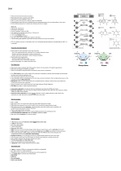
• DNA is a nucleic acid, which is a polymer made of nucleotides
• Phosphodiester bonds link each nucleotide (joins the phosphate group to the next deoxyribose in the chain)
• Pentose (ribose) always has 5 carbons (one sticking out) and one oxygen
Bases are:
• Adenine (A), Thymine (T)
• Cytosine (C), Guanine (G)
• Uracil (U) replaces Thymine in RNA
• Held together by hydrogen bonds (2 for A, T)(3 for G, C)
• A and G are Purines (larger)
• C, T, U are Pyrimidines (smaller)
• One side of the strand is upside down relative to the other
• A purine always goes opposite a pyrimidine to keep constant size across the molecule
• ATP has a similar structure to nucleotides, but it has 3 phosphate groups (adenosine monophosphate, AMP, is a
nucleotide)
Properties of Genetic Material
• Must be able to store information (very large amounts)
- Starch has repeating identical monomers so not a good information store
- Proteins could store information in order of amino acids
- Nucleic acids store information in order of bases/nucleotides
• Must be able to be copied easily
- Proteins would be difficult to copy
- Base pairs allow semi-conservative replication
• Must be inheritable, so a stable information store
DNA Replication
• DNA must be able to replicate itself if the genetic material is to be passed on through the generations
• Before this can happen, the DNA must unfold
• There are a number of enzymes which are involved in the process of replication
• First, DNA helicase moves up the middle of the molecule, breaking the relatively weak hydrogen bonds between
the bases and creating a replication fork
• This leaves bases exposed on the two strands
• Free nucleotides, which are floating around in the nucleus are then attached to their complementary bases on the
template strands by DNA polymerase
• DNA gyrase makes a cut in a strand, above the unravelled strands, to allow a strand in the top to release the
tension and also sticks the strand back
• Second template strand copied backwards, leaves gaps between Okazaki fragments
• DNA ligase joins gaps in sugar-phosphate backbone
• Conservative replication is the theory that two completely new molecules of DNA were made
• Dispersive replication is the theory that the original molecule fragments and makes two new molecules of DNA,
made up of old and new material
• Semiconservative replication (how DNA actually replicates) is when a DNA molecule is split and two new
molecules are made, both with a template strand and a new strand
DNA Transcription
• DNA -> mRNA
• RNA polymerase is an enzyme that makes long-chain RNA molecules from DNA
• RNA polymerase exposes the area which needs to be transcribed by separating the strands
• RNA polymerase binds to the promoter, travels along the strand and matches each nucleotide to its
complementary base (Uracil instead of Thymine)
• There is a promoter before each gene
• A repressor protein blocks promoters to prevent RNA polymerase from binding too early
• Post transcriptional modification edits out introns and leaves in exons
• DNA wraps around histones for structural support
DNA Translation
• mRNA always starts with AUG (start codon) (Methionine amino acid)
• A codon is three bases
• Messenger RNA (mRNA)
• Transfer RNA (tRNA)
• Ribosomal RNA (rRNA)
• tRNA folds into structure forming hydrogen bonds between specific bases, with an anticodon on the end
• rRNA and protein (mixed together in the ribosome) clamp down the mRNA, two codons at a time (six bases)
• Amino acids attached to tRNA collides with ribosome and if the tRNA has the correct anticodon, the
complementary bases bond (anticodon-codon binding)
• Peptidyl transferase is in the ribosome and forms a peptide bond between the two amino acids
• Once the amino acids bond, the tRNA leaves the ribosome and attaches to another amino acid
• After a tRNA is released, the ribosome shifts by one codon
• The three stop codons are UAG, UGA, UAA
• There is no anticodon for the three stop codons
• A polysome is when multiple ribosomes bind one mRNA
The Genetic Code
• A gene is a section of DNA on a chromosome coding for a polypeptide
• Each gene codes for a single polypeptide
• The genetic code is universal, it is conserved across all living organisms
• It is a triplet code, it is read in sets of three bases
• Degenerate
• Universal
• Non-overlapping
• Read in one direction
, DNA Organisation in Eukaryotes
10 November 2020 11:38
• DNA wraps around a histone protein to shorten the length of the molecule. This also adds
stability.
• A nucleosome is DNA wrapped round a histone octamer (eight histones)
• Chromatin is a fibre consisting of many nucleosomes packed together
• A chromosome is a length of chromatin
• A visible chromosome is densely packed chromatin
• Heterochromatin is densely packed and inactive in transcription
• Euchromatin is more spread out and is active in transcription
• Almost all cells need instructions (nucleus)
• Blood cells don't have a nucleus (can't divide)
• Instructions must be infallible to each cell
• DNA is a nucleic acid, which is a polymer made of nucleotides
• Phosphodiester bonds link each nucleotide (joins the phosphate group to the next deoxyribose in the chain)
• Pentose (ribose) always has 5 carbons (one sticking out) and one oxygen
Bases are:
• Adenine (A), Thymine (T)
• Cytosine (C), Guanine (G)
• Uracil (U) replaces Thymine in RNA
• Held together by hydrogen bonds (2 for A, T)(3 for G, C)
• A and G are Purines (larger)
• C, T, U are Pyrimidines (smaller)
• One side of the strand is upside down relative to the other
• A purine always goes opposite a pyrimidine to keep constant size across the molecule
• ATP has a similar structure to nucleotides, but it has 3 phosphate groups (adenosine monophosphate, AMP, is a
nucleotide)
Properties of Genetic Material
• Must be able to store information (very large amounts)
- Starch has repeating identical monomers so not a good information store
- Proteins could store information in order of amino acids
- Nucleic acids store information in order of bases/nucleotides
• Must be able to be copied easily
- Proteins would be difficult to copy
- Base pairs allow semi-conservative replication
• Must be inheritable, so a stable information store
DNA Replication
• DNA must be able to replicate itself if the genetic material is to be passed on through the generations
• Before this can happen, the DNA must unfold
• There are a number of enzymes which are involved in the process of replication
• First, DNA helicase moves up the middle of the molecule, breaking the relatively weak hydrogen bonds between
the bases and creating a replication fork
• This leaves bases exposed on the two strands
• Free nucleotides, which are floating around in the nucleus are then attached to their complementary bases on the
template strands by DNA polymerase
• DNA gyrase makes a cut in a strand, above the unravelled strands, to allow a strand in the top to release the
tension and also sticks the strand back
• Second template strand copied backwards, leaves gaps between Okazaki fragments
• DNA ligase joins gaps in sugar-phosphate backbone
• Conservative replication is the theory that two completely new molecules of DNA were made
• Dispersive replication is the theory that the original molecule fragments and makes two new molecules of DNA,
made up of old and new material
• Semiconservative replication (how DNA actually replicates) is when a DNA molecule is split and two new
molecules are made, both with a template strand and a new strand
DNA Transcription
• DNA -> mRNA
• RNA polymerase is an enzyme that makes long-chain RNA molecules from DNA
• RNA polymerase exposes the area which needs to be transcribed by separating the strands
• RNA polymerase binds to the promoter, travels along the strand and matches each nucleotide to its
complementary base (Uracil instead of Thymine)
• There is a promoter before each gene
• A repressor protein blocks promoters to prevent RNA polymerase from binding too early
• Post transcriptional modification edits out introns and leaves in exons
• DNA wraps around histones for structural support
DNA Translation
• mRNA always starts with AUG (start codon) (Methionine amino acid)
• A codon is three bases
• Messenger RNA (mRNA)
• Transfer RNA (tRNA)
• Ribosomal RNA (rRNA)
• tRNA folds into structure forming hydrogen bonds between specific bases, with an anticodon on the end
• rRNA and protein (mixed together in the ribosome) clamp down the mRNA, two codons at a time (six bases)
• Amino acids attached to tRNA collides with ribosome and if the tRNA has the correct anticodon, the
complementary bases bond (anticodon-codon binding)
• Peptidyl transferase is in the ribosome and forms a peptide bond between the two amino acids
• Once the amino acids bond, the tRNA leaves the ribosome and attaches to another amino acid
• After a tRNA is released, the ribosome shifts by one codon
• The three stop codons are UAG, UGA, UAA
• There is no anticodon for the three stop codons
• A polysome is when multiple ribosomes bind one mRNA
The Genetic Code
• A gene is a section of DNA on a chromosome coding for a polypeptide
• Each gene codes for a single polypeptide
• The genetic code is universal, it is conserved across all living organisms
• It is a triplet code, it is read in sets of three bases
• Degenerate
• Universal
• Non-overlapping
• Read in one direction
, DNA Organisation in Eukaryotes
10 November 2020 11:38
• DNA wraps around a histone protein to shorten the length of the molecule. This also adds
stability.
• A nucleosome is DNA wrapped round a histone octamer (eight histones)
• Chromatin is a fibre consisting of many nucleosomes packed together
• A chromosome is a length of chromatin
• A visible chromosome is densely packed chromatin
• Heterochromatin is densely packed and inactive in transcription
• Euchromatin is more spread out and is active in transcription